Skiathos
Things to do in Skiathos
Skiathos is a beach island before it is anything else, and most guides stop there. The island is small enough that you can see the rest of it in the gaps: a ruined medieval town on the north cliffs, a working monastery inland, a pine-covered trail network, and a harbour town that is a real town rather than a resort strip. What follows is the non-beach half of the island, which is also the half that stays open when the sea is up.
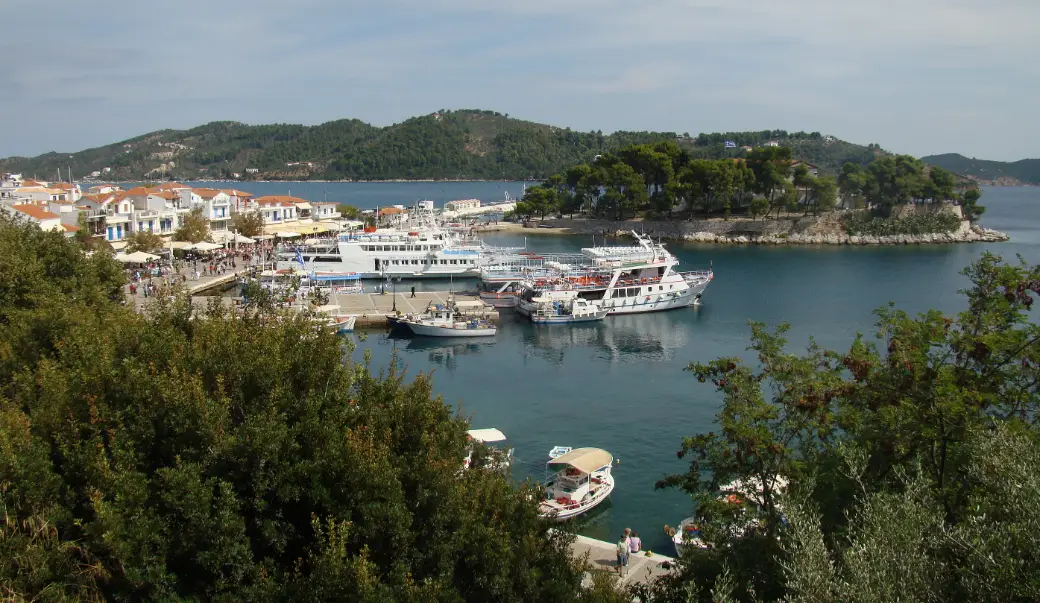
Skiathos Town, and the shape you should orient by. The town wraps around a curved harbour on the southeast coast. A small green headland called the Bourtzi splits the waterfront into an old port and a new one, and from the base of it the main street, Papadiamantis, runs straight up away from the water past the shops and offices. Behind and above that climbs a maze of stepped whitewashed lanes, and the highest ground carries a church you walk up to for the sunset. None of that closes or rebrands from one season to the next, which is exactly why it is the thing to navigate by rather than any list of venues.
The Kastro, which is the island’s real historical sight. On the north coast stands the ruined medieval town the islanders retreated to, on a headland chosen for the one quality that mattered: it is almost impossible to approach. That is still true, and it is what makes going there worth a day. You reach it on foot along the trails, or from the water on a boat trip that rounds the coast. What survives is fragmentary rather than restored, so go for the position and the walk rather than expecting a monument.
Evangelistria monastery, inland and above the town. The old monastery sits in the hills behind Skiathos Town and is the island’s other set-piece. It is a working religious site, so ordinary church etiquette applies: covered shoulders and knees, and quiet inside. Reaching it is a short drive or a walk on the trail network, and a bus line serves it. The country practice that governs behaviour at any Greek monastery is set out in Greek etiquette and customs.
The trails, which are the reason the interior is not empty. A marked network of walking paths crosses the pine hills, linking the town, the monastery, the Kastro and the north coast. It is the cheapest thing to do on the island and the one that changes your sense of its size, because a place that feels like a beach strip from the bus turns out to be a wooded interior on foot. The general picture of walking in the country is in hiking in Greece.
The boat trip, and why it is a fixture rather than an extra. The north coast has almost no road, so the ordinary way to see the caves, the arch at Lalaria and the cliffs under the Kastro is from the water. It runs when the sea is calm enough and does not when it is not, which is worth building into the week: keep one flexible morning rather than booking a fixed day. The beaches that trip reaches, and the ones the bus reaches instead, are on our Skiathos beaches page.
The Mamma Mia question, set straight. Skiathos is often sold as the Mamma Mia island and that is mostly not true. The 2008 film was shot largely on Skopelos, where the hilltop chapel wedding and the main beach scenes were filmed, with only some scenes on Skiathos; on screen the two islands together played the fictional Kalokairi. If the film is the reason you are coming, the pilgrimage is a Skopelos day out by boat, not a walk around Skiathos. The crossing is covered in Skiathos to Skopelos, and the wider group in the Sporades.
We name no bars, and that is on purpose. Skiathos has a genuine night out and it concentrates in town, along the waterfront and in the old-port lanes, with a strip of open-air clubs on the airport road in high summer. On an island this size venues rebrand, change hands and close from one season to the next, so a list of names is out of date before you read it. Go to the area and see what is open this year. The rest of the island, including where to base yourself, is in our Skiathos guide.