The short answer
The crossing takes roughly two to three hours, with the quickest published services under two hours and the slowest around 3h35. It is served mainly by high-speed craft, which is why it is fast - and also why it is the crossing most likely to be cancelled when the wind gets up.
This is the single most-travelled island-to-island hop in Greece, because it links the two islands most first-time visitors book. That popularity is the whole story of this page: book it early, and build a plan B.
Do it if you want the two headline islands in one trip. Reconsider if you are travelling in peak meltemi and have a fixed flight home from the far end.
Mykonos to Santorini at a glance
Why this crossing behaves differently
| Crossing time | ~2–3 hours (fastest under 2h, slowest ~3h35) |
|---|---|
| Vessel | Mainly high-speed catamarans |
| Direction | Southbound down the Cyclades chain |
| Books out | Yes - earliest of any inter-island hop |
| Weather risk | High. Fast craft stop first in a meltemi |
| Arrives at | Athinios, at the foot of the caldera cliff |
Most Cyclades hops have a choice of vessel: a fast catamaran or a slower conventional ferry. This one is dominated by high-speed craft, and that single fact drives everything else.
High-speed boats are enclosed, quick, expensive, and the first thing stood down when the meltemi blows. The meltemi is the northerly that blows hardest in July and August - exactly when this route is busiest. Heavy conventional ferries keep running in conditions that ground the fast boats, but on this particular crossing you have fewer of them to fall back on.
So the risk profile is unusual: a very popular route, on the most weather-sensitive class of vessel, in the windiest months. That is not a reason to avoid it. It is a reason to leave slack.
The practical version of “slack”: do not schedule this crossing for the day before an international flight home. Put a night’s margin in. When a ferry is cancelled covers what actually happens if it goes wrong.
Booking, and why early means earlier than you think
Every popular Greek route rewards booking ahead. This one punishes not doing it.
In July and August, book weeks to a few months out. The failure mode is not paying more - it is that the sailing you needed is full, your Santorini room is booked and non-refundable, and the next available crossing is the following day.
Off-peak, you have far more room and can often buy a day or two ahead. Frequency thins as the season winds down, so check what is running on your dates rather than assuming the summer pattern holds. See what to book ahead.
The arrival, which is not the town
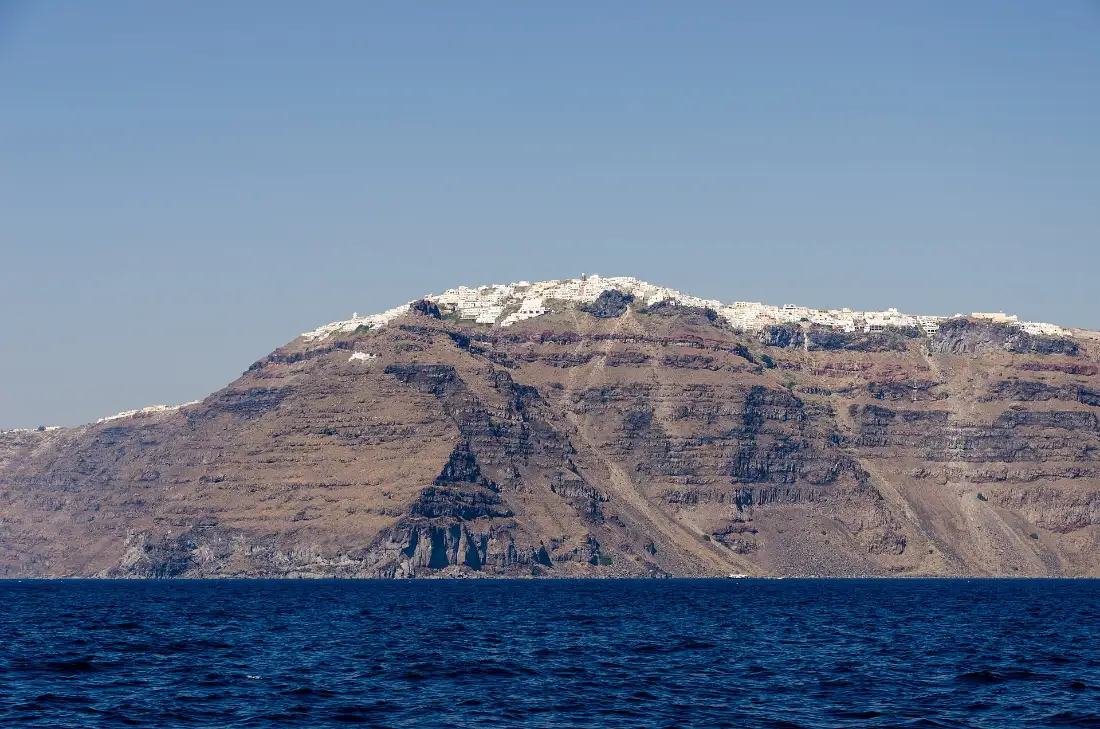
Ferries dock at Athinios, on the water at the base of the caldera cliff. Santorini’s towns are on the rim, hundreds of metres above, reached by a steep switchback road.
Athinios when a full fast boat empties in August is a crush of people, buses and taxis competing for the same road. Have your onward transfer arranged before you sail. This is the single most common way a good crossing turns into a bad arrival.
Doing it the other way, and doing it as part of a route
This page covers the crossing in both directions - it is one route, and southbound is simply the more common way to travel it, since most people work down the chain from Athens.
Where it fits: Mykonos and Santorini sit at opposite ends of a natural Cyclades run, and the islands between them are the ones most people skip and later wish they hadn’t. Naxos and Paros both sit on this line, both are cheaper and quieter, and stopping at one turns a two-island trip into a real island-hopping route without adding a single hour of sailing.
From Santorini you can continue south to Crete rather than backtracking to Athens - the move that turns a there-and-back trip into a one-way route. The method is in the island hopping guide.
Still deciding whether you need both islands? Santorini vs Mykonos is the honest version of that argument.

Diagram by Greece Trips. Free to reuse with credit - CC BY 4.0.
Frequently asked questions
How long is the ferry from Mykonos to Santorini?
Roughly two to three hours. The quickest published crossings come in under two hours and the slowest at about 3h35, depending on the vessel and whether it calls at other islands en route.
How far ahead should I book the Mykonos to Santorini ferry?
In July and August, weeks to a few months. This is the most-travelled island-to-island crossing in Greece and it sells out. Off-peak you have much more flexibility, but sailings thin as the season ends, so check your dates.
Do Mykonos to Santorini ferries get cancelled?
They can. The route is served mainly by high-speed catamarans, which are the first vessels stood down when the meltemi blows - and the meltemi is strongest in July and August. Leave a night of slack before any onward flight.
Can you fly from Mykonos to Santorini?
Both islands have airports (JMK and JTR). Whether a direct flight is operating depends on the season and the year, so check your actual dates - island-to-island networks change far more than the Athens routes do.
Where does the ferry arrive in Santorini?
At Athinios, the port at the base of the caldera cliff, well below the towns. The road up is a steep series of switchbacks and the port is chaotic when a big boat empties - arrange your onward transfer before you sail.
Should I stop somewhere between Mykonos and Santorini?
If you have the nights, yes. Naxos and Paros both sit on this line, both are quieter and cheaper than either end, and stopping at one adds no meaningful sailing time.
Next
Read the Santorini guide and the Mykonos guide, consider a stop at Naxos or Paros on the way, or plan the whole run with the island hopping guide.