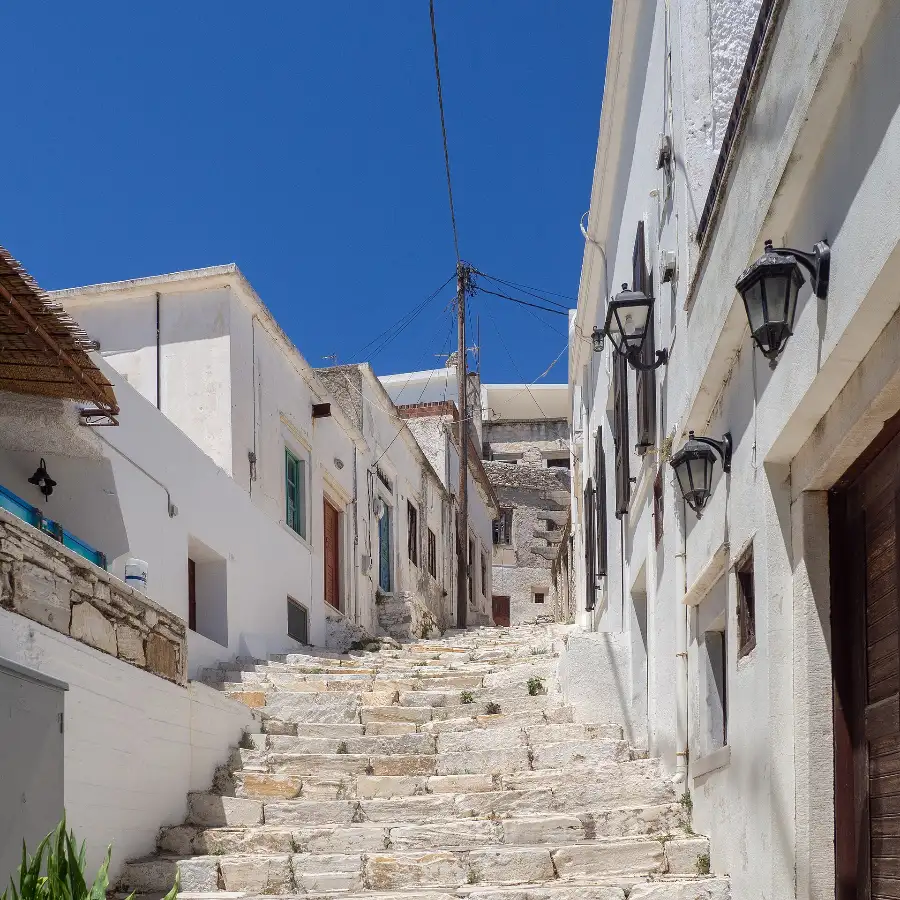
The lanes are paved in marble - not as decoration but because the mountain is made of it and it was the cheapest thing to hand. The same stone shows in doorframes, steps, thresholds and walls.

Diagram by Greece Trips. Free to reuse with credit - CC BY 4.0.
Why it feels different from the rest of the island
Apeiranthos was settled in part by people from Crete, and it kept a distinct identity: a recognisable local dialect that other Naxiots can pick out, its own musical tradition, and a strong sense of itself as a place rather than a stop.
It is also stone rather than whitewash. The Cycladic postcard is white cube houses; Apeiranthos is grey-brown marble and schist, with two Venetian tower houses standing among the lanes. It looks like a mountain village in a way almost nothing on the coast does.
What to do there
Not a great deal, and pleasantly so:
- Walk the lanes. They are narrow, roofed over in places, and worth an hour with no plan.
- The museums. For a village of this size it has an unusual cluster - a small archaeological museum, and others covering geology, folklore and natural history. Opening hours are informal; treat an open door as luck.
- The towers. Two Venetian-era tower houses, in private hands, but visible from the lanes.
- The kafeneia on the main square, which are the point of the visit for a lot of people. Sit down.
The road there is part of it
The drive up from the coast climbs through the mountains via Filoti, with long views back over the terraced hillsides and, if you time it, some of the best light on the island in late afternoon.
The road is good but winding. Between Filoti and Apeiranthos you are crossing the flank of Mount Zas, the highest peak in the Cyclades, and its trailheads are on the same run - see Mount Zas.
Further on, the road continues down to the east coast at Moutsouna, past the old emery workings - Naxos mined emery here for centuries, and the aerial cableway that carried it to the sea still stands in pieces along the hillside.
Practical notes
- You need a car. There is a bus, but the interior on a bus timetable is a frustrating way to spend a day.
- Parking is at the entrance to the village. The lanes are not driveable.
- Footwear. Marble that has been walked on for centuries is polished and slippery, particularly after rain.
- Off-season the village is quiet in a way that is either the appeal or the problem.
What to take from this page
Go for an afternoon and expect a village rather than an attraction. Walk the marble lanes, sit in the square, and treat the drive over from Filoti as half the reason you came.
Last checked August 2026. Museum opening is informal and seasonal - see our editorial policy.
Common questions
What is Apeiranthos known for?
Its marble-paved lanes, Venetian tower houses, an unusual cluster of small museums, and a distinct local dialect and musical tradition.
Why are the streets in Apeiranthos marble?
Because the mountain is marble. Naxos has quarried it since antiquity, and in the villages it was simply the material to hand.
How do you get to Apeiranthos?
By car from the coast, roughly forty minutes, climbing through Filoti on the flank of Mount Zas. A bus exists but the interior rewards your own transport.
How long should you spend in Apeiranthos?
An afternoon. An hour in the lanes, time in a kafeneio on the square, and the drive over.
Are the museums in Apeiranthos open?
Opening is informal and seasonal. Treat an open door as good fortune rather than planning the day around it.
Is Apeiranthos worth visiting?
If you want the Naxos that is not a beach, yes - it is the clearest example of the island’s mountain interior and looks nothing like the coastal villages.
Next
Read things to do in Naxos, Mount Zas, or choose a base with where to stay in Naxos.