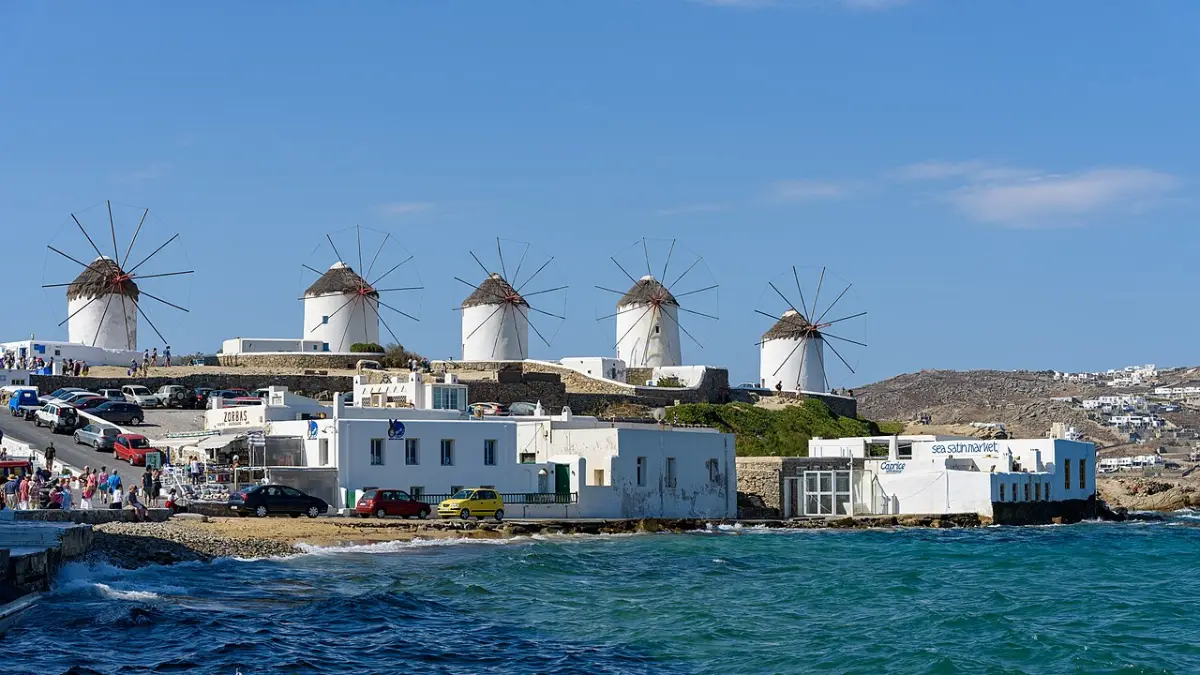
They were not picturesque. They were industry.

Diagram by Greece Trips. Free to reuse with credit - CC BY 4.0.
Why an island this dry had so many mills
Mykonos is barren. It grows very little, and it certainly never grew enough grain to need a bank of windmills.
What it had was position. The island sits on the sea route between the Greek mainland, the eastern Aegean and Asia Minor, and ships crossing that route needed provisioning. Mykonos milled grain that arrived by sea and sold flour and hard ship’s bread back to the boats.
The wind that makes the island uncomfortable in August is the same wind that made this possible: the meltemi, blowing hard and reliably from the north through the summer. The mills face it.
At the height of the trade there were considerably more than the seven at Kato Mili you see today, with mills standing on ridges across the island.
What you are looking at
The survivors are the standard Cycladic type: a round whitewashed tower, a wooden top that could be turned to face the wind, and a rig of triangular sails on wooden spars rather than the solid boards of a northern European mill.
Most are capped and closed. One, the Boni windmill above the town, is kept as a small museum and is the place to go if you want the mechanism rather than the outside.
When to go, and the sunset problem
Kato Mili faces west over the water toward Little Venice, which is why it is a sunset fixture and why it is unpleasant at sunset in August. The ridge is small, the crowd is not, and everyone is taking the same photograph.
Early morning is the honest recommendation. The towers are white, the light comes side-on, the town below is quiet, and you will have the ridge more or less to yourself.
If you want the sunset anyway, it is a short walk up from the town, and you should arrive well before the hour rather than during it.
Getting there
The mills stand on the low ridge at the southern edge of Mykonos town, a few minutes uphill from the waterfront and directly above Little Venice. There is no ticket and no gate - the ridge is open ground.
Wear something with grip. The approach is stone and polished smooth in places.
What to take from this page
Go early rather than at sunset, and look at the sail rig rather than only the silhouette. The mills are the reason Mykonos was wealthy long before it was fashionable, which is a better story than any of the photographs suggest.
Last checked August 2026. Museum opening varies by season - see our editorial policy.
Common questions
What were the Mykonos windmills used for?
Grinding grain, largely for passing ships rather than for the island itself. Mykonos sat on a busy Aegean sea route and sold flour and hard bread to the boats crossing it.
How many windmills are there in Mykonos?
Seven stand in the well-known row at Kato Mili above the town. There were considerably more across the island when the milling trade was at its height.
Can you go inside the Mykonos windmills?
Most are closed. The Boni windmill above the town is kept as a small museum, and that is where you can see the working parts.
What time should you visit the Mykonos windmills?
Early morning. The ridge is a sunset fixture and becomes very crowded for it in high season, while at dawn it is quiet and the light falls better on the white towers.
Where are the windmills in Mykonos?
On the low ridge at the southern edge of Mykonos town, a few minutes uphill from the waterfront and directly above Little Venice.
Is there an entrance fee for the windmills?
The ridge at Kato Mili is open ground with no ticket. The Boni windmill museum is separate.
Next
Read things to do in Mykonos, Little Venice, or choose a base with where to stay in Mykonos.