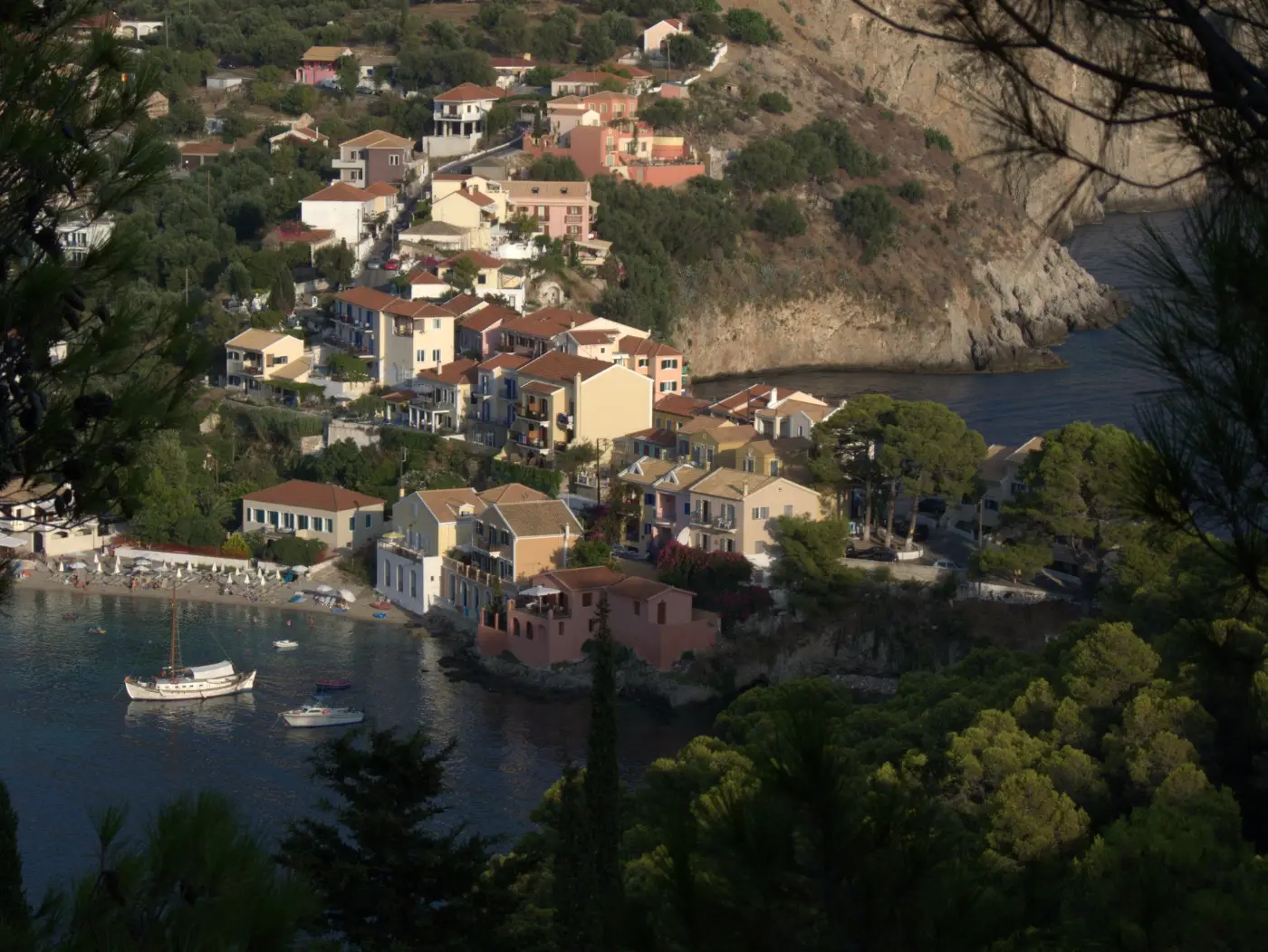
It is the picture that sells Kefalonia, and it is genuinely tiny - a couple of dozen buildings, one small beach, a handful of tavernas.

Diagram by Greece Trips. Free to reuse with credit - CC BY 4.0.
Why it looks the way it does
Two things.
The 1953 earthquake levelled most of Kefalonia, and the rebuilding that followed is why so much of the island looks modern. Assos was rebuilt after it, and the pastel colours - pink, ochre, pale green - date from that reconstruction rather than from Venetian times. It looks old and it looks lovely; the two are not quite the same claim.
The isthmus is the reason the site was chosen at all. A defensible neck of land with water either side is a good place to control, which is why the Venetians put a fortress above it.
The fortress is a walk, not a monument
The Venetian castle on the headland above dates from the late sixteenth century and once enclosed a substantial area - it was a refuge for the surrounding population, not just a garrison post.
What survives is mostly walls and gateways with pine woods growing through them. There is no ticketed visit and little interpretation. What there is:
- A steep path up from the village, or a road round
- A circuit of walls with views back down onto the isthmus and both bays
- Shade, which is rare on a Greek headland
Allow an hour or so up and back at a gentle pace. It is a proper climb in heat.
The village itself takes about an hour
Be realistic: Assos is small. You can walk its length in a few minutes. The visit is the setting rather than a list of things.
- The cove has a small pebble-and-shingle beach with clear, calm water, good for a swim rather than a beach day.
- The waterfront tavernas are the reason many people come, and they are busy at lunch in season.
- There is a small square with plane trees behind the front.
It works best as a half-day paired with Myrtos, which is on the same coast a short drive south, or with Fiskardo further north.
The road down
Worth flagging. Assos is reached by a steep series of hairpins dropping from the main coast road, and the village has very little parking at the bottom.
In August, cars back up on the descent and finding a space can take longer than the visit. Arriving early or late avoids most of that. If you are nervous about mountain driving, this is one of the roads on Kefalonia that will focus your attention - see renting a car in Greece.
What to take from this page
Come for an hour or two, not a day. Walk up to the fortress if the heat allows, swim off the cove, eat on the front, and combine it with Myrtos on the same run down the coast.
Last checked August 2026. Parking and taverna seasons vary - see our editorial policy.
Common questions
What is there to do in Assos, Kefalonia?
Walk up to the ruined Venetian fortress on the headland, swim in the sheltered cove, and eat on the small waterfront. It is a setting rather than a list of attractions, and an hour or two covers it.
How long does it take to walk to Assos castle?
Around an hour up and back at an easy pace on a steep path. There is more shade than on most Greek headland walks, but it is still hard work in high summer.
Is Assos worth visiting?
Yes, as a short stop, ideally combined with Myrtos beach on the same coast. Do not plan a full day around a village this small.
Why are the houses in Assos coloured?
The village was rebuilt after the 1953 earthquake that destroyed most of Kefalonia, and the pastel palette comes from that reconstruction rather than from the Venetian period.
Is parking difficult in Assos?
Yes in high season. The village sits at the bottom of a steep hairpin descent with very little parking, and August afternoons back up.
Can you swim at Assos?
Yes, off the small pebble beach in the cove. The water is calm and clear, though it is a swimming spot rather than a beach for a full day.
Next
Read things to do in Kefalonia, Melissani cave and Myrtos beach, or choose a base with where to stay in Kefalonia.