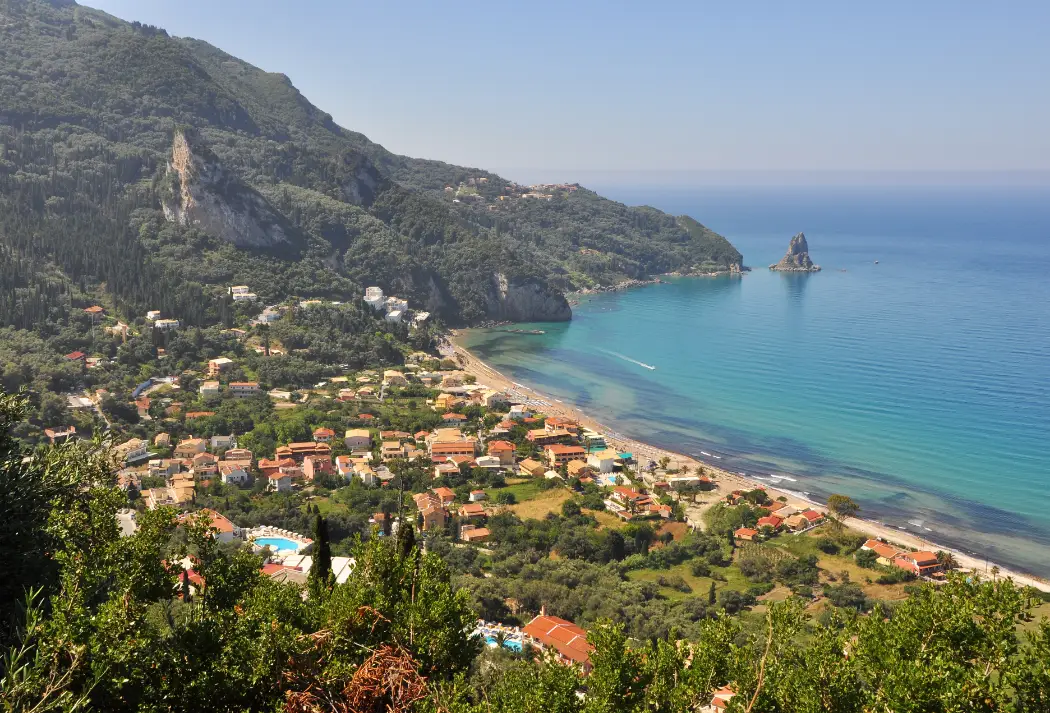
It is not the same beach the whole way along, which is the part nobody prints. The organised rows and the places to eat are in the middle, where the street lands. South of them the sand runs on under the cliffs towards the Ortholithi, the standing rock in the water. North of them the ground turns to pebbles and rock, with a rusting hull sitting on it.
So the only real decision this beach asks of you is where you stop walking. How it ranks against the rest of the island’s coast belongs to the best beaches in Corfu.

Diagram by Greece Trips. Free to reuse with credit - CC BY 4.0.
The ground changes as you walk it
The sand is coarse rather than powdery, with gravel through it. Coarse sand drains, and it does not cake onto you.
Then it changes. Two independent beach references put pebbles and rock along the northern part of the shore, where several widely read guides call the whole beach soft golden sand. The stony end is the one to plan around: it is the ground the rusting hull sits on. Go the other way and the sand runs on, with the umbrella rows thinning out under the cliffs.
The seabed is sand as well and it shelves gradually, so the shallow water carries a long way out. One visitor who spent a fortnight here put it as the sea going out for miles.
What this page will not do is tell you that water suits your children. The sea moves, sandbars shift through a season, and this is open west coast, not sheltered channel. That judgement belongs to the person standing in it, to the flag and to any lifeguard on duty. It is not a certificate a web page is in a position to issue.
Sunbeds and umbrellas are hired and priced at the board, and some places along the shore put you on a lounger for the price of a drink instead. Either way you agree it before you sit down.
The Ortholithi, and the hull at the other end
The Ortholithi is Greek for standing stone, and it rises out of the sea at the southern end of the beach, below the village of Pentati. Locally the same rock is called Tholeto, which is how Wikimedia Commons catalogues it.
Most accounts stop at saying the rock is there. One Corfu writer says what it is: a piece of the cliff that came away, probably long before anyone was there to watch, and stayed upright. The probably is his, and we keep it. It is visible from other parts of the island, which makes it a landmark rather than a curiosity.
At the other end, on the stony ground towards the north, sits a rusting boat hull. It is photographed constantly and it has become a fixture of the walk up that way.
How it got there is another matter. The accounts contradict each other on when it arrived and where it came from, and one adds a nationality no source we could open supports. None of it is printed here. A hull can be cleared, which is why the date at the foot of this page matters.
Getting down there, and the climb back out
You arrive at Agios Gordios by going down. The beach sits in a cove ringed by hills, and the road in comes off the ridge and through Sinarades.
That shape is also why this page prints no distance and no drive time: six sources give six different figures, and four different drive times, two of them on pages by the same publisher.
The green buses are run by KTEL Kerkyras, which lists route B10, Agios Gordios, among its South Corfu services on its own site. Take current routes and times from the operator rather than from any guide, this one included. Getting around Greece covers the general pattern.
There are car parks behind the beach, some charged and some not, reported to fill in July and August. Whether you want a car here is answered in which islands need a car.
Leaving on foot is the resort’s unadvertised half, and every version climbs. A road runs south and up to Pentati, the village above the Ortholithi, and a steeper shortcut path goes the same way; walkers report taking the road. A footpath comes down from Sinarades, so you can ride out and walk back in. Kato Garouna is a shorter climb with mountain views rather than sea, and walkers carry water on all of them.
One street, and two crowds on it
The resort is one street. Shops, tavernas, bars and rooms line the road that runs down to the sand, which is why the beach is busiest where the road lands and why a few minutes’ walk either way changes the crowd.
We name the street rather than the businesses on it, because places here change hands between seasons and the street does not. On it: places to eat looking onto the sand, mini markets, the ordinary resort infrastructure. Where to eat in Corfu is a page of its own.
Two crowds share it, and this is a read rather than a count. Publishers describing the village put families and couples on the sand by day, and a younger, more transient crowd up on the hillside above the resort. That mix is unusual on this coast. The island’s purpose-built party strip is Kavos, at the far southern tip, and Corfu nightlife covers it.
It fills in July and August, and the standing advice is to arrive early if you want a lounger in the organised rows. One August visitor found plenty free, so treat that as a pattern rather than a rule.
West-facing, with everything that comes with it
The sunset and the swell are the same fact. The cove faces west into open sea, so the sun goes down in front of it rather than behind a headland, and this is not the sheltered channel water of the east coast: the west takes the open Ionian and runs cooler.
At sunset the light comes back off the cliffs at the southern end. The hour moves through the season, so look it up for your date.
One visitor who stayed a fortnight describes the sea swinging from medium waves to flat calm inside a few days. Another guide calls it gentle, which is one calm day turned into a personality. What the Greek sea is like has the pattern.
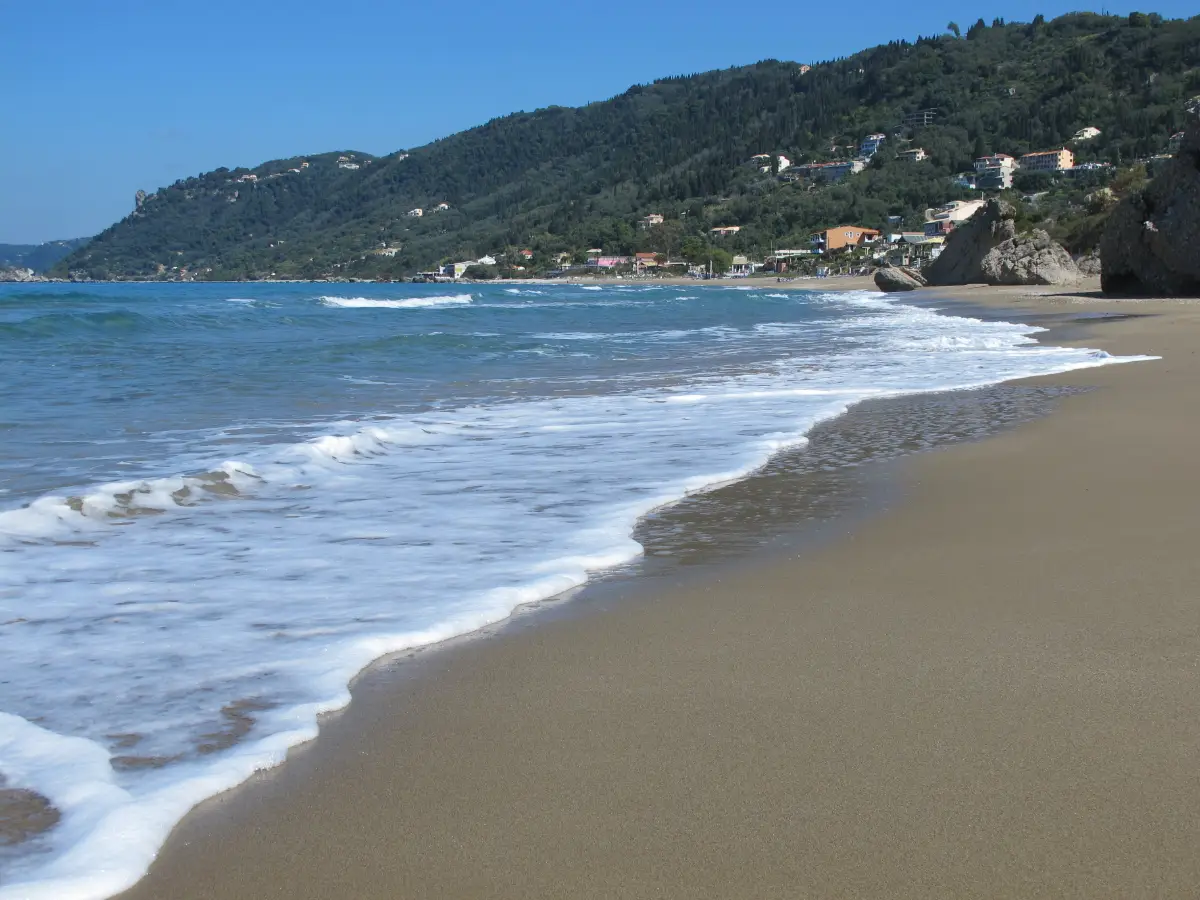
Late spring and September give a warm sea with room on the sand. July and August give the fullest version, crowds included.
Who this cove suits
Come for a day or a week built around one beach, with everything on hand in the middle and two different ends to walk to. Look elsewhere if you wanted to hop between coves on foot, because cliff closes this one at either end and every route out of it climbs. Where this beach sits against the island’s others, and where to base yourself, belong to the best beaches in Corfu and the Corfu guide.
What is worth arranging ahead for this cove is the bed behind the beach in the peak weeks and the way you plan to get in and out of it, because both come under pressure in the same fortnights. Where to stay in Corfu sets out the island’s bases.
Last checked July 2026. What gets re-checked here: the bus route at the operator, whether the hull is still on the stones at the northern end, and the organised set-up on the sand. The cliffs, the rock and the shape of the cove are not going anywhere. No distance, drive time, fare, sunbed price or business name appears on this page by design. How we date and correct facts is in our editorial policy.
Common questions about Agios Gordios
Where is Agios Gordios in Corfu?
Agios Gordios is a wide beach and a small resort on Corfu’s central west coast, at the bottom of a cove ringed by green cliffs and downhill from the village of Sinarades. A single street runs from the village to the sand. No kilometre figure appears here, because the sources that publish one do not agree with each other.
Is Agios Gordios beach sandy or pebbly?
Mostly sand, and coarse rather than powdery, with gravel through it. Two independent beach references describe the northern part of the shore turning to pebbles and rock, where several widely read guides call the whole beach soft golden sand. The organised rows sit in the middle, where the street lands, so where you put your towel decides what you are standing on.
What is the rock at Agios Gordios?
The Ortholithi, which is Greek for standing stone, rising out of the sea at the southern end of the beach below the village of Pentati. Locally it is also called Tholeto. A Corfu writer describes it as a piece of the cliff that came away, probably long before anyone was there to see it, and stayed upright. It is visible from other parts of the island.
How do you get to Agios Gordios from Corfu Town?
By road over the ridge and down through Sinarades, or on the green bus. KTEL Kerkyras, the island’s bus operator, lists route B10, Agios Gordios, among its South Corfu services, and current routes and times are worth taking from the operator rather than from a guide. There are car parks behind the beach, some charged and some not, reported to fill in July and August.
Is Agios Gordios good for families?
What is checkable: a wide beach with room to spread out, organised rows with shade for hire and free sand either side of them, places to eat looking onto the sand, and a shore that shelves gradually so the shallow water carries a long way out. What this page will not do is tell you the water suits your children. The sea moves, this is open west coast rather than sheltered channel, and that judgement belongs to the person standing in it, to the flag and to any lifeguard on duty.
Is there a shipwreck at Agios Gordios beach?
A rusting boat hull sits on the stony ground towards the northern end of the shore, a few minutes’ walk from the organised middle. The accounts of when it arrived and where it came from contradict each other, so none of them is printed here. A hull on a beach can also be cleared, so treat it against the date on this page.
Is Agios Gordios a party resort?
What is here is one street of tavernas and bars running down to the sand, an evening built around eating and drinking along the shore, and a younger crowd based up on the hillside above the resort. That mix is unusual on this coast. The island’s purpose-built party strip is Kavos, at the far southern tip, and our Corfu nightlife page treats it at length.