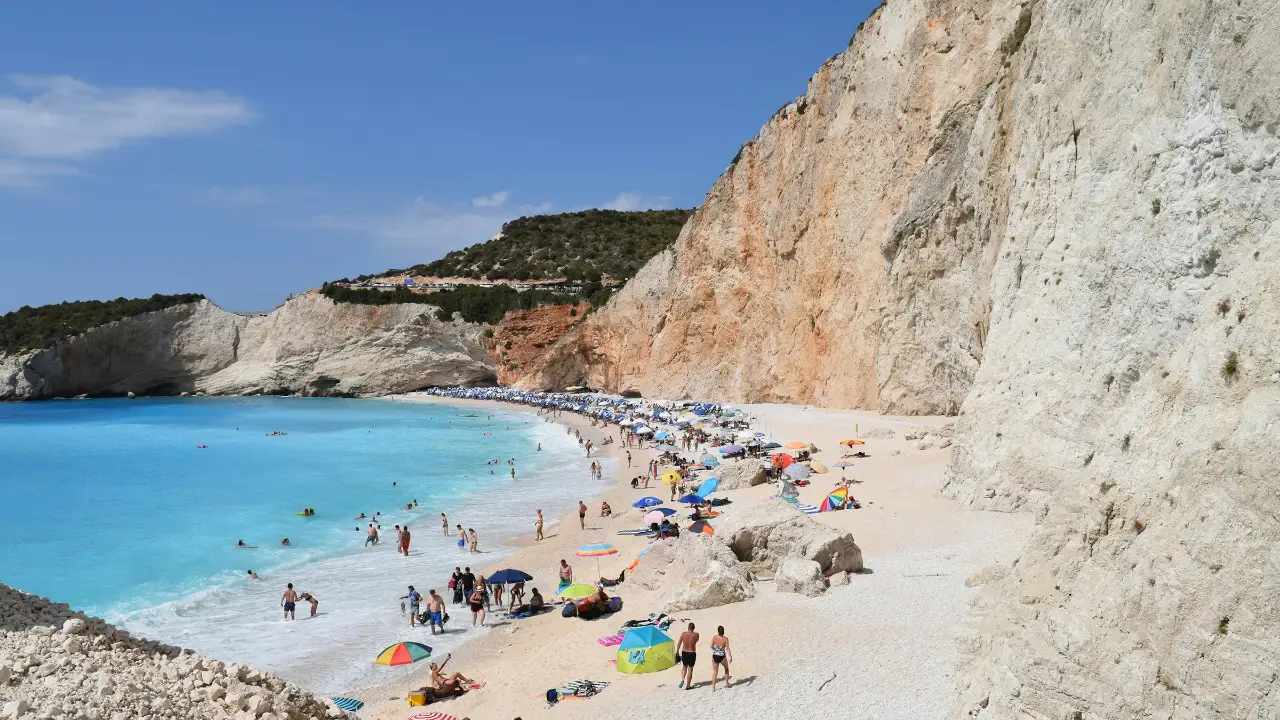
Where it is
Lefkada is one of the Ionian islands, off the western mainland of Greece, joined to it by a causeway and a floating bridge - the reason there is no mainland ferry. It runs roughly 35 km north to south by 15 km east to west, and its highest point is Mount Stavrota at about 1,158 m. Capital: Lefkada Town
Getting there
nearest airport is Aktion (PVK), near Preveza, a short drive across the water - Fraport Greece, its operator, lists it as the airport serving Preveza and Lefkada. From Athens the only direct route is to drive, roughly four to five hours west via Patras and the Rio-Antirrio bridge. A KTEL bus runs to Lefkada Town via Preveza for the car-free. Sources: pvk-airport.gr (Fraport Greece) for the airport; routing services for the drive
Ferries
no mainland ferry. Everyday links are short island hops from Vasiliki and Nidri to Kefalonia (Fiskardo, Sami), Ithaca (Frikes, Pisaetos) and Meganisi; a longer seasonal line runs a few days a week in late summer towards Paxi, Corfu and Zakynthos
Best months
late May to June and September for warm days, a swimmable sea and thinner crowds; July and August are hottest, busiest and windiest (best for windsurfing); spring and autumn are the walking seasons
Travel details last checked July 2026.
That single fact reshapes the whole trip. What waits on the other side is a west coast of white cliffs dropping to turquoise water, and, in the south at Vasiliki, one of Europe’s most dependable afternoon windsurf winds. This page covers how you reach Lefkada, what the island is actually like coast by coast, who it suits, where to base, and when to go.
Where Lefkada is, and why the bridge changes the trip
Lefkada sits just off the western mainland of Greece, in the Ionian Sea, separated from the coast by the narrow Lefkada Canal. Where every other famous Greek island makes you catch a boat, here a causeway runs out across the shallows and a floating pontoon bridge completes the last stretch, carrying the road straight onto the island.
The bridge is the detail worth knowing. It floats on the water rather than arching over it, so to let boats through the canal it swings open at set times through the day - a published schedule of several openings, each lasting somewhere around ten to fifteen minutes, on different summer and winter timetables - and the road traffic waits until it closes again. The Lefkada port authority publishes the current times, and they are worth a look if you are arriving on a tight connection. Time it wrong and you sit in a short queue; time it right and you barely notice you left the mainland.
There are three ways in. By air, the nearest airport is Aktion National Airport, near Preveza, a short drive over the water from the bridge; most visitors rent a car at the airport and drive straight on. From Athens, driving is the only direct way, and it is a long half-day at the wheel rather than a hop - reckon on roughly four to five hours west via Patras and the Rio-Antirrio bridge, more if you leave the city at the wrong moment. Without a car, a KTEL bus runs to Lefkada Town via Preveza, which gets you onto the island but not easily around it. The mechanics of both are in our driving in Greece and flights to Greece guides.
One thing the bridge does not do is connect you onward. Lefkada’s own ferries are island-to-island: the everyday ones are short hops from Vasiliki and Nidri to Kefalonia, Ithaca and Meganisi, and in late summer a longer seasonal line runs a few days a week up to Paxi and Corfu and down towards Kefalonia and Zakynthos. No ferry runs to the mainland, because you already drove across it.

Diagram by Greece Trips. Free to reuse with credit - CC BY 4.0.
Two coasts: dramatic west, sheltered east
Point the car west and you get the postcard; point it east and you get the calm. Which way you turn in the morning decides the kind of day you have, and most Lefkada trips end up doing both.
The west coast is the one on the images: a long run of white cliffs falling to water that reads turquoise over pale sand and stone. It faces the open Ionian, so the sea has room to build, and on a windy afternoon the same beach that looked like a swimming pool at ten in the morning can be rolling surf by four. That openness is the draw and the catch in one, and it pays to know what the sea is really like before you plan a west-coast swim day.
The east coast is the opposite: green, low and sheltered. Around Nidri and Nikiana the water sits calm behind a screen of small islands, which is why this side is the launch point for the day boats out to Meganisi and the islets offshore. Skorpios, the old Onassis island, is the one people point at from the deck. Families and anyone who wants easy, flat water tend to base over here.
Between the two runs a single highland spine, topped by Mount Stavrota, so crossing from coast to coast means a short but winding climb up and over rather than a straight line. Nothing on Lefkada is far in kilometres; plenty of it is slow in minutes.
So the mental map is simple: drama and open sea to the west, easy water and boats to the east, a mountain in the middle, and the bridge at the top corner where you came in.
The beaches, and the effort each one costs
Lefkada’s best beaches are earned rather than strolled onto, so the useful way to sort them is not by looks - the water is turquoise almost everywhere - but by the effort each one costs you in stairs, parking and shade.
The west-coast cliff beaches are the famous, demanding ones:
- Porto Katsiki is the signature Lefkada image, a wedge of sand under a sheer white cliff. You leave the car in a paid car park at the top and walk down a long flight of steps cut into the cliff. There is little natural shade, so carry water and go early, before the car park fills.
- Egremni, further south, was once reached by an even longer cliff staircase. Its access is a special case, and it comes just below.
- Kathisma is the west coast made easy: loungers, beach bars and level access from the road, which is why it draws the crowds the other two make you work for.
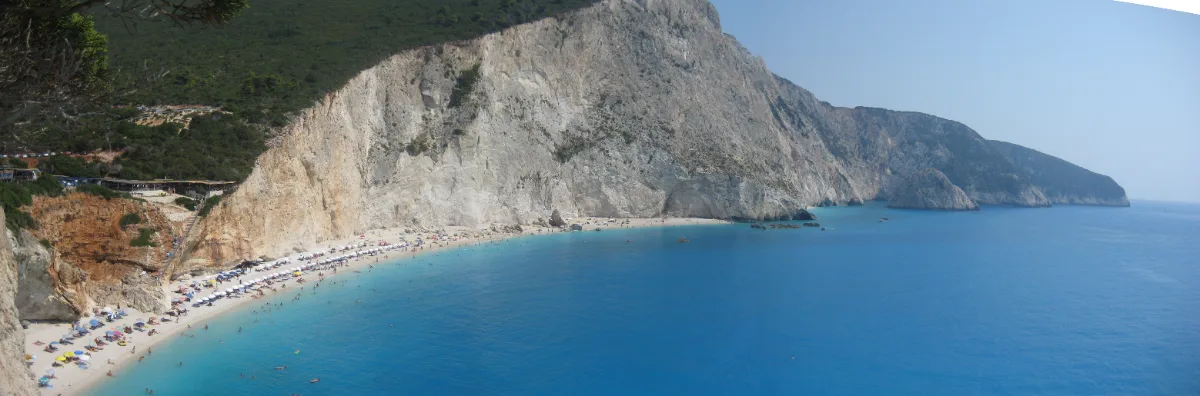
The turquoise coves are gentler. Agiofili, near Vasiliki in the south, is a small, clear cove reached on foot or by a short boat shuttle from the harbour. Mylos, on the west, is a walk or a boat ride, and quieter for the effort. The watersports beaches - Agios Ioannis near Lefkada Town and Vasiliki in the south - are shallow and breezy, built for boards more than sunbathing; Vasiliki gets its own section next.
Egremni needs telling honestly. On 17 November 2015 a magnitude 6.5 earthquake struck about 19 km south-southwest of Lefkada and shook a flank of the west-coast cliffs loose, cutting off the long staircase that was the beach’s land access. The sand is still there; what changed is how, and whether, you can get down to it, and that has kept changing since. Rather than trust a reopening date - the specific years you will read online trace to tour-operator blogs, not to any authority - check the current access locally before you build a day around Egremni.
The pattern holds across the island: the more spectacular the beach, the longer the stairs and the thinner the shade. The west-coast cliff beaches reward an early start, a full water bottle and shoes you can walk down steps in. Whether Lefkada needs a car to reach them is barely a question - see which islands need a car.
Vasiliki and the afternoon wind
Vasiliki, in the south, is one of the most reliable places to windsurf in Europe, and the reason is not luck but geography: its wind is thermal, so it runs to a daily timetable you can plan around.
Here is the cycle. The bay sits under a mountain. In the morning the air is light and onshore, gentle enough for beginners to learn and for lessons to run on flat water. As the sun climbs and heats the mountain slope through the day, warm air rises off the rock and pulls a cross-shore wind down into the bay, building through the afternoon into the strong, steady conditions advanced sailors come for. When the sun drops behind the ridge in the evening, the engine switches off and the wind usually fades with it.
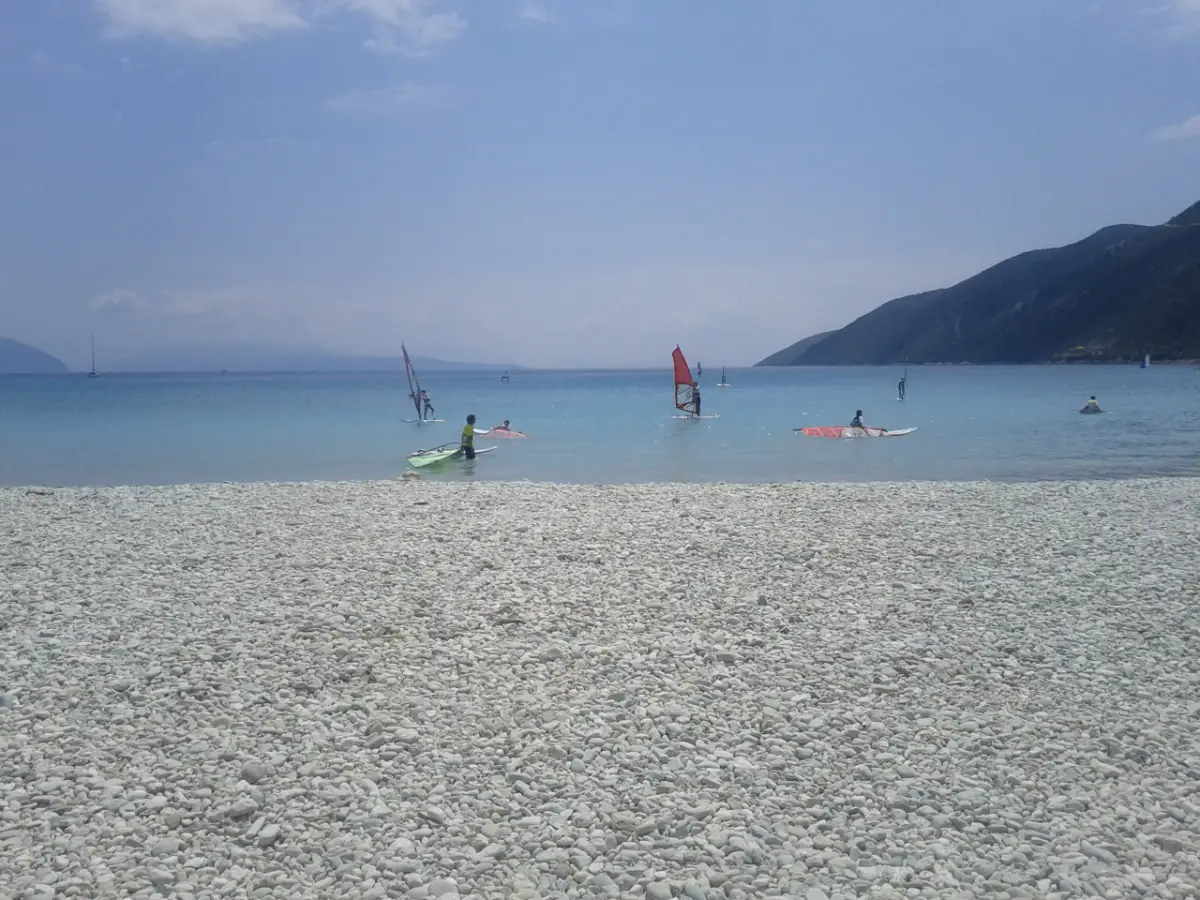
That rhythm is the whole planning trick. If you are learning, book the morning. If you want your strongest sessions, keep the afternoon free and expect company on the water. And if the wind is the point of the whole trip, note that it blows hardest in high summer, the same weeks the beaches are busiest.
Vasiliki is not the only spot. Agios Ioannis, on the flats just outside Lefkada Town, is the island’s other main windsurf and kitesurf beach, shallow and open, and it works as the northern base for the same sport. Between the two, Lefkada gives a windsurfer somewhere to sail whichever way the day sets up.

Diagram by Greece Trips. Free to reuse with credit - CC BY 4.0.
Beyond the beach: villages, waterfalls and walks
Drive twenty minutes inland from any beach and Lefkada changes character completely: cliffs give way to pine, lentil fields and stone villages that stay cooler than the coast. This is the half of the island most beach trips never see, and it is where the walking is.
The easiest way in is the Dimosari gorge walk above Nidri. A short, mostly shaded trail follows the stream up to the Nidri waterfalls and a plunge pool at the base, and cold is the word for it, because the water stays sharp even in August. It is gentle enough for most walkers and a real relief on a hot afternoon.
Higher up sit the mountain villages. Karya is the best known, a square-and-plane-tree village with a long tradition of needlework and embroidery. Englouvi, the highest village on the island, is lentil country, and its terraced fields are the reason those lentils turn up on every local menu. Sivros and the smaller inland settlements nearby are slow and lived-in, worth an unhurried hour more than a checklist stop.
At the southern tip, the road runs out to Cape Lefkatas, a headland of high white cliffs where a lighthouse stands and where legend puts Sappho’s Leap. There is little to do out there but look, and on a clear day the look is the point.
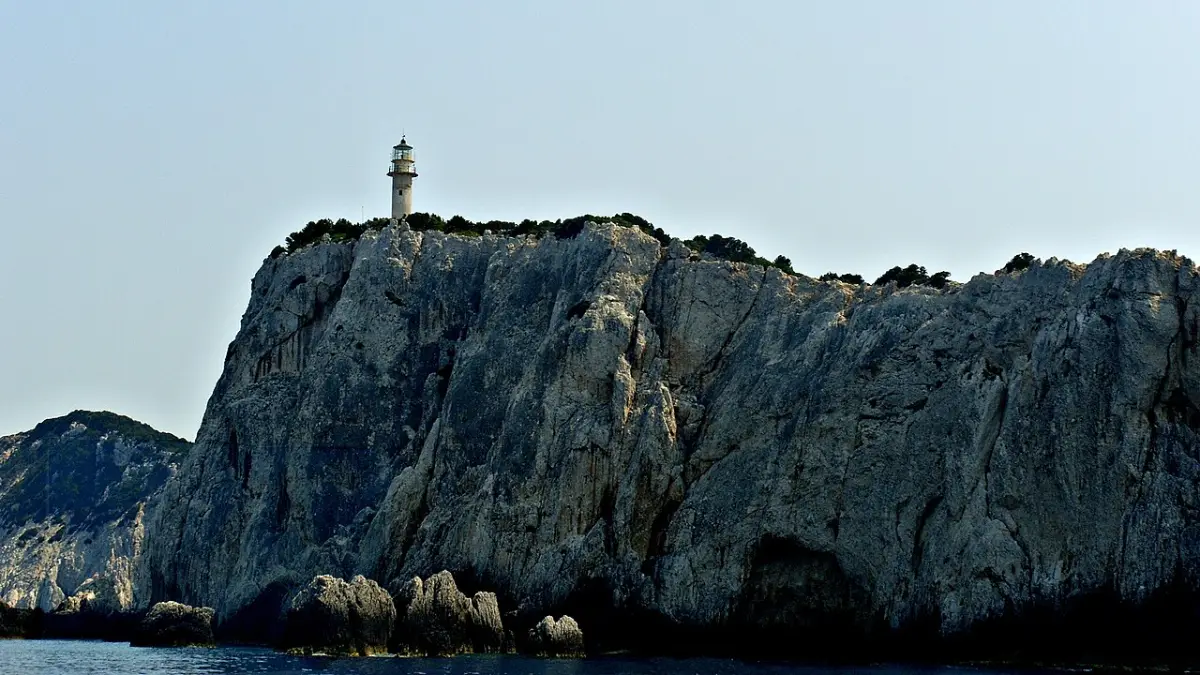
Time your walking by the season and it pays off. Spring brings wildflowers and mild air; autumn stays warm but empties out; midsummer inland is hot and better spent by the cold pool than on an exposed ridge. If you came to Lefkada mainly to walk, the shoulder months are yours, and they are not the windsurfer’s months. For where the island sits in the wider archipelago, see the Ionian islands.
When to go
The sweet spot for Lefkada is late May into June, or September: warm days, a sea that has had the summer to warm up, and noticeably thinner crowds than the peak. Rooms are easier, and the famous beaches are calmer at both ends of the day.
July and August are the other Lefkada. They are the hottest and busiest weeks, and they are also the windiest, which is exactly why a windsurfer should want them and a walker probably should not. If Vasiliki is your reason for coming, high summer is your season; if you came to hike the gorge and the villages, the heat inland works against you.
Spring and autumn are the walking seasons proper: green, mild and quiet, with wildflowers early and warm, empty trails late. The trade-off is the water. The sea is cooler at the edges of the season, and some beach services - loungers, bars, the boat shuttles - wind down or close once the crowds thin.
So the honest answer depends on what you came for. The windsurfer’s ideal week is the hiker’s worst, and the swimmer sits somewhere in between, so line the season up with your reason for going. For the wider picture, see the month-by-month weather and best time to visit Greece guides.
Where to base yourself
Where to stay in Lefkada is a question about areas, not hotels, because each part of the island sets up a different kind of trip. Pick the base by what you came for and let the room follow.
Lefkada Town, at the northern tip by the bridge, is the convenient all-rounder. It is walkable, with restaurants, a waterfront and a Venetian castle guarding the canal, and it is well placed for the airport and for reaching both coasts. What it is not is a beach base: you sleep in a working town and drive to the sand.
Nidri, halfway down the east coast, is the island’s biggest resort and its boat-trip hub, the busiest and most built-up spot on Lefkada. That suits families and easy, boats-and-tavernas days; it works less well if you wanted quiet.
Nikiana and Perigiali, just north of Nidri, are the calmer east-coast alternative: close to the same boats, without the resort density.
Agios Nikitas is the small, pretty west-coast village, and the closest good base to the cliff beaches. It is also the one that books out earliest, precisely because there is not much of it.
Vasiliki, in the south, is the windsurf base: relaxed, sport-focused and a fair drive from the north of the island. Sivota, tucked into a fjord-like inlet nearby, is a small yacht-and-dinner harbour, quiet by design.
None of these is the right answer on its own; the right one is whichever matches your list. Travelling with children shifts the balance toward the calm east coast and its flat water - our family trips in Greece guide has more on that.
Who Lefkada suits, and who should skip it
Lefkada rewards some travellers and frustrates others, and it is worth being honest about which you are before you book.
It is a strong choice if you like to drive a destination rather than ferry-hop it: you arrive by car over the bridge, and a rental turns the whole island into a string of day trips. It suits families, with the calm east-coast bays and a range of beaches from easy to demanding. It suits windsurfers and watersports travellers, who have Vasiliki. And it suits anyone who wants Ionian turquoise without stringing together a flight and a ferry to reach it.
It is a harder sell in four cases. If you will not have a car, know that the buses run to the main towns rather than down the side roads to the cliff beaches and mountain villages, so a car-free Lefkada is a small slice of the island. If you want a compact, walk-everywhere island, this is not one: Lefkada is big and spread out. If you are after a sunset-strip party scene, the nightlife here is low-key and modest, concentrated in Lefkada Town and Nidri rather than any famous strip. And if you need step-free access to the famous west-coast beaches, remember that Porto Katsiki and Egremni are reached down long cliff staircases.
Practicalities: a car, a few days, and where it fits
Rent a car. On Lefkada that is less advice than arithmetic: the best beaches and villages sit down winding roads that the limited bus network was never built to serve, and the island is too spread out to base yourself in one spot and walk everywhere. Pick the car up at Aktion airport or in Lefkada Town, and fill the tank before the long west-coast runs. The full mechanics are in renting a car in Greece.
Parking at the famous beaches is paid: you leave the car in a signed car park at the top and pay a displayed fee before you walk down. Treat it as part of the day, not a surprise.
On length, give Lefkada four to seven days. Three is enough for a taste - a beach or two and a drive - but four to seven is what it takes to do the west-coast beaches, spend a day on a boat out of Nidri, get down to Vasiliki, and walk the gorge or a village without rushing between them. That range is the consensus of people who have done it, not a rule.
And because you drove on, Lefkada slots easily into a bigger trip. Short ferries link it to Kefalonia and Ithaca, and the mainland is already under your wheels, so a mainland-and-Ionian road loop is the natural shape. For how the boats work, see Greek island ferries.
Making Lefkada part of a bigger Greece trip
The bridge that makes Lefkada easy to reach is also what makes it easy to combine. Because you arrive by car and never have to sync a mainland ferry, the island drops neatly into a longer route: a few days here, a short crossing to a neighbour, and back onto the mainland road whenever you like.
So treat Lefkada as an anchor rather than a stop in isolation. It can carry a week on its own, or two or three days inside an Ionian loop or a road trip down the western coast. When you are ready to draw the rest of the line, start with our Greece itineraries, browse the full list of destinations, or open the interactive map and see what sits within a short drive or a short sail.
Lefkada FAQ
Do you need a ferry to get to Lefkada?
No. Lefkada is joined to the mainland by a causeway and a floating bridge, so you drive straight onto the island and there is no ferry to book. Its ferries are island-to-island: everyday hops to Kefalonia, Ithaca and Meganisi, plus a seasonal line a few days a week towards Paxi, Corfu and Zakynthos in late summer. The bridge does swing open at set times to let boats through the canal, each opening lasting roughly ten to fifteen minutes, so you may wait a few minutes to cross; check the port authority’s current schedule.
How do you get to Lefkada from the airport?
The nearest airport is Aktion (PVK), near Preveza, a short drive across the water; Fraport Greece, which runs it, lists it as the airport for Preveza and Lefkada. Most people rent a car there and drive over the bridge onto the island; a taxi or a KTEL bus via Preveza also works. Confirm current fares and the drive time close to your trip.
Do you need a car in Lefkada?
Effectively yes. The island is big and spread out, the buses run to the main towns rather than down the side roads to the cliff beaches and mountain villages, and the best of Lefkada waits at the ends of those roads. Base without a car only if you are content to stay put and book the occasional excursion. See which islands need a car.
How many days do you need in Lefkada?
Three days for a taste, four to seven to do it properly. Four to seven is enough for the west-coast cliff beaches, a boat day out of Nidri, a session or a lesson at Vasiliki, and an inland walk, without spending the trip in the car. It is an editorial call from trip reports, not a fixed rule.
What are the best beaches in Lefkada?
The signature ones are on the west coast: Porto Katsiki and Egremni, dramatic sand beneath white cliffs reached by long staircases, and Kathisma, the organised west-coast beach with easy access. For calm, clear water, try the coves, Agiofili and Mylos in the south and west. Sort them by the effort each costs in stairs, parking and shade rather than by a ranking.
When is the best time to visit Lefkada?
Late May to June and September give warm days, a swimmable sea and thinner crowds. July and August are hottest, busiest and windiest, ideal if you came to windsurf and hard if you came to walk. Spring and autumn are the best walking months, but the sea is cooler and some beach services close for the season.
Is Lefkada good for windsurfing?
Yes, and reliably so. Vasiliki Bay in the south has a thermal wind: light, onshore mornings that suit beginners and lessons, and a cross-shore wind that builds through the afternoon as the mountain heats up, for stronger sailors. Agios Ioannis near Lefkada Town is the other main windsurf and kitesurf spot.
What happened to Egremni beach after the 2015 earthquake?
On 17 November 2015 a magnitude 6.5 earthquake about 19 km south-southwest of Lefkada shook a flank of the west-coast cliffs loose and cut off the long staircase down to Egremni. The beach is still there, but how you reach it has changed and kept changing since. Check the current access locally before you plan a day around it; the specific reopening years quoted online come from tour blogs, not an authority.
Plan by category
The Lefkada guides
5 guides, each scoped to a decision you actually have to make.
 Attractions
Things to do
See the attractions → Hotels
Where to stay
Compare the areas →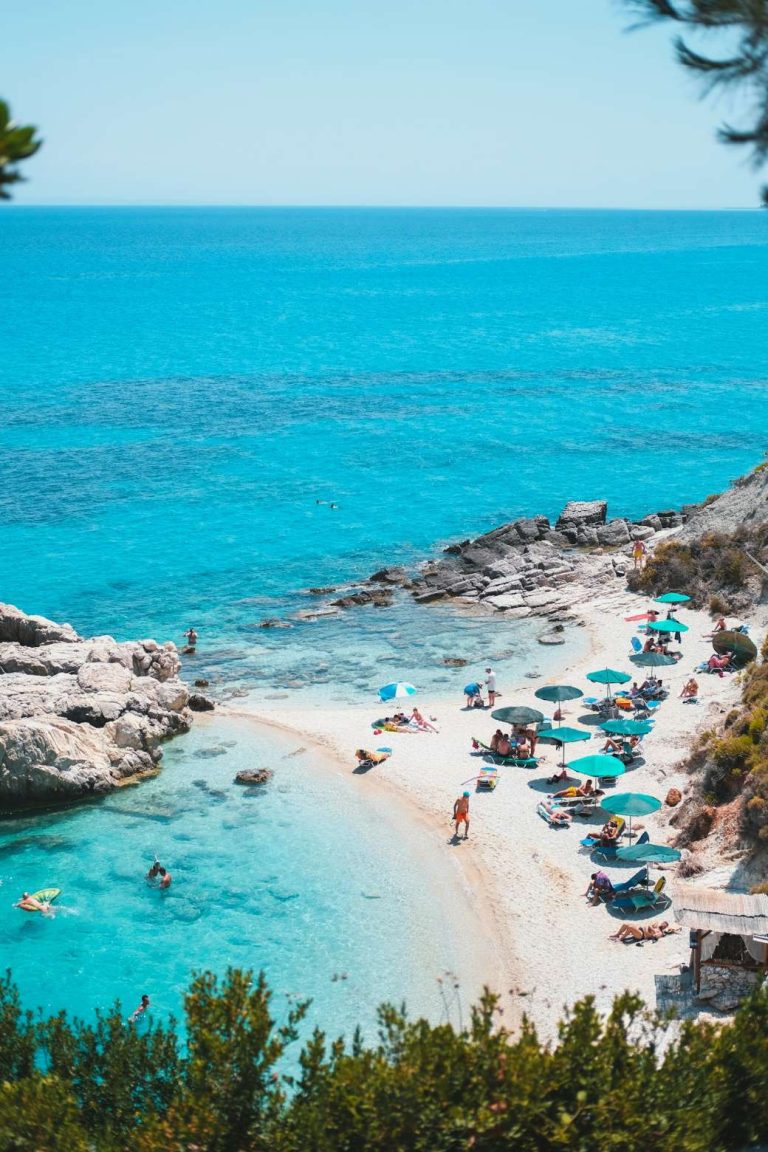 Beaches
The beaches
See the beaches →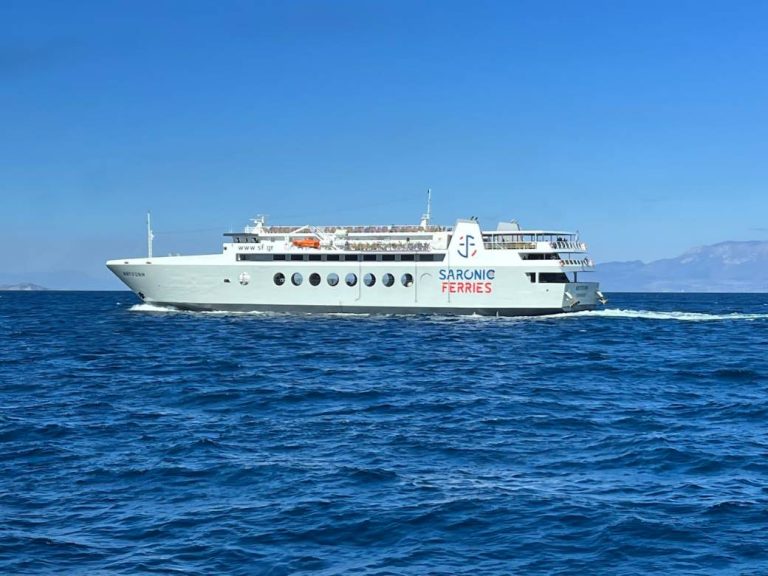 Itinerary
Day by day
See the itinerary →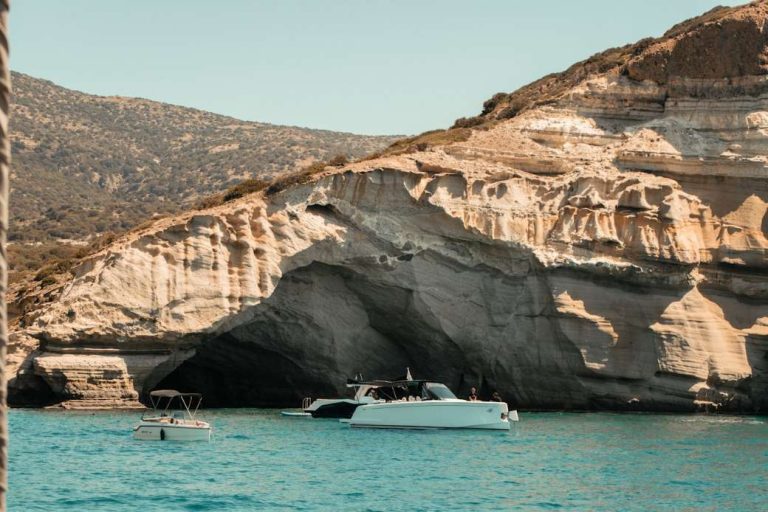 Day trips
Day trips
See the day trips →
Booking
We sell nothing and book nothing for you. Every guide on this page tells you how to arrange each piece yourself - which ferry operator, when to book, what to prebook and what to leave loose.