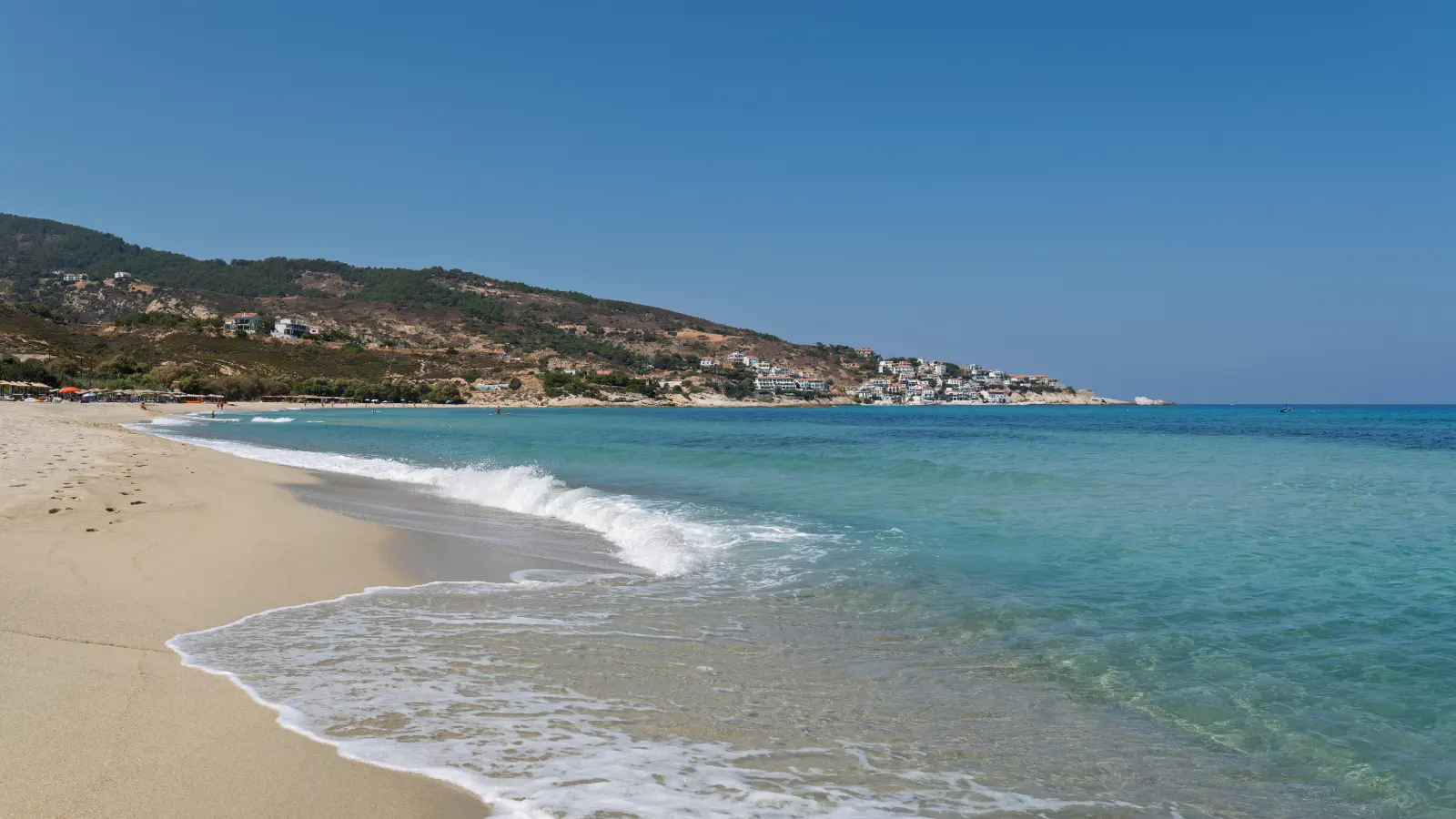
Island group
North Aegean (East Aegean), Greece; a short ferry from Samos, out on the Piraeus line
Shape and terrain
a long, narrow, mountainous island, roughly 40 km end to end, spined by the Atheras/Pramnos range (over 1,000 m), with around 200 villages
Ports
two - Agios Kirikos (capital, south) and Evdilos (north); from Piraeus, Evdilos is served by both operators and Agios Kirikos is the thinner option
Airport
a small national airport (JIK) near the south coast; Athens flights of about an hour, flown by Olympic Air and Sky Express
Ferry from Piraeus
roughly 6 to 8h15 depending on port of arrival and stops, on Blue Star Ferries and Seajets; from Samos, a little over an hour from Karlovasi and about 2h15-3h from Vathy
Blue Zone
one of five regions popularised as Blue Zones by Dan Buettner (National Geographic); the term was coined by demographer Michel Poulain and physician Gianni Pes. The “one in three reaches their 90s” headline belongs to Buettner’s reporting and the 2012 New York Times Magazine article “The Island Where People Forget to Die.” The separate University of Athens Ikaria Study (1,420 islanders, 2009) found 1.6% of male and 1.1% of female participants were over 90, above the European average - it is not the source of the one-in-three figure.
Honey
prized local honey, especially anama monofloral heather honey (Erica manipuliflora) and pine honey; named among longevity foods by Dan Buettner. Claims of medical benefits come from sellers, and we have not verified them
Hot springs
naturally hot, radon-bearing mineral springs at Therma and Agios Kirikos, roughly 31-58°C, used since antiquity; ranked among the most radioactive natural springs in the world. Therapeutic claims are published by a tourism body, not medically established
Best months
June and September for beaches with space; mid-July to early September for the panigiria and a warm sea (busiest, windiest); spring for hiking.
Travel details last checked July 2026.
Where Ikaria is, and what it’s actually like
Ikaria island sits in the North Aegean, part of the East Aegean group, a short ferry from Samos and out on the long line from Piraeus, the port of Athens. On the map it is a long, narrow ridge rather than a rounded island, roughly 40 kilometres end to end and never very wide.
A single mountain range, the Atheras, also called Pramnos, runs the length of it and climbs past 1,000 metres, so the island is really a spine with a coast on either side. Between the peaks and the sea sit deep gorges, terraced slopes, granite boulders the size of houses and something close to 200 villages scattered thin across the folds. Nothing here is a quick drive, because the roads have to climb and switchback to get anywhere.
The character is the part people remember. Ikaria has a reputation for being free-thinking, self-reliant and unbothered by the clock: shops that open when the owner appears, meals that start late, a general refusal to hurry for a visitor. Travel writers who know the island, including Matt Barrett’s long-running Greece guide, tie that temperament to its twentieth-century history as a place of political exile, when the state sent dissidents here and the islanders, already used to fending for themselves, absorbed them. Read the pace as the island’s own rather than as poor service and you will get on with the place.
Set your expectations before the beaches and the festivals tempt you: this is not a resort island and it is not a nightlife island. There are no big hotel strips, no manicured marinas and no club scene to speak of. What it has instead is space, character and time. For its nearest neighbour and an easy pairing, see Samos; to place it against the rest of the country, browse all the Greek islands.
The Blue Zone reputation, told straight
Researchers link Ikaria’s longevity to a cluster of everyday habits rather than any single cause: a plant-heavy mountain diet, constant low-effort movement, afternoon naps, herbal teas, periodic religious fasting, close daily social ties and low stress. Ikaria is one of five places labelled a Blue Zone, and the pattern is documented, not guaranteed.
The term Blue Zone was coined in the early 2000s by the demographer Michel Poulain and the physician Gianni Pes, who drew blue circles on a map around long-lived villages in Sardinia. The journalist Dan Buettner carried the idea to a wide audience through National Geographic and his books, identifying five such regions - Sardinia, Okinawa in Japan, Nicoya in Costa Rica, a community in Loma Linda, California, and Ikaria - where people reach old age in unusual numbers.
It is worth separating two things that usually get told as one. The headline figures you will see quoted, that around one in three Ikarians reaches their nineties, with notably low rates of dementia and depression, belong to the popular reporting: Buettner’s National Geographic work and a 2012 New York Times Magazine piece with the memorable title “The Island Where People Forget to Die.”
The peer-reviewed work is a separate and more modest thing. The Ikaria Study, run by the First Cardiology Clinic at the University of Athens medical school, surveyed 1,420 islanders aged thirty and over in 2009, then looked closely at those past eighty. It found that 1.6 per cent of the men and 1.1 per cent of the women it surveyed were over ninety, which it described as well above the European average. That is a real finding, and it is not the same claim as one in three. If you see the study cited as the proof behind the headline number, it is not.
What the researchers describe are associations, not a proven recipe. The Ikarian way of life they point to is a mountain diet slanted toward wild greens, beans, vegetables and olive oil with little meat; constant gentle movement from gardening and walking uphill rather than the gym; an afternoon nap; herbal mountain teas; regular fasting tied to the Orthodox calendar; dense, unforced social contact; and an easy relationship with time. Each of these is plausibly part of the picture. None of them is a switch a visitor can flip in a week.
That is the honest shape of the story: a well-documented reputation with real research behind the way of living, not a health outcome you can purchase. Eating the honey, bathing in the springs or spending a fortnight here will not extend your life, and anyone who tells you it will is selling, not reporting. What Ikaria offers is the chance to see that way of living up close, and, if you want, to borrow its pace for a while.
Getting to Ikaria: two ports and a small airport
You reach Ikaria two ways: a long ferry from Piraeus, the port of Athens, or a short domestic flight from Athens to the island’s small airport. Ferries land at one of two ports, Agios Kirikos in the south or Evdilos in the north, and choosing the right one for where you will sleep saves you a mountain drive.

Diagram by Greece Trips. Free to reuse with credit - CC BY 4.0.
The ferry is the classic way in and it is a commitment. The main line runs from Piraeus and the crossing is long, roughly six to eight and a quarter hours depending on which port you land at and how many islands the boat calls at on the way. Blue Star Ferries and Seajets both work the route, year-round, with one or two crossings a day at the height of summer and as little as a couple a week off-season.
The hop from Samos is shorter than it is usually described, and how short depends entirely on which Samos port you leave from. From Karlovasi, the western port, Evdilos is a little over an hour. From Vathy, at the other end of Samos, it is more like two and a quarter to three. Weekly sailings also tie the island into the wider North Aegean and the Cyclades. Times, fares and which company runs which route change by season and year, so treat any specific figure as something to confirm on an operator or ferry-booking site close to your trip.
The single smartest decision you make is which port to arrive at, because the two sit on opposite sides of the mountain. Agios Kirikos is the capital, on the south coast, near the airport and the Therma springs. Evdilos is the northern port, and it is the one that suits the beach country. If you are basing yourself on the north coast - Armenistis, Nas, Gialiskari or the Messakti sands - book a boat that calls at Evdilos, a short drive away; arrive at Agios Kirikos instead and you face an hour to an hour and a half over the ridge. Not every sailing stops at both ports, and the two are not served equally: from Piraeus, both operators call at Evdilos, while Agios Kirikos is the thinner option. Match the ticket to the bed.
Ikaria also has a small national airport near the south coast, with flights from Athens that take about an hour, flown by Olympic Air and Sky Express. It is lightly served and the aircraft are small, so book early rather than counting on a last-minute seat.
| Arrive at | Best if you’re sleeping | How you get there |
|---|---|---|
| Evdilos (north port) | Armenistis, Nas, Gialiskari, Messakti - the north-coast beaches | Ferry from Piraeus; some Samos and North Aegean sailings |
| Agios Kirikos (south port) | The capital, the Therma springs, the south coast | Ferry from Piraeus and from Samos; nearest to the airport |
| Ikaria airport (south) | The south, or anywhere if you would rather not sail | Short flight from Athens |
How the boats actually work is in Greek island ferries; which islands have runways at all is in which islands have an airport; and to string Ikaria together with Samos or a Cycladic stop, start with the island-hopping guide.
Getting around: you will want a car
Distances on Ikaria are short in kilometres and long in hours. The roads climb and switchback across the mountain, so a village that looks close on the map can be forty minutes away, and the public bus network is thin and hard to plan around: schedules are set locally, are not published far in advance, and are often keyed to when the ferries dock rather than to a fixed timetable.
For anyone based outside a single village, a rental car or a scooter is close to essential; without one you are tied to your immediate surroundings and the bus’s mood. Hitchhiking is also a genuine local habit here, ordinary and socially easy in a way it is not on busier islands, and short lifts are part of how the place moves. That is a custom worth knowing rather than a plan we would put your day on. If you want to move on your own terms, hire wheels. Whether an island really needs a car of your own is worth thinking through in advance in which Greek islands need a car.
The beaches worth the drive
Ikaria’s beaches are wild and unmanicured, and the best of them are on the exposed north coast, which is both the appeal and the catch: clear turquoise water, and a sea that can turn rough and pull hard when the wind is up.
Nas, on the northwest tip, is the signature one: a small pebble cove at the mouth of a river, framed by cliffs, with the scant remains of a sixth-century-BC Temple of Artemis Tauropolio on the headland above. It is dramatic and fully open to the north wind. Messakti, near Gialiskari and Armenistis, is the island’s most popular beach, a long stretch of golden sand that doubles as a genuine surf beach when the swell rolls in, with the calmer, shallower Livadi beside it. For the postcard water, Seychelles - Seixelles on some signs - sits on the south coast near Manganitis: white pebbles and vivid blue water reached by a steep path down or by a summer boat, so the access is the price of the quiet. The southern coast around Faros and Therma is generally the calmer side, and the shallows near Armenistis and Kambos suit families.
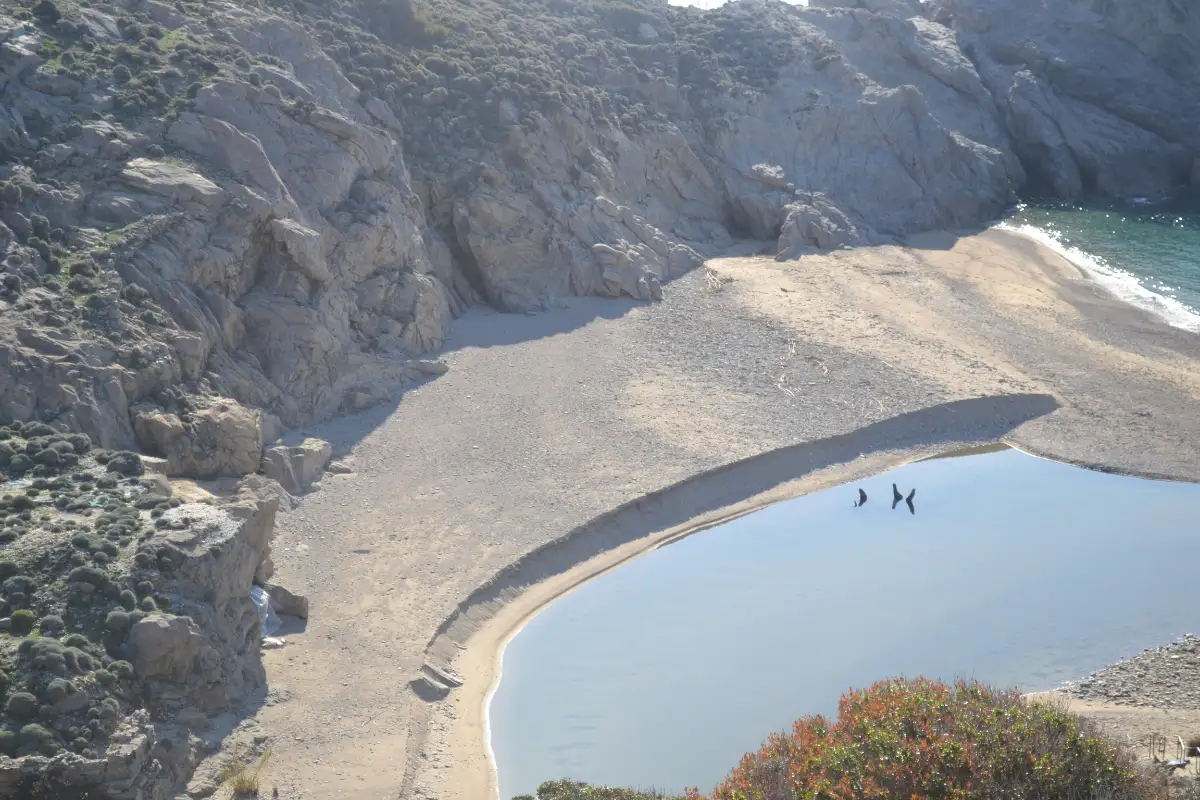
The honest part the beach lists skip is the sea itself. When the meltemi, the summer north wind, blows, the north-coast beaches, Nas and Messakti especially, get strong currents and real surf, and Messakti is gentle and shallow close to shore but can pull harder further out. None of that puts the beaches off-limits; it makes them beaches to read before you swim. Look at the wind and the water, watch what the sea is doing that day, and keep children in the shallows. What the Greek sea is actually like, and how the meltemi behaves, is covered in what the sea is like.
If these northern beaches are why you are coming, Armenistis is the natural base: a small coastal village within reach of Nas, Messakti and Gialiskari, close enough that the beach is a short drive rather than an expedition.
Panigiria: the all-night festivals that fund the village
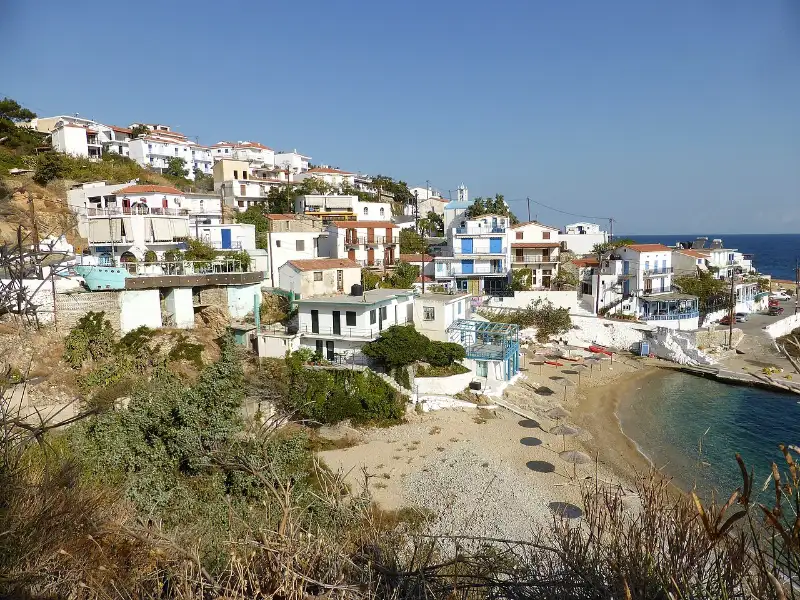
A panigiri is a Greek Orthodox saint’s-day festival, and on Ikaria it is the island distilled: a whole village gathers for an open-air feast with live music, circle dancing, grilled food and local wine that starts late in the evening and runs until sunrise. The money it raises stays in the village.
These feasts are tied to the church calendar and spread across the warm months, roughly May to October, with the dense run falling between mid-July and early September and the biggest of them clustered around the fifteenth of August, the feast of the Dormition. The music is live and local, violin, lute and the tsabouna, the island bagpipe, and the dancing is the ikariotikos, a circle dance that pulls in everyone who can stand. Nobody is performing for tourists; you are a guest at a village party.
The part that sets Ikaria apart, and that most guides leave out, is where the money goes. The panigiria are run by volunteers, and their proceeds are ploughed straight back into the village that throws them: the road, the church, the school, the clinic. Local and Greek-culture sources, from travel.gr to the Friends of Ikaria and the Greek Gastronomy Guide, trace the custom to the island’s mid-twentieth-century self-reliance, when a poor and often cut-off community learned to fund what it needed itself. When you buy your plate of goat and your carafe of wine, you are not being charged so much as chipping in.
Dates move from village to village and year to year, so the useful advice is not a schedule but a habit: ask locally when you arrive, or check a current island calendar, rather than trusting a printed list. Join the circle when the dancing starts, buy the food and the wine because that is the whole point, and treat it as the community event it is. The wider rhythm of Greek festival season and the fifteenth of August is in Greek Easter and August, and the etiquette that travels to any village feast is in Greek etiquette and customs.
The hot springs at Therma
Just east of Agios Kirikos, the village of Therma is built around naturally hot mineral springs that people have bathed in since antiquity, around what the official tourism site calls the organised facilities of the ancient spa town. Some of the water surfaces free and open-air, warm pools bleeding into the sea where you can sit for the price of nothing; others feed organised bathhouses, both public and private, in and around the village and at Lefkada-Xylosyrti further along the coast.
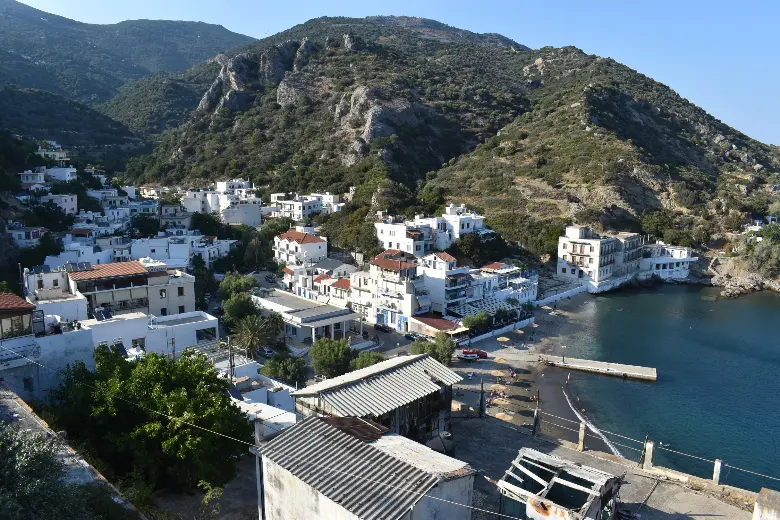
What makes Therma unusual is the water itself. The official Ikaria tourism site, drawing on municipal survey data, ranks these among the most radioactive natural springs in the world, and says the radiation is due mainly to radon, a naturally occurring radioactive gas. The same source puts the water between about 31 and 58 degrees Celsius, which is why the springs are usable through much of the year.
Radon and radioactivity sound alarming, and the springs’ long list of claimed cures sounds miraculous, and the honest position is to hand you neither. Radon is a naturally radioactive gas; that is a plain fact, not a warning the sources attach to bathing here. The therapeutic benefits credited to the water are a longer list than most visitors expect - arthritis and rheumatism, gout, respiratory, kidney and gynaecological complaints - and the honest thing to say about that list is where it comes from. It is published by a tourism body, not drawn from clinical trials. We report the practice and its reputation; we do not certify a cure, and we do not invent a hazard the sources do not state. Bathe if it appeals and decide for yourself, and if you have a medical condition, take a doctor’s advice rather than folk advice. General notes on pharmacies and health care in Greece are in pharmacies and health.
Food, wine and Ikarian honey
The Ikarian table is the way of living in edible form, and you do not have to believe the health claims to eat well from it. The everyday mountain diet leans on wild foraged greens, horta gathered from the hillsides, alongside beans and lentils, seasonal vegetables, good olive oil, sourdough bread, goat’s milk over cow’s, herbal mountain teas and not much meat. These are the same foods the longevity researchers keep pointing to, which is less a coincidence than the point: the diet came first, and the studies followed it.
Ikaria honey is the island’s most famous edible and a genuine daily staple, not a souvenir invented for visitors. The prize is anama, a monofloral heather honey from the Erica manipuliflora bush that grows high on the mountain, dark and intense, and there is fine pine honey too. Ikarian honey earned its wider fame when Dan Buettner named honey among the island’s longevity foods in his Blue Zones reporting. Take that as a reason it is worth trying and worth carrying home, not as a medical promise: the stronger claims you will read, that this honey fights cancer or outperforms others in antioxidants, rest on sellers and single studies, and we would not bank on them. Buy it as an excellent local product, which it plainly is.
Ikaria has a long wine history and a handful of small, often organic wineries that welcome visitors; ask locally which are pouring rather than chasing a name off a list, because the small ones come and go. And somewhere in all of this is the slow Greek coffee that punctuates an Ikarian day, taken sitting down, unhurried, in no rush to be finished, which is as good a summary of the island’s pace as any. More on how Greeks actually eat and drink is in Greek food and drink.
When to go
Ikaria’s calendar sets up a real choice, because its best cultural season and its busiest season are the same weeks. Mid-July to early September is panigiria time, with a warm sea and a village feast most nights; it is also the most crowded stretch, and the one when the north coast is most likely to be windy.

Diagram by Greece Trips. Free to reuse with credit - CC BY 4.0.
June and September are the sweet spot for most travellers: the sea is warm, the beaches have room, and the island is awake without being full. Spring, roughly April into early June, is the season for walking, when the mountain is green, the wild greens are at their best and the gorges run, though the sea is still bracing. Winter is very quiet, with thinner ferry schedules and many services closed, which suits solitude and little else.
So come in high summer if the festivals are what you are here for and you will trade crowds and wind for them; come in June or September if you want the beaches and the warmth with more space; come in spring if you are here to hike. The wider logic of Greek seasons is in the best time to visit Greece, and the case for the shoulder months specifically is in shoulder season in Greece.
Who Ikaria is for, and who should skip it
Ikaria is a filter, and it is more useful to tell you who it disappoints than to sell it to everyone.
It rewards slow, independent travellers who are happy to drive themselves and set their own hours. It suits hikers, returning Greece hands who have done the postcard islands and want something rougher, the Blue-Zone-curious who want to see the way of life rather than buy a wellness week, and anyone who would rather be at a village panigiri than a beach club. Island-hoppers pair it naturally with Samos next door.
It is the wrong island for a traveller who wants manicured resorts, dependable luxury, a lively club scene or easy, predictable logistics. It is wrong for a short trip, because the ferry alone eats the better part of a day at each end, and wrong if you are chasing Instagram-ready infrastructure, because the beauty here is unpolished and the effort is real. Those are all fair things to want. Ikaria simply is not where you go to get them. If it fits into a longer route, see how it slots together on the itineraries page, or read up on its other North Aegean neighbour, Chios.
Practicalities before you go
A little preparation replaces a lot of friction on Ikaria. Carry cash: ATMs are few and cluster in the two ports and the larger villages, and a mountain taverna may not take a card. Expect island time, where shops and services keep their own hours and an afternoon shut is normal rather than a problem. Mobile and data coverage is fine in the towns and patchy up in the mountains and the gorges, so download your maps before you climb.
Medical care is basic: the island has a health centre and pharmacies for everyday needs, and serious cases are transferred off-island, which is one more reason not to build a trip here with no slack in it. And because the island is small and runs on its own community fabric, travel lightly: take your rubbish out of the wild coves, respect the water, and spend in the villages. The practical detail lives in cash and cards in Greece, staying connected and travelling light on the Greek islands.
Planning Ikaria around the island, not against it
The trick with Ikaria is to plan the logistics hard and then let go of them. Book the port that matches where you will sleep, rent a car or a scooter, pick your season around whether you want the festivals or the quiet, and carry some cash, and then stop planning. The island does not reward a packed schedule; it rewards the traveller who has arranged the practical bones of the trip and is then willing to let the days go slow. Do that, and Ikaria gives you exactly the thing it is known for. To build it into a longer Greek route, start with the itineraries.
Ikaria FAQ
Why do people in Ikaria live so long?
Researchers link Ikaria’s longevity to a cluster of habits rather than one cause: a plant-heavy mountain diet, constant gentle movement, afternoon naps, herbal teas, periodic religious fasting, close social ties and low stress. Ikaria is one of five places labelled a Blue Zone, popularised by Dan Buettner and studied by the University of Athens. These are documented associations, not a promise that visiting will extend your own life.
How do you get to Ikaria?
You reach Ikaria by a long ferry from Piraeus to one of its two ports, Agios Kirikos in the south or Evdilos in the north; by a shorter ferry from Samos, a little over an hour from Karlovasi and nearer two and a half to three from Vathy; or by a flight from Athens of about an hour to the island’s small airport. Book the port nearest your base, and confirm ferry times and fares close to your travel date, because they shift by season.
What are the panigiria festivals in Ikaria?
Panigiria are Ikaria’s all-night summer village feasts, held on Orthodox saints’ days between roughly May and October and peaking around mid-August. They bring live island music, the ikariotikos circle dance, communal food and local wine, running from late evening to sunrise. They are staffed by volunteers, and the proceeds fund the village. Dates shift by village and year, so check a local calendar on arrival rather than a printed schedule.
Are Ikaria’s hot springs safe, and what is the radon?
The Therma springs are naturally hot mineral waters and, according to the island’s tourism site, among the most radon-rich in the world; radon is a naturally occurring radioactive gas. People have bathed here since antiquity, and the therapeutic benefits credited to the water are published by a tourism body rather than established by clinical evidence. Whether to bathe is a personal call we are not in a position to certify; if you have a medical condition, ask a doctor.
What is Ikarian honey?
Ikarian honey is the island’s prized local honey, above all anama, a dark monofloral heather honey from the Erica manipuliflora bush that grows high in the mountains, along with pine honey. Locals eat it daily, and Dan Buettner named honey among Ikaria’s longevity foods in his Blue Zones work. Treat it as an excellent product to buy and bring home rather than as a cure; the stronger medical claims are seller-sourced and unverified.
Is Ikaria worth visiting?
Yes, if you want an unhurried, self-driven island with wild beaches, radon hot springs, all-night festivals and a documented culture of long, slow living, and you are happy to earn it with a long ferry and your own set of wheels. No, if you want polished resorts, nightlife, dependable luxury or an easy short hop. Ikaria is a deliberate choice, and it rewards the travellers who make it on purpose.
Plan by category
The Ikaria guides
2 guides, each scoped to a decision you actually have to make.
 Attractions
Things to do
See the attractions →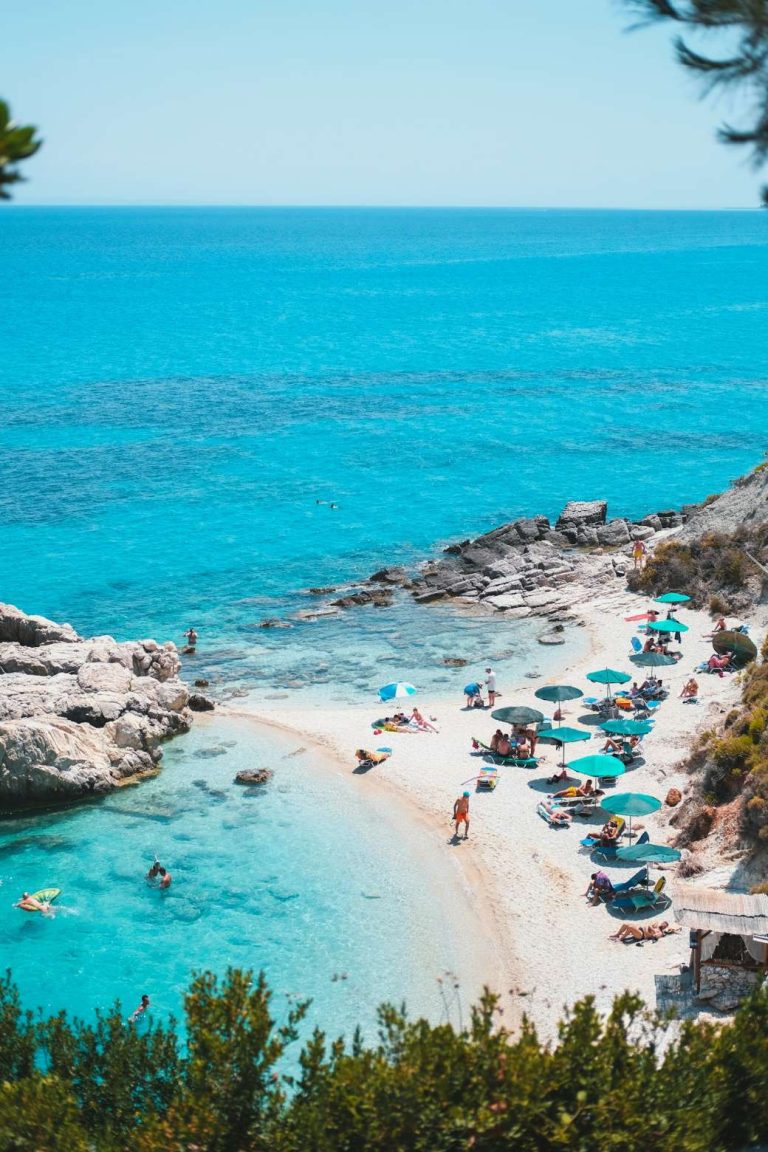 Beaches
The beaches
See the beaches →
Booking
We sell nothing and book nothing for you. Every guide on this page tells you how to arrange each piece yourself - which ferry operator, when to book, what to prebook and what to leave loose.