
Diagram by Greece Trips. Free to reuse with credit - CC BY 4.0.
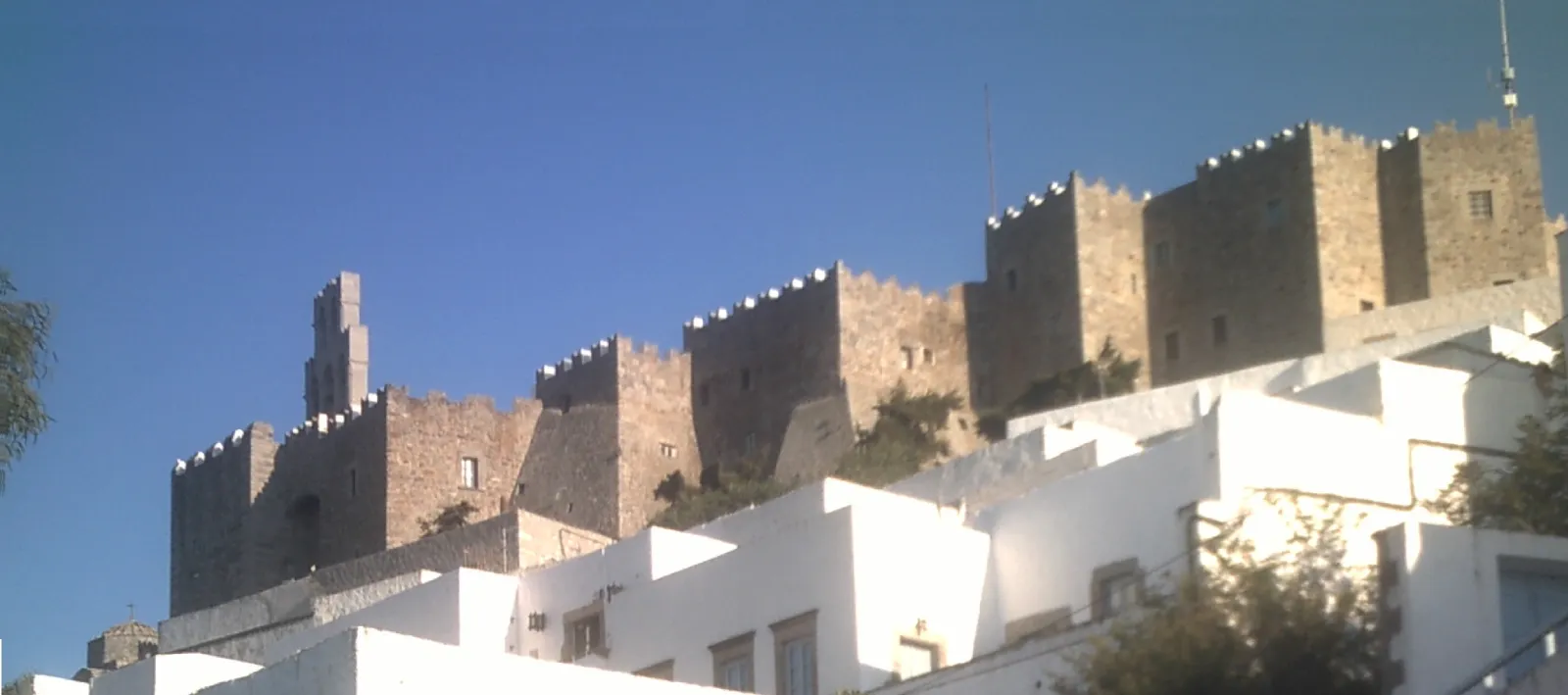
It was founded in the late eleventh century, commonly given as 1088 - though sources conflict, and we carry the date with that caveat rather than printing it flat.
One UNESCO site, three parts
The monastery is not listed on its own. Together with the town of Chora and the Cave of the Apocalypse it was inscribed on the UNESCO list in 1999 under a single name: the Chora of Patmos with the Monastery of Saint-John the Theologian and the Cave of the Apocalypse.
The cave and the monastery are best understood as one thing rather than two. They sit on the same hill, they share a schedule, and most visits take both.
The schedule that governs your day
The single most useful practical fact about visiting Patmos:
The monastery publishes one schedule covering itself and the cave: open every morning, shut in the early afternoon, reopening on only a few afternoons a week.
So mornings are the reliable window. If your ferry lands at lunchtime, that is a day to spend on Chora’s lanes or a beach and to visit the monastery the following morning instead.
We print no hours. That schedule is exactly the kind of fact that changes, and the shape of it is the durable part.
Why Patmos stays quiet
It has no airport. The island is reached only by ferry, which is the whole reason it is not busier - the nearest airports are Kos, Leros and Samos, and none of them is on the island.
That filter is also why Patmos suits a certain kind of trip and not another. Athens to Patmos calls it the long way to a quiet island, which is the honest framing.
Practical notes
Distance: roughly 145 nautical miles from Piraeus, and the direct crossing runs from about seven hours to twelve depending on the boat’s stops, often taken overnight.
The island: about 34 km² with roughly 3,300 residents (3,283 at the 2021 census). Its highest point is Profitis Ilias, 269 m.
When: June, July and September, with late May and early October quieter still. August is the hottest, busiest and priciest.
Modest dress applies, as at any active Orthodox house.
Common questions
When was it founded? Late eleventh century, commonly given as 1088 - but sources conflict, so treat the specific year as the common attribution rather than a settled fact.
Is it still a working monastery? It is an active Orthodox site, which is why the dress code and the schedule exist. Visit it on those terms.
Monastery or cave first? They share a hill and a schedule. Take the morning and do both.
Next
Our Patmos guide has the practicalities, the Cave of the Apocalypse covers the grotto below, and things to do in Patmos covers the island.