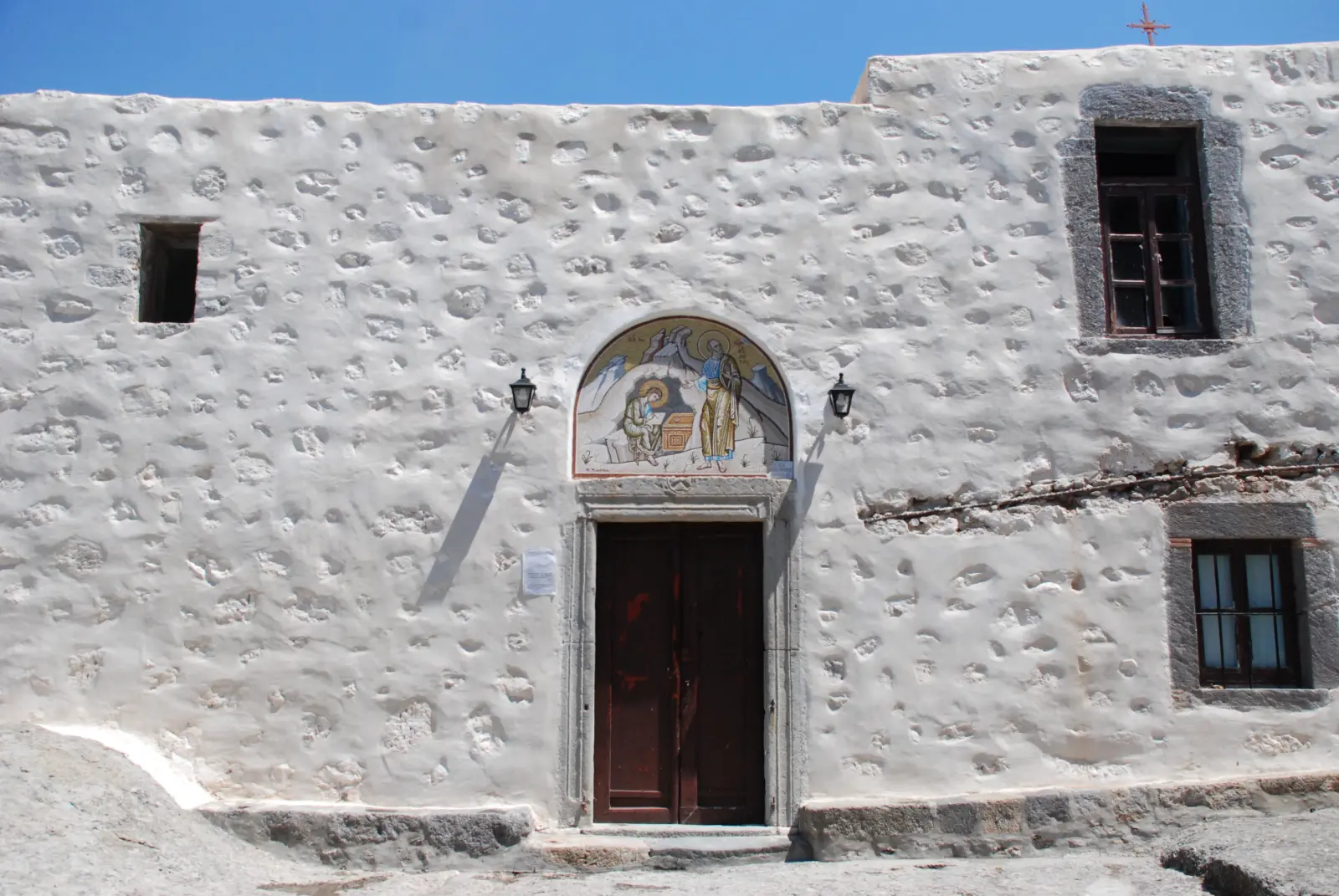
The Cave of the Apocalypse is a small rock grotto on the road between Skala and Chora, roughly halfway up the hill, where Christian tradition holds that John received the visions of Revelation.

Diagram by Greece Trips. Free to reuse with credit - CC BY 4.0.
What the page will and will not settle
The island’s weight comes from one sentence: “the isle that is called Patmos” (Revelation 1:9). That is why a bare-rock island of a few thousand people carries what it does, and why two very different kinds of traveller step off the same ferry.
None of this settles what the visions mean. That is a question for a different kind of book. What the island offers is the place itself, and this page describes the place.
We carry the attribution as our own guide does: tradition holds. It is not stated as established fact and it is not dismissed.
One site, not two
The cave and the monastery are best understood as one thing rather than two. Together with the town of Chora they were inscribed on the UNESCO list in 1999 under a single name: the Chora of Patmos with the Monastery of Saint-John the Theologian and the Cave of the Apocalypse.
So plan them as one visit. The Monastery of Saint John sits above, and Chora is the town around it.
The opening schedule is the thing to plan around
This is the practical fact that decides your day, and it is unusual:
The monastery publishes one schedule covering itself and the cave: open every morning, shut in the early afternoon, reopening on only a few afternoons a week.
Read that twice. Mornings are the reliable window. An afternoon arrival is a gamble unless you have checked which afternoons are open that week - and we print no hours here, because they are exactly the thing that changes.
Practical notes
Patmos has no airport. It is reached only by ferry - the nearest airports are Kos, Leros and Samos. It sits roughly 145 nautical miles from Piraeus, and the direct crossing runs from about seven hours to twelve depending on the boat’s stops, often taken overnight.
When: June, July and September; late May and early October quieter still. August is the hottest, busiest and priciest.
Modest dress applies at both the cave and the monastery, as at any active Orthodox site.
Common questions
Is this where Revelation was written? Christian tradition holds so. We carry that attribution rather than asserting it, and our guide is explicit that the meaning of the visions is not a travel page’s question.
Can I visit the cave without the monastery? They share a schedule and sit on the same hill. Most visits take both.
When is it open? Mornings reliably; only a few afternoons a week. Check the current schedule before you plan around an afternoon.
Next
Our Patmos guide has the practicalities, the Monastery of Saint John covers the house above, and things to do in Patmos covers the island.