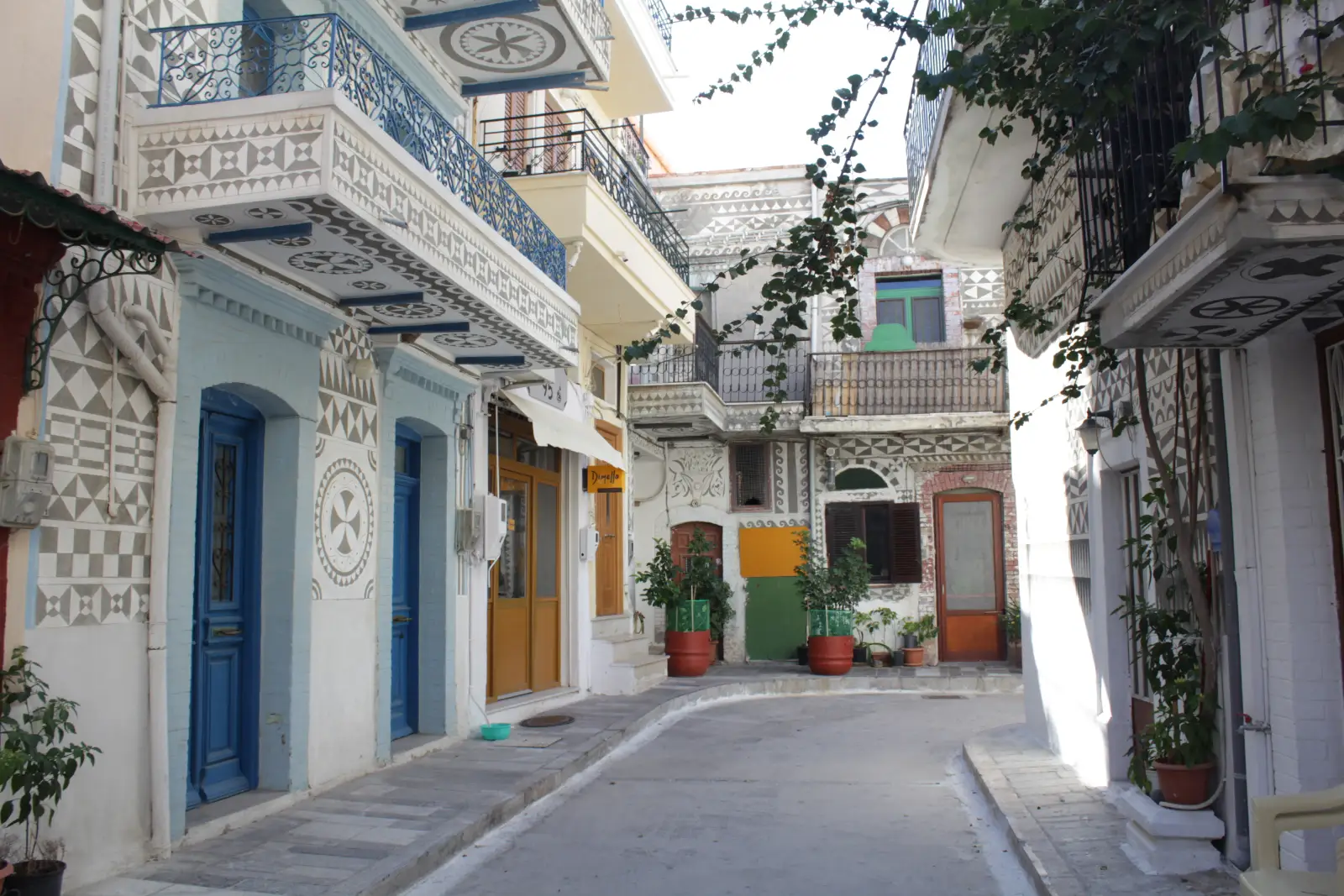
Pyrgi is scratched all over.

Diagram by Greece Trips. Free to reuse with credit - CC BY 4.0.
There is nothing else quite like a Pyrgi street in Greece.
Why it survives
The technique is durable in the truest sense. It is plaster, not paint, and it has been redone the same way for generations.
That is the difference between a decorated village and a restored one. Xysta is maintenance rather than heritage display, which is why the pattern is still sharp.
The pattern runs over every surface the eye reaches, balcony soffit included, and it changes band by band instead of repeating one motif. Look up as much as along.
Why the village is fortified at all
Pyrgi is one of the medieval villages of southern Chios, laid out as fortresses against pirates and raiders when mastic was worth more than the ground it grew on.
Chios is the only place on earth where mastic is commercially grown, and the villages exist in the shape they do because of that crop. Mesta, the other one worth planning around, took a different defensive approach: a closed pentagon of houses whose outer walls formed the perimeter.
Olympi, nearby, keeps the same fortified plan.
Doing it as a loop
The mastic villages sit only a short drive apart, roughly twenty minutes from one to the next, which makes them a natural half-day loop by car.
That is the right way to see Pyrgi - as one stop in a run of three, rather than a destination on its own.
Practical notes
Chios is toured by car, not walked from a single beach. It is one of the largest Greek islands, at 842 km².
Getting there: ferry from Piraeus six to seven days a week year-round, around eight hours direct and half a day or more on the multi-stop routing; a short flight from Athens; or the Cesme (Turkey) crossing, 20 to 30 minutes, year-round.
When: May, June and September, with early September the pick. August is hot and busy, largely with domestic and diaspora visitors.
Common questions
What is xysta? Black-and-white geometric plasterwork, carved through a dark top coat to the white below. Plaster rather than paint, and redone the same way for generations.
Is Pyrgi touristy? Chios is a large North Aegean island most international tourists skip. It rewards slow, culture-minded travellers and disappoints anyone after a party or a single-beach resort week.
Pyrgi or Mesta? Both, in the same half-day. They are twenty minutes apart and they are not the same thing - one is decorated, one is a maze.
Next
Our Chios guide has the practicalities, things to do in Chios covers the mastic villages and Nea Moni, and the beaches cover the coast.