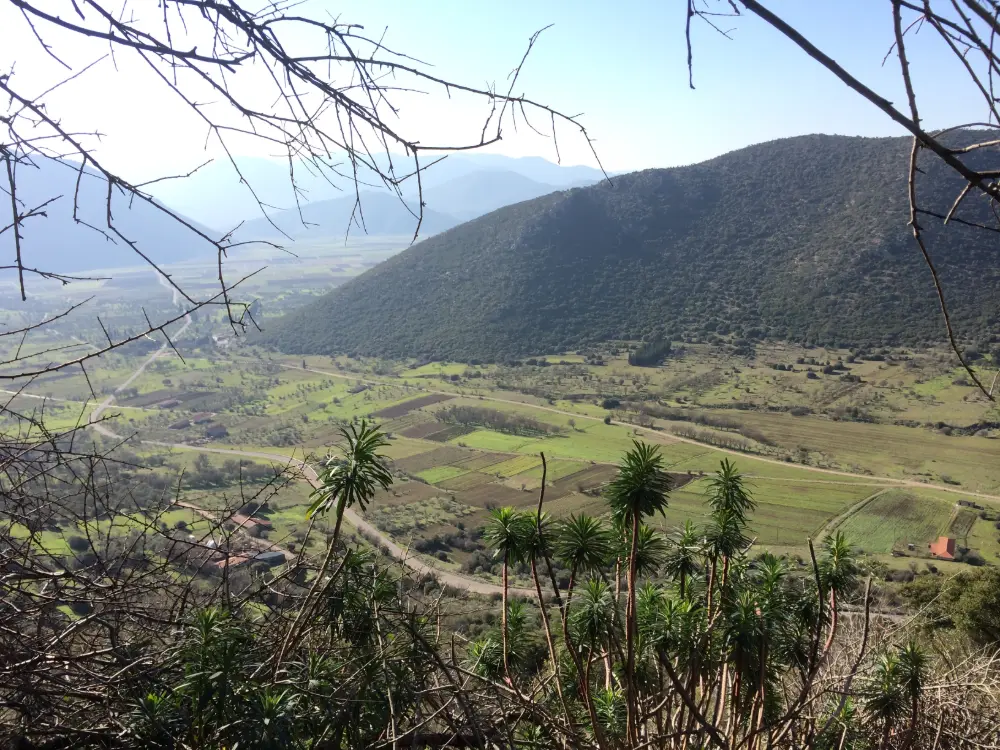
Tripoli sits on a high plateau in the middle of the Peloponnese at around 650 metres, ringed by mountains, and it is the point where the roads to Sparta, Kalamata, Patras, Nafplio and Athens all meet.

Diagram by Greece Trips. Free to reuse with credit - CC BY 4.0.
Very few people plan a night here. A great many people pass through, and it is worth knowing what is in it when you do.
The town
Modern, because it was burned in 1821 during the revolution and rebuilt afterwards. The centre is Areos Square, one of the largest town squares in Greece, planted with trees and used properly in the evening.
The archaeological museum, in a neoclassical building by Ernst Ziller, is better than the town’s profile suggests: finds from across Arcadia, including material from Mycenaean sites and the region’s sanctuaries.
Tripoli is a genuinely Greek provincial city, with almost no tourism infrastructure, which some people find refreshing and others find dull. It is honest either way.
What it is the junction for
This is the practical value:
- Sparta and Mystras, about an hour south.
- Dimitsana, Vytina and the Lousios gorge, about 45 minutes north-west into the mountains.
- Nafplio and the Argolid, an hour north-east.
- Kalamata, about an hour and a quarter south-west.
- Athens, about two hours on the motorway.
Mantineia and the mountains
Just north lie the remains of ancient Mantineia, with a visible circuit of city walls, and beside them a genuinely strange modern church, Agia Fotini, built in the 1970s from a mix of Byzantine, classical and folk elements that has to be seen rather than described.
The plateau is also wine country: the Mantinia appellation grows Moschofilero, an aromatic pink-skinned grape making dry white wine, and several producers take visitors.
Getting there and how long
On the Athens to Kalamata motorway, about two hours from Athens.
One night, usually as a break in a longer Peloponnese drive.
Last checked August 2026. Museum and winery hours change - see our editorial policy.
Common questions
Why do people go to Tripoli?
Mostly because the roads meet there. It is the junction between Athens, Nafplio, Sparta, Kalamata and the Arcadian mountains.
Is there anything to see in Tripoli?
The large Areos Square, a good archaeological museum covering all of Arcadia, and ancient Mantineia just north.
What wine comes from around Tripoli?
Mantinia, a dry white from the aromatic pink-skinned Moschofilero grape, grown on the plateau. Several producers take visitors.
Why is Tripoli a modern town?
It was burned in 1821 during the Greek revolution and rebuilt afterwards, so little of the older fabric survives.
What is Agia Fotini?
An unusual modern church near ancient Mantineia, built in the 1970s from a mixture of Byzantine, classical and folk elements.