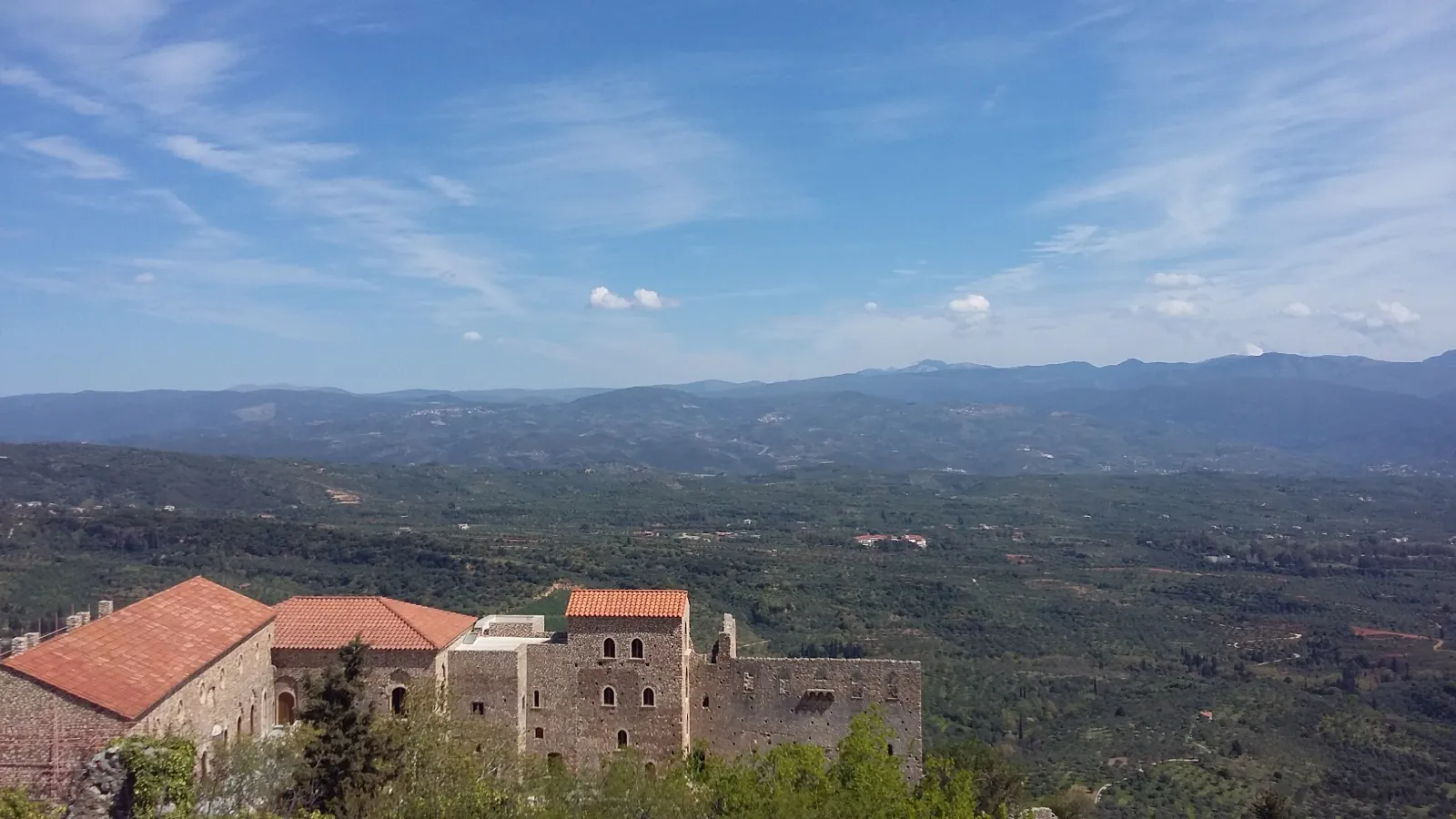
Mystras is the reason to be in the Eurotas valley. It is a complete late-Byzantine city on the steep flank of Mount Taygetos, five kilometres from Sparta, abandoned in the nineteenth century when the modern town was founded, and never built over since.

Diagram by Greece Trips. Free to reuse with credit - CC BY 4.0.
What that leaves is a hillside of churches, palaces, houses, cisterns and lanes, with the shell of a city still legible in them.
What is there
- The Palace of the Despots, a large complex around a courtyard, extensively restored over the past two decades, and the only substantial Byzantine secular palace to survive anywhere.
- The churches, which are the reason art historians come: the Metropolis, Perivleptos, Pantanassa and Afentiko, several keeping substantial fresco cycles from the fourteenth and fifteenth centuries.
- The Pantanassa convent, still occupied by a small community of nuns, and the one living building on the site.
- The Frankish castle on the summit, built in the thirteenth century before the Byzantines took the site over.
Why it matters historically
Mystras was the seat of the Despotate of the Morea and the last significant centre of Byzantine culture. The final Byzantine emperor was crowned here, and the city was a centre of learning in the empire’s last decades, associated with the philosopher Plethon whose teaching fed into the Italian Renaissance.
It fell to the Ottomans shortly after Constantinople, and it kept going in reduced form until the nineteenth century.
Visiting it
There are two entrances, upper and lower, and this is the practical decision of the day. Enter at the upper gate and walk down through the site; the alternative is climbing the whole hill.
The ground is steep, cobbled and uneven throughout, there is little shade, and a proper visit is two to three hours. Some churches close individually.
Getting there
Five kilometres from Sparta, about three hours from Athens by road, and roughly an hour from Monemvasia‘s side of the Peloponnese. Most people base in Sparta or in the villages below the site.
Last checked August 2026. Site and individual church opening hours change - see our editorial policy.
Common questions
What is Mystras?
An abandoned late-Byzantine city on the slope of Mount Taygetos near Sparta, with palaces, frescoed churches and a Frankish castle, never built over after it emptied.
Why is Mystras important?
It was the seat of the Despotate of the Morea and the last major centre of Byzantine culture, where the final emperor was crowned and where Plethon taught.
Which entrance should you use at Mystras?
The upper one. Entering at the top and walking down avoids climbing the entire steep hillside.
How long do you need at Mystras?
Two to three hours. The ground is steep, cobbled and largely unshaded.
Is anything at Mystras still in use?
Yes, the Pantanassa convent is still occupied by a small community of nuns.
Next
Read Sparta, Monemvasia, or Kardamyli.