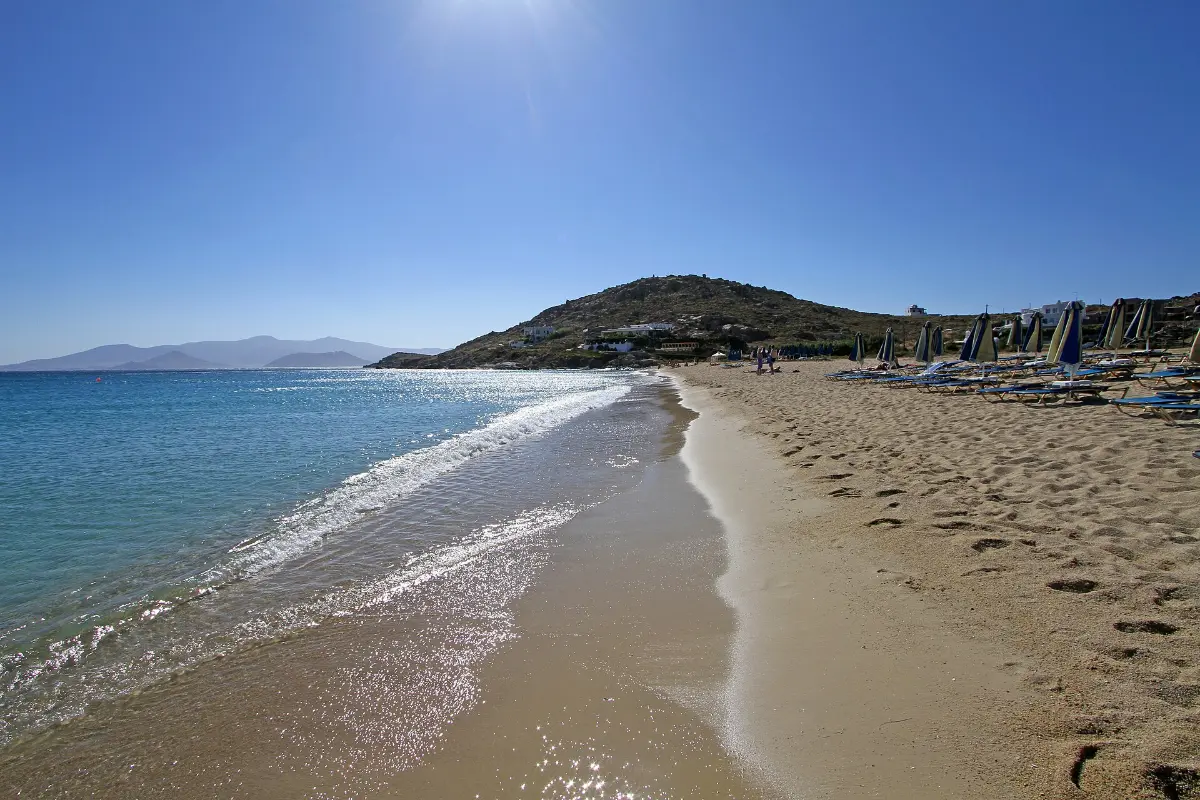
It runs along the island’s west coast a few kilometres south of Naxos Town: a wide sweep of pale sand backed by low dunes, with the sunbeds, tavernas, mini markets and rental shops gathered behind it. On a coast that gets progressively wilder the further south it goes, this is the organised end.
The sand, the shelve and the water
The sand is coarse rather than powdery, and that matters more than it sounds. It drains quickly, it does not cake onto you, and it stays walkable through the afternoon in a way fine sand does not. Behind the beach it piles into low dunes.
The seabed is sand too, and it shelves gradually, so the shallow water carries a long way out from the shore. Over that bottom the sea reads pale turquoise and then deepens as the floor drops away. On a still morning you can stand chest-deep and see your own feet.
That gradient is why families collect here, and it is the honest reason to pick this beach over the emptier ones further south. What this page will not do is tell you the water suits your children. The sea moves, sandbars shift through a season, and that judgement belongs to the person standing in it, to the flag and to any lifeguard on duty. It is not a certificate a web page is in a position to issue.
The salt pan behind the sand
Behind the beach sits an old salt pan, known locally as Kokkini Limni, the red lake. Naxos worked salt here, and the shallow water it left draws herons and other wading birds.
It is a short detour rather than an attraction, and it repays an early start.
How it joins the rest of the coast
Agios Prokopios is not a self-contained bay. A low rocky point and a small fishing harbour separate it from Agia Anna, and the sand picks up again on the far side, so the two work as one strip you walk between rather than drive.
South of Agia Anna the dunes take over and the same coast becomes Plaka, which is this beach with the facilities stripped out and the length turned up. Northwards the strip runs back towards Naxos Town, the harbour and the Portara standing on its islet by the port.
The west-coast bus out of Naxos Town serves this stretch, which is what makes a car-free beach stay realistic here, and part of why the island keeps coming up in the best Greek island for first-timers.
Wind, and the thing that spoils a day here
The meltemi comes down from the north through high summer and runs along this coast rather than straight into it. Agios Prokopios is not the most exposed beach on Naxos.
It is not sheltered from the wind either. On a hard meltemi day the sand travels, the water roughens, and umbrellas become a two-person job. The dunes and the rocky point take some of it off the northern corner, so look at the wind before you commit to a stretch of coast. The gradient down the whole west side is laid out in the best beaches in Naxos.
Who it suits
Come here on a first Naxos trip, on a stay without a car, with a mixed group who want different things within a hundred metres of each other, or on any day when you would rather buy lunch than carry it.
Keep driving if what you want is empty sand. This beach fills in July and August, the umbrella rows go up early, and that is the trade you make for having everything on hand. The Naxos guide sets out how the island’s beach coast and its mountain interior divide a trip between them.
The booking that matters for this stretch is a room behind the sand in the peak weeks, and the ferry that gets you to the island.
Last checked July 2026. No price, timetable, water temperature or distance in minutes appears on this page by design.