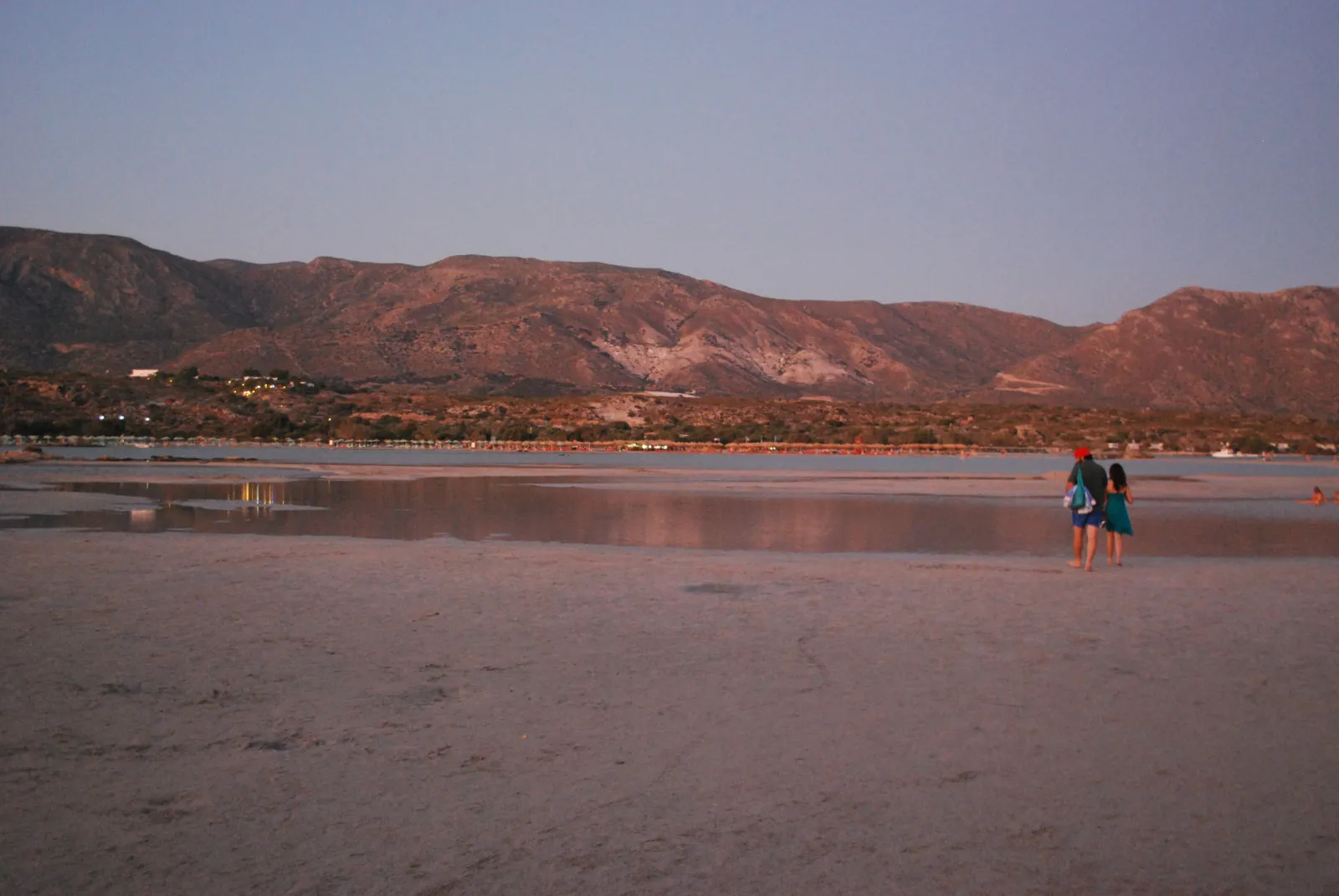
Where
The far southwest corner of Crete, Chania regional unit; a shallow lagoon between the mainland and a low islet
From Chania
Roughly 75 km, close to two hours each way, via the Topolia gorge on a narrow winding road
Protection
In the Natura 2000 network. Taking sand, shells, plants or animals is prohibited. The dunes hold Androcymbium rechingeri, a priority species under the EU Habitats Directive found in three places on earth
The sand
White to patchy rose pink, coloured by crushed shell rather than mineral. The Region of Crete’s own record lists it as white sand
Facilities
Lifeguard service and a Blue Flag listed; natural shade: none. Rented sunbeds and umbrellas on the organised stretch; paid parking set back from the beach
Best hours
Early. The coaches and hire cars converge through the late morning, and it is busy in July and August in proportion to its fame
Travel details last checked July 2026.
It sits in the far southwest corner of Crete, roughly 75 km from Chania but close to two hours each way by road, because the route climbs through the Topolia gorge and stays narrow and winding most of the way. What you find at the end is a shallow turquoise lagoon between the mainland and a low islet, with sand that runs from white to a patchy rose pink.
The area is in the Natura 2000 network. The dunes behind the sand are fenced and crossed by boardwalks, and taking sand, shells, plants or anything else out of the area is prohibited. Those are not decorative rules, and the reason for them is genuinely interesting rather than bureaucratic.
What the pink actually is, and why it is patchy
The colour does not come from the rock. It comes from crushed shell.
The sand at Elafonisi is mixed with the broken remains of marine organisms, and the standard explanation attributes the rose tint to foraminifera, single-celled creatures whose fragmented shells are pink. We are attributing that rather than asserting it, because we found no scientific or official source for the mechanism, only a very consistent travel-field account. What is uncontested is the general point: the colour is biological debris, not mineral, and it washes and drifts.
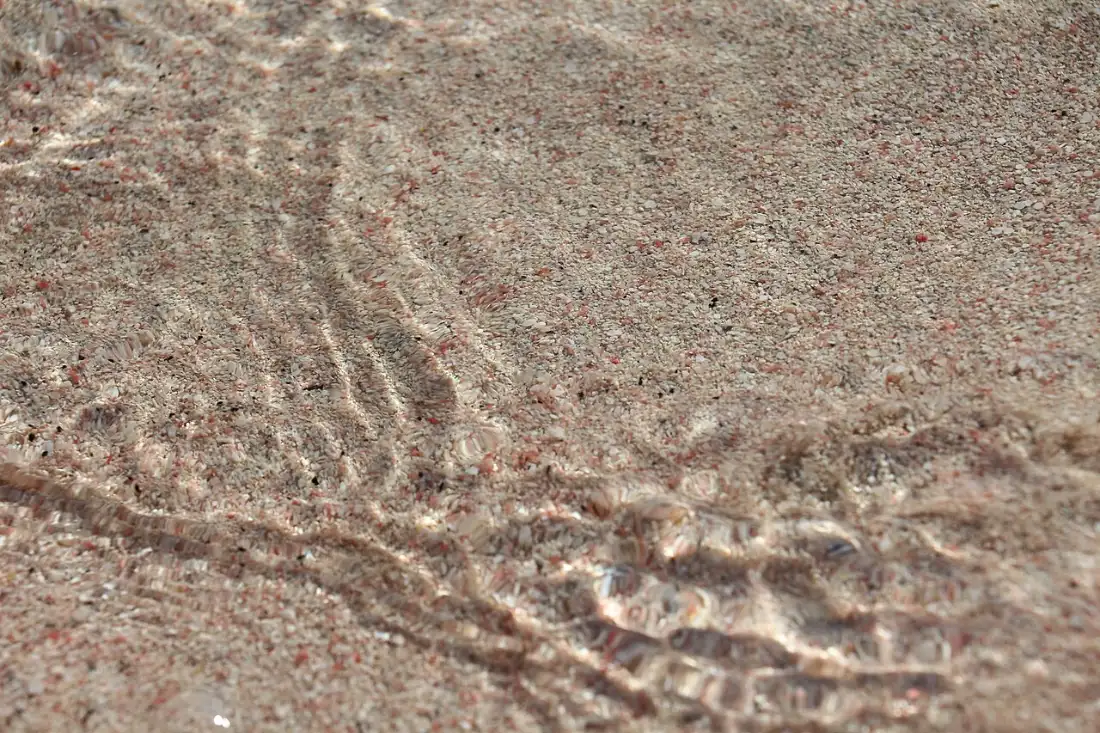
Which is why the pink is patchy rather than uniform, and why it concentrates in some places and some months more than others. It is a deposit, and deposits move.
Set your expectations accordingly, and here is the most honest source we can give you for that: the Region of Crete’s own tourism record for Elafonisi describes the beach as white sand. It does not call it pink at all. The photographs you have seen are real, taken in the right patch at the right moment, usually with the colour helped along a little. The place is remarkable. It is not uniformly rose-coloured, and going expecting that is how a two-hour drive turns into a disappointment.
Why you may not take any of it
Now the rule that people break without meaning to, and the reason it exists.
Removing sand, shells, plants or animals from Elafonisi is prohibited. It is a protected area, the prohibition is enforced, and travellers have been stopped and fined over jars of Greek beach material. We are not printing a figure, because press reports give different ranges and we did not read any legal instrument. The point does not need a number: do not fill a bottle, and if a child fills one, empty it before you leave.
The reason is worth two minutes, because it makes the rule make sense.
The dunes behind the beach hold Androcymbium rechingeri, a plant that grows at Elafonisi, at Falassarna and on the islet of Imeri Gramvousa, and nowhere else in the world. CretaPlant, the plant micro-reserve project run by the University of Athens Department of Biology, records it as listed on the EU Habitats Directive as a priority species, protected under Greek Presidential Decree 67/81 and the Bern Convention, and classed as endangered in the Greek Red Data Book, with a plant micro-reserve covering the western part of the Elafonisi islet. Its recorded pressures are tourism-related.
You will not see it. It flowers in winter, roughly December to February, so a summer visitor is walking past bare sand that happens to be one of three homes on the planet for a species. That is exactly why the fences and the boardwalks are where they are, and it is a better argument for staying on the marked routes than any sign.
Stay on the boardwalks, take nothing out, and take your rubbish with you. The rules here are not about tidiness.
The lagoon, the islet, and what the water is doing
The shape of the place is a shallow channel of water between the mainland beach and a low sandy islet, with open sea beyond it.
That channel is what everyone photographs and what everyone wades. The Region of Crete’s own record describes shallow water, and on a calm day the crossing is a paddle. It is also a channel between an open coast and a lagoon, which means wind and sea state push water through it, and the depth and the pull are not the same on two consecutive days. This page cannot see the water you are standing in, and we are not going to rate the crossing in either direction. Look at what the water is actually doing when you get there, watch it for a minute before you commit, and note that the Region lists a lifeguard service on the beach.
Two things about that lifeguard listing, because people over-read it. It is an inventory entry, not a statement about conditions on your day, and its hours and season are not something we know. The same applies to the Blue Flag the beach carries: a Blue Flag is an award about water quality, facilities and environmental management. It is not a rating of the sea.
The islet itself is low, sandy and open. Walk out on it and you are on the seaward side of the whole system, which is the part of the visit most people skip and the part that explains the geography.
Then the fact that shapes a whole day out here, and it comes from the same official record: natural shade, none. There is nothing growing on that sand tall enough to sit under. Sunbeds and umbrellas are rented on the organised stretch, and beyond it you are in the open. Bring more water than you think, and treat the middle of the day as the hour to be in the sea or under something you paid for.
The organised end and the rest of it
Elafonisi is not one beach with one character, and knowing where the line falls saves you a walk.
The stretch nearest the car park is the organised one. That is where the rented sunbeds and umbrellas are, where whatever facilities the beach has are concentrated, and where the lifeguard service the Region lists is based. It is also where everybody is, because it is closest to where everybody parked. We are not going to print an inventory of what is open on the day you come, because nobody publishes one and it is a seasonal trade.
Walk on, and the furniture stops. The further stretches along the lagoon and out onto the islet are open sand with nothing on them, which is quieter and also means no shade, no water, no toilets and nothing to sit on but what you brought. Both versions of the beach are legitimate. They are just very different days, and the one you get is decided by how far you are willing to carry your things.
Between and behind them is the dune system, and this is where the boardwalks and the fencing matter. The marked routes exist to keep feet off the vegetation, and the vegetation is the reason the whole area is protected. Cross the dunes rather than walk along them, and use the walkways where they are laid.
One thing we will describe carefully rather than confidently. The Region of Crete’s record answers its accessibility field for Elafonisi with a yes. That is a yes or no box on an official inventory and it comes with no description of what is actually provided, how far it reaches, or whether it covers the walk in from the car park as well as the beach itself. Those are exactly the details that decide whether the trip works for a wheelchair user, and we have not seen them stated anywhere. If that is your question, it is worth putting to the municipality before committing to a four-hour round trip.
The drive is the real cost
This is a long way from anywhere, and pretending otherwise is how people ruin a day.
From Chania it is roughly 75 km and close to two hours, and the second half of that is a narrow mountain road through the Topolia gorge with blind bends and a good deal of climbing. From Heraklion or the eastern resorts it is not a day trip at all in any sensible sense. That drive is the single biggest input into whether this visit works, and our Chania guide treats Elafonisi as one of the two or three big days a west-Crete base is for.
Three practical consequences.
Go early. Not for the light, though that helps, but because the coaches and the hire cars converge through the late morning and the beach is genuinely busy in July and August in proportion to its fame. Leaving Chania at seven changes the day completely.
Come by car or by excursion bus, and know which you are doing. Our Crete guide makes the general case: you can see Crete’s cities without a car, but not Crete, and Elafonisi is the clearest example on the island. There is a bus, and the Region’s record confirms bus access, but we print no timetable and no fare because we read neither at an operator. If you are driving, renting a car in Greece and driving in Greece cover the road.
Park where you are told and walk in. There is a parking area set back from the beach with a short walk down to the sand, and the separation is deliberate: vehicles stay off the dune system. It is charged.
Nothing about Elafonisi is booked in advance at the beach level. What you book is the car or the excursion seat, and the day works or fails on the drive. What a Greece trip costs has the wider bands.
Who this trip is for
Be honest about the trade before you spend four hours on a road.
Elafonisi is worth it if shallow warm water and an extraordinary setting are what you came for, if you are travelling with small children who want water they can stand up in, or if you are the kind of traveller who wants to have seen the famous thing. The lagoon genuinely is unusual, the islet is genuinely worth walking, and on a still morning before the crowd it is one of the best mornings in Crete.
It is not worth it if you want a shaded, easy beach day close to your base, if you are staying east of Rethymno, or if you would resent four hours in a car for a beach. Crete has hundreds of beaches and most of them are closer to wherever you are sleeping. Which ones are worth which effort is a question our Crete guide frames by region rather than by ranking.
And if you go, go as a visitor to a reserve. Boardwalks, no souvenirs, nothing left behind. The pink sand is only there because it has not been carried away one bottle at a time.
Last checked July 2026. What gets re-checked on this page: the Region of Crete’s own record for the beach, the protected status and its rules, and the drive time carried from our Crete guide. No parking charge, sunbed rate, bus timetable or fine figure appears here by design. How we date and correct facts is in our editorial policy.
Common questions
Why is Elafonisi beach pink?
The colour comes from crushed shell rather than from the rock. The sand is mixed with the broken remains of marine organisms, and the tint is usually attributed to foraminifera, whose fragmented shells are pink. We attribute that explanation rather than asserting it, because we found no scientific or official source for the mechanism. The practical consequence is that the pink is patchy and moves: it is a deposit, and deposits drift. The Region of Crete’s own tourism record describes the beach as white sand, which is worth knowing before you drive two hours.
Can you take sand from Elafonisi?
No. Elafonisi is a protected Natura 2000 area, and removing sand, shells, plants or animals is prohibited. It is enforced, and travellers have been fined over jars of Greek beach material. The reason is not tidiness: the dunes hold Androcymbium rechingeri, a plant recorded as growing at Elafonisi, Falassarna and the islet of Imeri Gramvousa and nowhere else on earth, listed as a priority species under the EU Habitats Directive with a micro-reserve on the Elafonisi islet. Stay on the boardwalks and take nothing out.
How far is Elafonisi from Chania, and how long does the drive take?
Roughly 75 km southwest, and close to two hours each way, because the route climbs through the Topolia gorge and stays narrow and winding for much of its length. That is the real cost of the day and the thing to plan around: leaving early is what separates a good visit from a crowded one. From Heraklion or eastern Crete it is not a sensible day trip.
Is there shade at Elafonisi?
The Region of Crete’s own record for the beach answers the natural-shade field with a flat no. Nothing grows on that sand tall enough to sit under. Sunbeds and umbrellas are rented on the organised stretch, and away from it you are entirely in the open. Carry more water than you expect to need, and plan to be in the water or under something rented through the middle of the day.
Can you walk across to the Elafonisi islet?
People wade the channel between the beach and the islet, and the Region’s record describes shallow water. It is a channel between an open coast and a lagoon, though, so wind and sea state move water through it and the depth is not the same on two consecutive days. No page can see the water you are standing in, so we describe it and rate nothing. Look at what the water is doing when you arrive, and note that the beach has a lifeguard service listed, whose hours and season we do not know.
Is Elafonisi worth visiting?
Yes if the shallow warm lagoon and the setting are what you want, if you are travelling with small children who want water they can stand in, or if you are staying around Chania and have a car. No if you are based east of Rethymno, if you want a shaded easy beach close to your hotel, or if four hours in a car would sour the day. It is one of the best mornings in Crete if you arrive early and one of the more crowded afternoons in Crete if you arrive at noon in August.
What does the Blue Flag at Elafonisi mean?
The Region of Crete’s record lists a Blue Flag for the beach. A Blue Flag is an award covering water quality, facilities, environmental management and information, and it is routinely misread as a rating of the sea itself. It is not one. Nor is the listed lifeguard service a statement about conditions on any given day. Treat both as facts about the beach’s provision, and read the water yourself.
Booking
We sell nothing and book nothing for you. Every guide on this page tells you how to arrange each piece yourself - which ferry operator, when to book, what to prebook and what to leave loose.