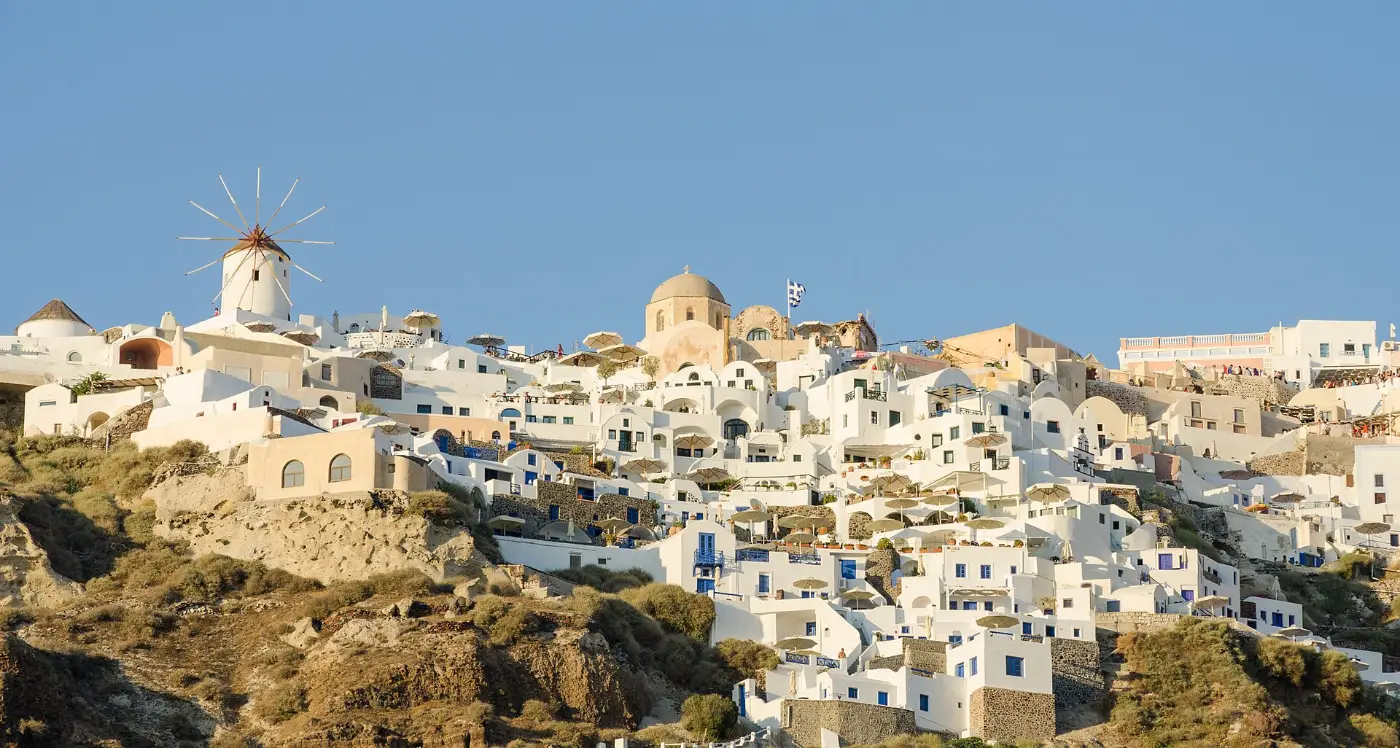
Search Oia Santorini Greece and you get the same picture a thousand times: white houses stacked on a cliff, blue domes, an orange sea, and nobody in the frame. On the evening you are booked for, the frame is full of people.
Here is the shape of it. In season, the western tip of Oia Santorini starts filling from mid-afternoon: onto the ruined castle at the point, along the clifftop walkway behind it, onto the booked terraces above, and down at sea level in Ammoudi. People arrive over an hour or two. They leave in about twenty minutes, through the same road.
So this is not a list of viewpoints. It is where the crowd stands, when each surface fills, and how the village empties.
The light really is that good and the event really is mobbed, and both are true on the same evening. The only thing that decides which one you get is when you arrive and when you leave. The island around it is in the Santorini guide.

Diagram by Greece Trips. Free to reuse with credit - CC BY 4.0.
Where the crowd actually stands
Ask where to watch the sunset in Oia and every page hands you the castle. The crowd forms on four surfaces, and they are four different evenings.
- The castle ruins, on the point: the postcard, standing room, and it fills first and hardest.
- The rim walkway behind it: the same sun, a thinner crowd, and it keeps moving.
- The terraces above: a seat and a clear horizon, if you booked one.
- Ammoudi, at sea level: no caldera panorama, and the sun going into the water in front of you.
The castle is the ruined Venetian fort of Agios Nikolaos, also called Fort Londsa, part of the same defensive system as Pyrgos. What survives is a small stone platform on the point, and the most thorough guide to the village calls it the most photographed and most crowded single spot on the island.
The walkway is the pedestrian street tracing the caldera edge back into the village, and most people end up on it whether they planned to or not. The same sun is in it. That guide puts the alternative plainly: the street directly below the castle “gives a similar view with a noticeably thinner crowd”. It is a thoroughfare rather than a grandstand, so you can arrive late, find a gap at the wall, and still see it.
The terraces above sell the same sky with a chair under it. We name none of them: this season’s terrace is next season’s rebrand, and a page built on venue names lies to its next reader. A seat on the rim at sunset is a booked seat, priced as one, days ahead. What that does to a budget is in what a Greece trip costs.
The blue domes are a viewpoint on the walkway rather than a monument, and the church beneath them is a working one. They also make the crowd’s shape visible. One first-hand account found the viewpoint “very, very busy” at 6.45pm and holding four or five people by 7.30pm, because everyone migrates to the castle as the sun drops. Those clock times are one evening in one season, not a timetable: sunset moves by well over an hour across the year, and the crowd moves with it. The crowd moves, and the surfaces empty in sequence.
All four surfaces sit on the edge of a cliff, in a village built down its face. We describe that ground and we do not rate it, in either direction: certifying a cliff path is not something we are in a position to do.
When it starts filling, and what decides how big it gets
Two things set your evening, and neither is the month on your booking.
The first is the sun, which keeps no office hours. Sunset moves by roughly two hours between midsummer and the shoulder months, so every arrival time you read is meaningless until you anchor it to your own date. We print no sunset times here, for the same reason we print no bus fares: a number that changes daily makes a page that is wrong most of the year.
How far back you need to work depends on the surface, and the sources disagree. For the castle ruins in high season the most thorough guide says at least two hours before sunset, earlier at the peak; other first-hand accounts say an hour to ninety minutes. Those are travellers’ numbers rather than an authority’s, because nobody sells a ticket to a horizon. The castle fills first and hardest and the walkway fills last, so if the walkway will do, you can arrive close to the hour.
The second thing is the ship schedule. Cruise calls and coach tours feed the crowd through the afternoon, and our island guide already records cruise ships pushing thousands of day-trippers into Fira and Oia around midday. Four ships in on a Tuesday in June beats one on a Saturday in July.
Policy is now pushing on that lever. Press and trade reporting describes a daily ceiling on cruise passengers at Santorini, run through the port’s berth slotting, and a seasonal cruise levy that is higher here than at most Greek ports. We could not open a ministerial decision or a port fund publication for either, so we print no figure for the cap and none for the levy. Fewer cruise passengers on the busiest days than in 2023 and 2024 is a reported pattern, not a promise about your evening.
The shoulder months have the same sun and a fraction of the crowd: which month buys which trip is in when to come to Greece.
The twenty minutes after, which is where the evening goes wrong
The sun goes down and the village empties almost at once.
Within twenty minutes the castle platform, the walkway and the whole western end of Oia pour back east through the lanes into one road, one bus stop, a coach park and a taxi rank, all trying to move a crowd that arrived over two hours and is leaving in twenty minutes. Our island guide is blunt about what that does to the buses and about the size of the island’s taxi fleet, and those numbers live there rather than here: how you actually get around Santorini.
So here is the recommendation this page exists to make. Do not leave with the crowd.
Stay. The twenty to forty minutes after the sun has gone are the best of the day: the sky holds its colour, the lights come on along the caldera, and the lanes empty. The photography guide puts the best light in the 20 to 30 minutes after sunset, once the lights come on, and the evening after the crowd goes reaches the same conclusion from the other end of the night. Eat, walk the rim in the blue hour, and take a bus that is not full.
If you truly cannot stay, leave early rather than late: walk away as everyone around you raises a phone. You give up the last four minutes of the sunset and you buy back an hour.
We sell you nothing here, and none of this is a reservation. The order that fixes an Oia evening is the boring one: settle where you sleep first, because on this island the bed decides the transport.
Ammoudi, at the bottom of the steps
Ammoudi is the small port at the foot of the village on its west side: tables at the water, a rock edge people swim off, fishing boats, and the crossing to Therasia. Oia’s other harbour, Armeni, is on the south side.
From sea level it is a different event. You give up the caldera panorama and the postcard, and you get the sun landing in the water at eye level, with a table under you that you booked.
Three ways down, described rather than rated.
On foot, down the stepped path from the castle end. Wikipedia gives 300 steps to the port, and a first-hand account points out that each step is really a set of shallow risers, so you put a foot down a good deal more than 300 times. It is a long stepped descent down the open face of a caldera wall, and what goes down comes back up unless you take the road.
The path is a working animal path. Donkeys and mules use those steps, and people and animals share the same stones. That is a fact about the ground and not an instruction: whether you ride one is your decision, and we are not going to make it for you in either direction.
By road, which runs down to the port and carries taxis and cars. By water, because Ammoudi is a working port: the Therasia boat goes from it and caldera boat trips use it.
We rate none of it. Not the steps, not the descent, not the climb back. You are the only person who knows what you can do on a cliff path.
Dinner belongs on the restaurants page rather than this one. The tables at the water are where a good part of the village walks down at six o’clock, and they fill.
The other twenty-two hours
About a thousand people live in Oia: 1,087 at the 2021 census, 838 in the community proper. On a summer evening the crowd is a large multiple of that. We could find no published count of the sunset crowd itself, so we print none, and the census figure stands as the scale check.
For most of the day the village is not doing this. Before the coaches and the ships arrive, the lanes are empty and the light on the white houses is the reason anybody came. The morning and the blue hour are the same insight at opposite ends of the day.
What is here when you can see it: the castle ruins at the tip, the old windmill from half the postcards, the maritime museum in a restored nineteenth-century captain’s mansion with its figureheads, charts and ships’ models, and the whitewashed cubic houses with cave rooms cut back into the rock. We print no opening hours. Hours rot, so check them for the day you go.
Oia was a shipowners’ village, and the 7.8-magnitude earthquake of 9 July 1956 wrecked it: the population fell to 306 by 1977. What stands today was rebuilt, and then rediscovered.
Walking in from Fira along the caldera path is the best arrival there is, and the Santorini guide carries the distance and the hours. The island’s other headline sight is the Bronze Age town at Akrotiri.
Arrive early or stay late
The light is that good. The crowd is that big. Both are true, and you cannot change either one.
What you can change is your two timestamps. Oia rewards the visitor who is there before the crowd or after it, and it punishes the one who arrives at the last minute and leaves at the first. Pick your surface, look up the sunset for your own date, arrive early enough for the surface you picked, and then stay half an hour longer than the people around you.
Last checked July 2026. The only thing on this page that moves is the cruise policy. The rest of it is stone.
Oia Santorini FAQ
How early should you arrive in Oia for the sunset?
It depends on the surface you want, and the guidance genuinely disagrees. For a place on the castle ruins in high season the most thorough independent guide says at least two hours before sunset, earlier at the peak; other first-hand accounts say an hour to ninety minutes. For the walkway behind it, far less.
Work backwards from the sunset time for your own date, which moves by roughly two hours across the season, and allow more if several ships are in.
Where is the best place to watch the sunset in Oia?
That depends on what you are willing to spend, in time or in money. The castle ruins are the most photographed and the most crowded. The rim walkway a few metres back has almost the same sun with a thinner crowd, and it is where most people end up. The terraces above buy you a seat. Ammoudi, at sea level, is a different event altogether.
Is the Oia sunset worth it?
Yes, and here is the trade. The light is genuinely extraordinary and the event is genuinely mobbed, and the visitor who arrives early or stays late gets a different evening from the one who turns up at the last minute. The hour after the sun goes down costs nothing and is the best hour Oia has, and the same sky runs along the whole caldera rim. The island-wide version of the question is in the Santorini guide.
How do you get from Fira to Oia?
By KTEL bus, by taxi, by car, or on foot along the caldera path. The fares, the frequency and the walking time are on the Santorini guide rather than here, because they are the island’s numbers and not this village’s. The one thing to know is that the sunset-hour buses are the pinch point in both directions, because everyone on the island wants the same trip at the same time. How the country’s buses, taxis and transfers work is in getting around Greece.
How many steps are there from Oia down to Ammoudi?
Wikipedia gives 300 steps from the village down to the port, and first-hand accounts point out that each step is really a set of shallow risers, so you put a foot down more often than that. Take it as roughly 300, attributed rather than certified. It is a stepped path down a cliff face, shared with working donkeys, and a road runs down as well.
How crowded does Oia actually get?
About a thousand people live in Oia, 1,087 at the 2021 census. On a summer evening the sunset crowd is several times that, concentrated onto a few hundred metres of clifftop at the western end of the village. Its size tracks the cruise and coach schedule rather than the month, and Greek policy has been capping and pricing cruise arrivals, so the busiest evenings are reported to be less extreme than in 2023 and 2024.
Booking
We sell nothing and book nothing for you. Every guide on this page tells you how to arrange each piece yourself - which ferry operator, when to book, what to prebook and what to leave loose.