Where
Southeast coast of Santorini, on the flat side, running south into Perivolos and Agios Georgios
The beach
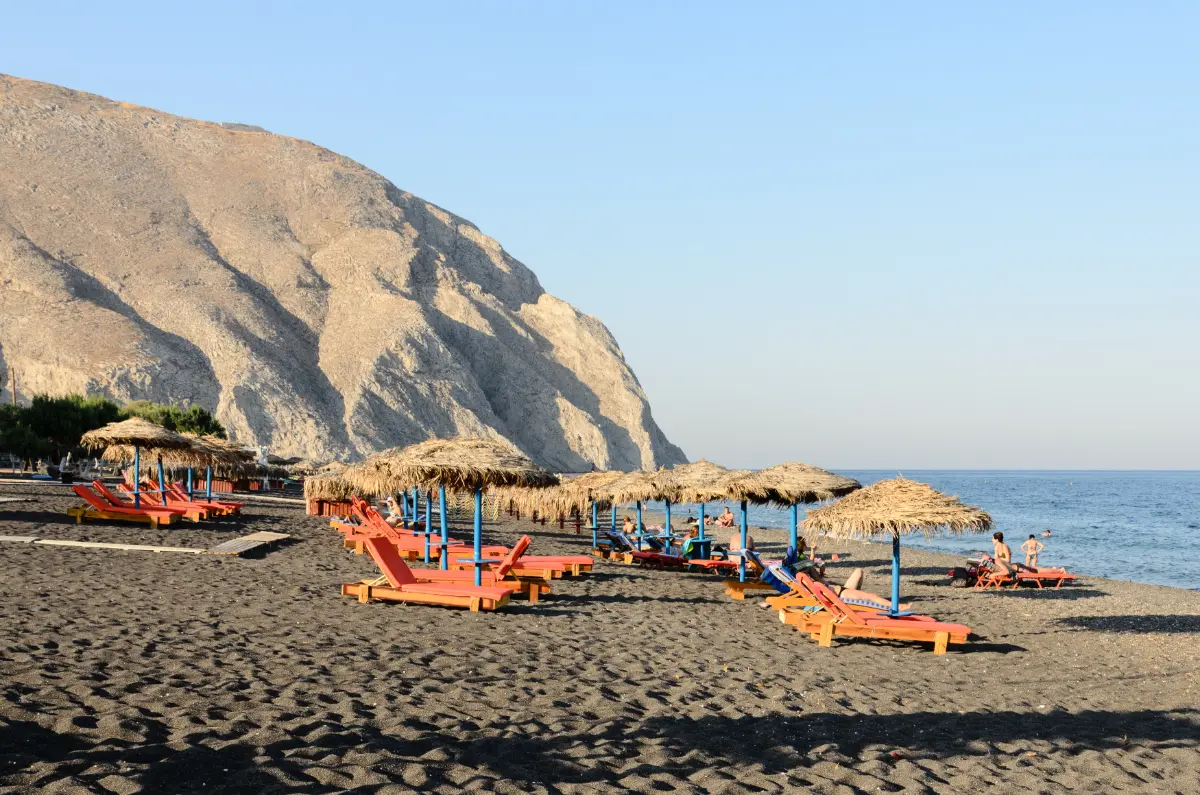
Black volcanic sand and pebble, organised with sunbeds and umbrellas, tavernas and beach bars behind. No beach length is printed here: published figures disagree
The sand in summer
Dark volcanic sand absorbs heat and is hard to cross barefoot in the afternoon. Bring something for your feet
Above it
Mesa Vouno, the rock dividing Perissa from Kamari, with the ruins of Ancient Thera on the ridge. Footpath up from Perissa, road up from Kamari
Wind
The beach faces roughly southeast and the meltemi blows from the north, so the wind is often offshore here. Flat water close in; floating things travel outwards
Blue Flag
Held for 2026, one of seven on Santorini. An award covering water quality, environmental management, information and services, not a rating of the sea. Awarded annually
Getting there
KTEL buses from Fira; short ordinary drive. Not joined to Kamari by a coast road
Travel details last checked July 2026.
It sits on the southeast coast, on the flat side of the island, and it is a long strip of black volcanic sand and pebble running on into Perivolos and then Agios Georgios without any obvious seam between them. Behind it is a beachfront of tavernas, beach bars and modest hotels. Above its northern end is Mesa Vouno, the rock mass that separates Perissa from Kamari and carries the ruins of Ancient Thera on its ridge.
What it does not have is a caldera view, which is the whole point. Rooms here cost a fraction of what the same standard costs on the rim, there is space to put a towel down, and the sea is at the end of your street rather than four hundred metres below it.
The sand is the thing to plan around
Start with the practical fact that catches nearly everyone, because it is the one nobody warns you about.
Black volcanic sand absorbs heat rather than reflecting it, and by the middle of a July afternoon the surface of this beach is genuinely punishing underfoot. The distance from your sunbed to the water is short. It does not feel short at two in the afternoon in bare feet.
So: bring something on your feet that you are willing to walk to the water in and then leave on the pebbles. Flip-flops, water shoes, anything. This is a small thing that materially changes a black-sand beach day, and it applies at Kamari and Perivolos exactly as much as here.
Two more consequences of the same material. The sand is coarse and shades into pebble in places, so it is not the fine powder some visitors are picturing; it packs firm and it does not blow around, which are both improvements. And it holds the day’s heat into the evening, which is why the beachfront here stays comfortable long after the rim towns have cooled.
We print no temperature figure for any of that, because nobody has measured this beach and a number invented to sound precise would be worse than the mechanism.
The water, the wind, and what to look for
The geometry here is worth understanding before you decide what to float on.
Perissa faces roughly southeast, and the meltemi, the dry summer wind that dominates the Aegean, comes from the north. On this coast that means the wind is often blowing off the land and out to sea. The visible effect is a flat, inviting surface close in, because an offshore wind flattens the water rather than piling it up. The less visible effect is that the same wind carries floating things away from the shore, steadily, and faster than they seem to be moving. Inflatables, lilos and paddleboards are the ones this catches.
We are not going to rate the water, on this coast or any other. The sea moves, no page can see the day you are standing in, and that is not a certificate we are in a position to issue. What we can tell you is what to read when you arrive: the flag flying on the beach, the lifeguard post if one is staffed that day, and any notice the municipality has put up. Those three things know more about your afternoon than any article does. The general mechanics of Greek sea conditions, the meltemi included, are set out in what the sea is like in Greece.
One signal that gets over-read, and it is worth correcting here because Perissa carries it. Perissa held a Blue Flag for 2026. The Municipality of Thira carries seven awards that year, and they are not seven separate beaches: Perissa, Perivolos, Agios Georgios, Vlychada, Monolithos, and Kamari, which is awarded twice as two separate stretches. A Blue Flag is an award covering water quality, environmental management, information and services. It is not a rating of the sea, and it is not a statement about conditions on your day. It is also awarded annually, so a flag in one summer says nothing about the next.
Ancient Thera on the ridge above you
The best half-day on this side of the island starts at the north end of the beach and goes up.
Mesa Vouno is the tall rock that closes Perissa off from Kamari, and on its ridge stand the remains of Ancient Thera: the city that occupied the high ground for centuries, laid out along a spine with terraces, an agora, a theatre and the ordinary bones of a town, looking down over both beaches at once. It is a very different proposition from Akrotiri, which is a Bronze Age settlement buried by the eruption and roofed over. This is a later, open, walkable ruin whose main argument is the position.
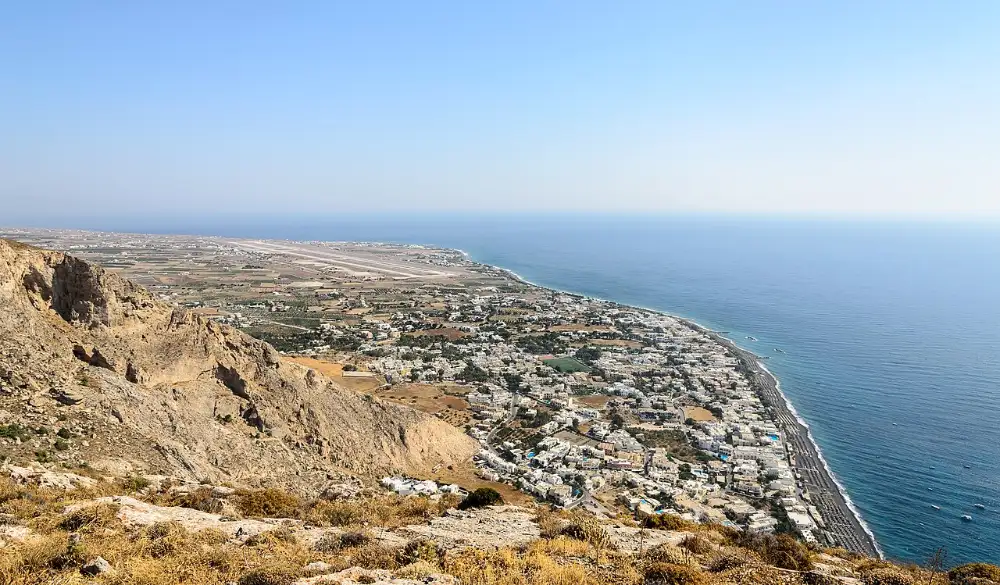
You can climb to it on the footpath from Perissa, and you can drive to it from the Kamari side. The path is steep, unshaded and on bare volcanic ground; it is not a stroll and we are not going to tell you whether it suits you. What we can say is that everyone who does it in the morning is glad and everyone who does it at noon is not. We print no opening hours and no ticket price for the site, because both change and we read neither at the ministry.
If you want the more famous Bronze Age story instead, the excavation and its museum are covered on our Akrotiri page and the Santorini guide fits both into a week.
Perissa or Kamari, and who this side suits
Two beach towns, one rock between them, and the difference is real but small.
Perissa is the younger and cheaper of the pair. Its beachfront runs long and loose, the accommodation skews towards apartments, studios and family-run hotels, and it merges southwards into Perivolos, which is where the more designed beach bars are. Kamari, on the other side of Mesa Vouno, is tidier and more sedate, has a promenade rather than a strip, and is closer to the airport.
We name no bar, taverna or hotel on either. That trade turns over faster than any page can track it, and a list of names is wrong by the following August. What is durable is the shape: the whole southeast coast is organised beach with sunbeds and food behind it, and the character shifts gradually as you walk south.
Rooms and sunbeds here are sold directly and locally, and this coast is where the island’s value sits, which our Santorini guide sets out against the caldera premium.
This side is the right call if you want a swimming holiday with Santorini attached, if you are travelling on a budget the rim would eat, if you have children who need to be near water rather than near a cliff edge, or if you would rather spend your evenings at a table by the sea than queuing for a sunset. It is the wrong call if the caldera is the reason you came, because you will be commuting to it by bus.
Getting there and getting around
Perissa is on the flat side, which makes everything simpler.
KTEL buses run from the station in the middle of Fira out to Perissa, and the Santorini guide has the network and the fares; we print neither here, because one page should own them. The road is ordinary and the drive is short, which is the opposite of everything about the caldera rim.
The local detail people miss: Perissa and Kamari look adjacent on a map and are not connected by road around the base of Mesa Vouno. Getting between them means going inland, or walking over the rock on the footpath. Plan a day on one side or the other rather than assuming you can drift between them.
The honest verdict
Perissa is not the Santorini on the postcard and it does not pretend to be. It is a long black beach with cheap rooms, good tavernas, an archaeological site on the ridge and space to exist, on an island where space is the scarcest thing money can buy. Bring shoes for the sand, look at the flag before you swim, walk up Mesa Vouno early, and take the bus to the rim for the sunset like everybody else.
Last checked July 2026. What gets re-checked on this page: the Blue Flag list, which is annual, and the access arrangements for Ancient Thera. No sunbed price, bus fare, opening hour, venue name or beach length appears here by design. How we date and correct facts is in our editorial policy.
Common questions
What is Perissa beach in Santorini like?
A long strip of black volcanic sand and pebble on the island’s flat southeast coast, running on into Perivolos and Agios Georgios, with a beachfront of tavernas, beach bars and modest hotels behind it and the rock of Mesa Vouno closing off its northern end. It is organised beach: sunbeds, umbrellas and food. There is no caldera view, which is why rooms here cost a fraction of the rim, and it is the side of Santorini people choose when they want to swim rather than to photograph.
Is the black sand at Perissa hot?
Dark volcanic sand absorbs heat instead of reflecting it, and in the middle of a summer afternoon this beach is difficult to cross in bare feet. That is the single most useful thing to know before you arrive: bring flip-flops or water shoes you can walk to the water in and leave on the pebbles. The same applies at Kamari and Perivolos. It also has one benefit, which is that the sand holds warmth into the evening and the beachfront stays comfortable long after the rim has cooled.
Perissa or Kamari, which is better?
Perissa is the younger, cheaper and looser of the two, merging south into the beach-bar strip at Perivolos. Kamari is tidier and more sedate, with a promenade rather than a strip, and it is closer to the airport. Both are black sand, both are organised, and Mesa Vouno stands between them. Note that they are not joined by a coastal road: getting from one to the other means going inland or walking the footpath over the rock, so plan a day on one side rather than drifting.
How do you get from Fira to Perissa?
KTEL public buses run from the station in the middle of Fira out to Perissa, and driving is straightforward because this is the flat side of the island with ordinary roads. We print no fare and no timetable here; the Santorini guide carries the bus network so one page owns it. Perissa is also a short hop from the airport, which is on the same side of the island.
What is Ancient Thera, and can you walk up from Perissa?
Ancient Thera is the ruined city on the ridge of Mesa Vouno, the rock at the northern end of Perissa beach, and it looks down over both Perissa and Kamari. A footpath climbs to it from the Perissa side, and there is also a road up from Kamari. The path is steep, unshaded and on bare volcanic ground, and it is a climb rather than a walk. Morning is the hour for it. It is a later and more open site than the buried Bronze Age settlement at Akrotiri, and the two make a good pair across one trip.
Does Perissa have a Blue Flag, and what does that mean?
Perissa held a Blue Flag for 2026, one of seven awards in the Municipality of Thira - the others being Perivolos, Agios Georgios, Vlychada, Monolithos and Kamari, which holds two. A Blue Flag is an award covering water quality, environmental management, information and services, and it is routinely misread as a rating of the sea. It is not one, and it says nothing about conditions on your day. It is also awarded annually, so check the current year rather than trusting a page. On the day, the things to read are the flag flying on the beach, the lifeguard post if one is staffed, and any municipal notice.
Should you stay in Perissa or on the caldera rim?
Stay in Perissa if you want a swimming holiday with Santorini attached, if the rim’s prices would define your trip, or if you want a beach at the end of the street rather than a cliff. Stay on the rim if the caldera is the reason you booked the flight, because from Perissa you are commuting to it. Many people split the week, which the Santorini guide treats as the sensible compromise it is.
Booking
We sell nothing and book nothing for you. Every guide on this page tells you how to arrange each piece yourself - which ferry operator, when to book, what to prebook and what to leave loose.