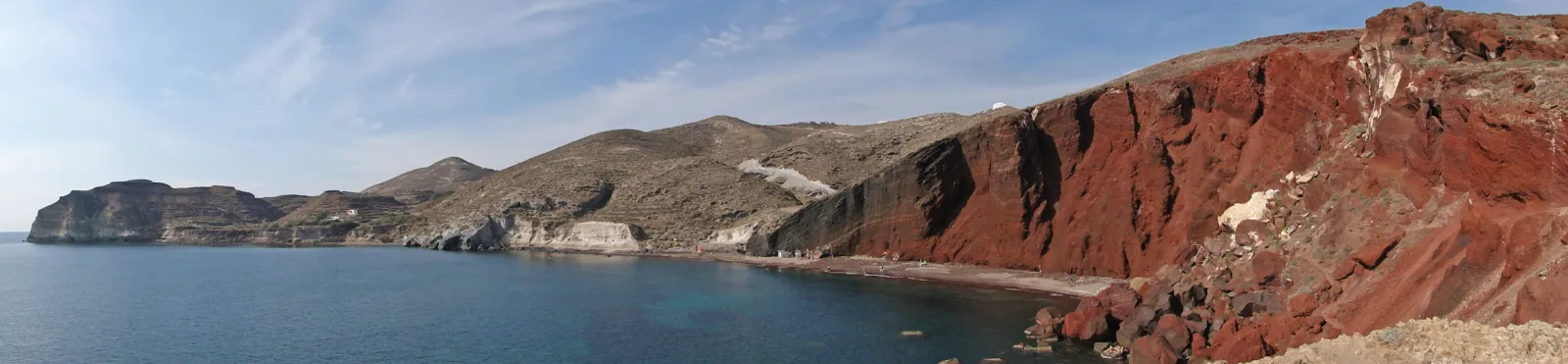
Where
South coast of Santorini, past Akrotiri village and beyond the archaeological site
Why it is red
Oxidised iron in the volcanic cliff; the beach is made of material shed from the cliff
Official position
Access prohibited by the municipality since 2013, after a landslide that August; warning signs posted on the approach
Documented falls
August 2013, 13 April 2018 (southern end, no injuries reported), February 2025 (during the seismic swarm, filmed)
What the science says
Greek university geologists and ISMOSAV: the erosion cannot be stopped or prevented; rockfalls are unpredictable and instantaneous. Rockfalls are “frequent enough to close access from time to time”
Alternative view
From a boat working the south coast, and from the headland above the cove
Before you go
Ask locally on the day, and read the signage in front of you
Travel details last checked July 2026.
That is not a detail at the bottom of the page. It is the page.
What the red is
The colour comes from the rock, not from the sand’s origin somewhere else.
The cliff behind the beach is iron-rich volcanic material that has oxidised, which is the same chemistry as rust and the same reason so much of the southern Aegean’s volcanic rock runs from ochre through to deep brick. Waves and rockfall break that cliff down, the fragments end up on the shore, and the beach is therefore made of the cliff. Everything else on this page follows from that sentence, including the difficult part.
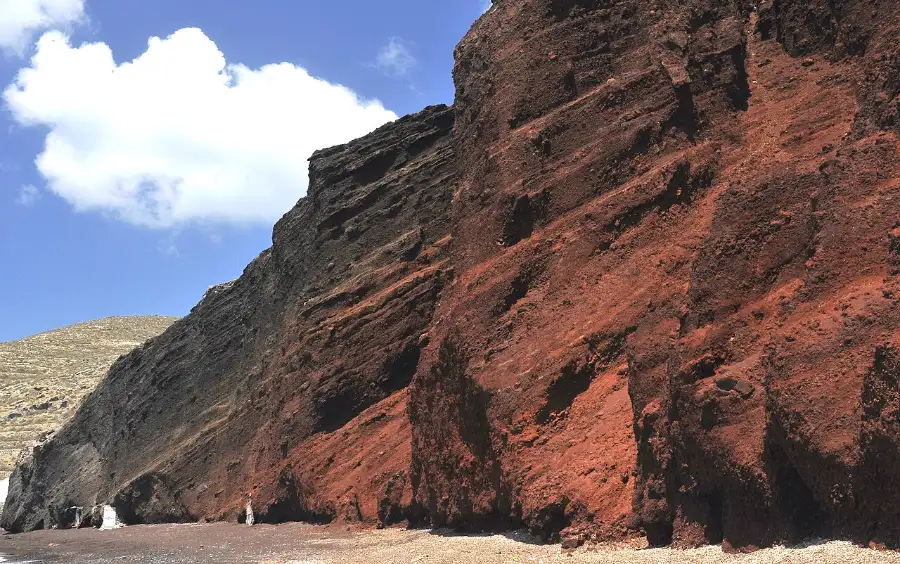
It is a small beach. Photographs taken from the headland flatten it and make it look like a long crescent; in person it is a pocket of shore at the foot of a wall, and there is not very much of it.
The cliff, the science and the prohibition
This is the section the other pages skip, and it is the only one that matters.
Red Beach sits beneath an actively eroding cliff, and rock comes off it. Geologists and volcanologists from Greek universities and from the Institute for the Study and Monitoring of the Santorini Volcano concluded that further erosion cannot be stopped or prevented, and that because rockfalls are instantaneous and unpredictable, the authorities should act to keep people away from the beach. A 2017 engineering-geology paper on the site is titled “Beyond the boundaries of feasible engineering geological solutions”, which tells you the finding before you read a word of it.
The municipality prohibited access in 2013, after a major landslide that August. Its press release said access to Red Beach is forbidden and urged tourism businesses to respect the prohibitions. Warning signs went up along the approach; the wording reported in 2018 warned of the danger of landslides and read “No entry”.
Falls have followed. One came down at the southern end of the beach on 13 April 2018, without injuries reported. Another was filmed in February 2025 during the island’s earthquake swarm, with people on the beach at the time; To Vima reported that the beach was closed to the public then and reachable only by boat. That was the position in February 2025, and we are printing it with its date attached because it is a dated event and not a description of today.
Writing on the European Geosciences Union’s geomorphology blog in April 2026, Stratis Karantanellis of the Geohazards and Remote Sensing Lab at California State University Fullerton put the pattern plainly: rockfalls here are frequent enough to close access from time to time. He also makes a point that is worth carrying, because it disposes of the commonest argument on the forums. Landslides are often not sudden events at all. They are small incremental movements accumulating over time, which is why they are studied with repeated drone surveys and 3D models rather than with the naked eye. “It looked fine when we were there” is not evidence about a slope.
Now the part where this page stops.
We will not tell you that Red Beach is safe, and we will not tell you to walk past a sign or a barrier. The first is a judgement that belongs to geologists and to the municipality, and they have made it in public. The second is not something any travel page should ever put in a reader’s head. What we can give you is the record: a prohibition that has stood since 2013, warning signs on the approach, documented falls in 2013, 2018 and 2025, and a scientific consensus that the erosion cannot be engineered away.
What we cannot give you is your day. Signage, barriers and the state of the slope have all changed repeatedly, and the only person who can see what is actually posted in front of them is you. Ask at your hotel or at the Akrotiri site before you drive over, read what the sign in front of you says, and take it at face value.
Seeing it from the water
There is a version of this visit that does not involve the approach at all, and it is the one most people end up preferring.
Boats run along Santorini’s south coast and pass under the red cliffs, usually taking in the white and black beaches nearby on the same circuit. From the water you get the thing you actually came for, which is the cliff face in full, rather than a pocket of shingle at the bottom of it looking up. It is also the version that was still available in February 2025 when the land approach was shut.
We name no operator and print no fare, because both change every season and neither would survive to your trip. Trips of this kind are sold at the ports and in Fira; the boat day and the caldera volcano circuit are separate products and are frequently confused, so ask which coast you are being sold before you pay.
Nothing at Red Beach itself is booked in advance. What is booked is the boat, and it is sold locally and directly.
The viewpoint, which nobody tells you about
Between the car park and the beach the path crosses a headland, and from the top of it you are looking down on the whole cove: the red wall, the shingle, the water, the colour contrast that made the place famous.
That view is the photograph. Almost every image you have seen of Red Beach was taken from above rather than from the sand, which is the single most useful thing this page can tell a photographer. It is also where a good many visitors, having read the signs, decide they have seen what they came for.
Getting there, and what to expect on arrival
Red Beach is at the far southwestern end of the island, past the village of Akrotiri and beyond the archaeological site. Buses from Fira serve Akrotiri, and the Santorini guide has the network; from the bus stop or the car park it is a walk on rough unsurfaced ground, and the routing of that walk has been altered more than once.
Combine it with the excavation. Akrotiri is a genuinely extraordinary site and it is five minutes away, and a morning that does the site and then looks at the cove from the headland is a better morning than either half alone.
Two practical things that are true whatever the access situation is. There is no shade at the cove and none on the walk in, so this is a place for early or late rather than the middle of the day. And whatever services are trading at the top on the day you come, they are a car park’s worth of trading and not a beach club; treat it as a place you visit rather than a place you spend a day.
If what you want is an actual Santorini beach day, with sand you can lie on and a taverna behind you, the black-sand towns on the southeast coast are where that happens. Perissa is the long one, and it is a different Santorini altogether.
What to take away from this page
Red Beach is worth seeing and it is worth understanding. The colour is oxidised iron in a volcanic cliff, the cliff is eroding, the erosion has been studied and found to be beyond engineering, and access has been prohibited by the municipality since 2013 with signs to match. Falls are documented in 2013, 2018 and 2025.
None of that is a verdict on your trip. It is the information you should have before you make one, plus one instruction that is not ours but everybody’s: read the sign in front of you, and believe it.
Last checked July 2026. What gets re-checked on this page: the municipal position, the signage, any new rockfall reported by the Greek press, and the geoscience literature. No closure status is printed here as current, by design, and no price, fare or operator appears at all. How we date and correct facts is in our editorial policy.
Common questions
Is Red Beach in Santorini open?
That is a question about the day you travel, and this page deliberately does not answer it. What is on the record: the municipality prohibited access in 2013 after a landslide, warning signs have been posted on the approach, warning of the danger of landslides and reading “No entry”, and further falls came down in April 2018 and in February 2025, when To Vima reported the beach closed and reachable only by boat. Access has been restricted, altered and re-restricted repeatedly since. Ask locally before you drive over, and read the signage in front of you when you get there.
Why is Red Beach dangerous, and what do the geologists say?
The beach sits at the foot of an actively eroding volcanic cliff and rock comes off it. Geologists and volcanologists from Greek universities and the Institute for the Study and Monitoring of the Santorini Volcano concluded that further erosion cannot be stopped or prevented and that, because rockfalls are unpredictable and instantaneous, authorities should keep people away. A 2017 engineering-geology paper is titled “Beyond the boundaries of feasible engineering geological solutions”. We report those findings. We do not add a risk rating of our own, in either direction, because that is not a judgement a travel page is in a position to make.
Why is Red Beach red?
Oxidised iron in the volcanic rock, which is the same chemistry that makes rust. The cliff behind the beach is iron-rich volcanic material, waves and rockfall break it down, and the fragments become the shingle and coarse sand of the shore. That is the standard geological explanation and we attribute it rather than assert a measured composition. The practical consequence is worth holding onto: the beach is made of the cliff, so the thing that produces the colour is the thing that falls.
Can you see Red Beach by boat?
Yes. Boats work Santorini’s south coast and pass under the red cliffs, usually taking in the neighbouring white and black beaches on the same run. That was still the available route in February 2025 when the land approach was shut. It is also the better view, because the cliff face reads from the water in a way it does not from the shingle. We name no operator and print no fare; ask which coast a trip covers before paying, because the south-coast boat and the caldera volcano circuit are different products.
How do you get to Red Beach from Fira?
It is at the far southwestern end of the island, past Akrotiri village and beyond the archaeological site. Buses run from the KTEL station in Fira to Akrotiri, and the Santorini guide covers the network; from the stop or car park it is a walk over rough unsurfaced ground, and that route has been changed more than once. There is no shade at any point, so go early or late. Pair it with the Akrotiri excavation, which is five minutes away and worth more of your morning.
Is Red Beach worth visiting?
For the geology and the view from the headland above the cove, yes, and it pairs naturally with Akrotiri. As a beach day, no. It is a small pocket of red shingle with no shade under a cliff whose access has been in dispute for a decade, and Santorini has long organised black-sand beaches on the southeast coast that do the beach-day job properly, starting with the long black-sand stretch at Perissa. Many visitors walk to the headland, take the photograph everyone recognises, and go no further, which is a reasonable way to spend the visit.
Booking
We sell nothing and book nothing for you. Every guide on this page tells you how to arrange each piece yourself - which ferry operator, when to book, what to prebook and what to leave loose.