Meteora
Things to do in Meteora
Meteora is a group of sandstone pillars rising out of the Thessalian plain with monasteries built on top of them, and six of those monasteries are still lived in by monks and nuns. That is the fact that governs everything below: these are working religious houses first and sights second, and they are visited on their terms rather than yours.
The six, and who lives in each. At its sixteenth-century peak Meteora held around twenty-four monasteries and hermitages. Six remain active and open. Four are communities of monks: Great Meteoron, Varlaam, Holy Trinity and St Nicholas Anapausas. Two are convents of nuns: Rousanou and St Stephen.
Great Meteoron and Varlaam, the pair most people do first. Great Meteoron, properly the Monastery of the Transfiguration, is the oldest and largest and sits highest of all on its tower. It was founded in the fourteenth century by Athanasios the Meteorite, a monk who came from Mount Athos. Varlaam is its near neighbour and still keeps the old rope-and-net winding tower that once hauled up everything and everyone who went in. Standing under that tower is the quickest way to understand why these buildings are where they are.
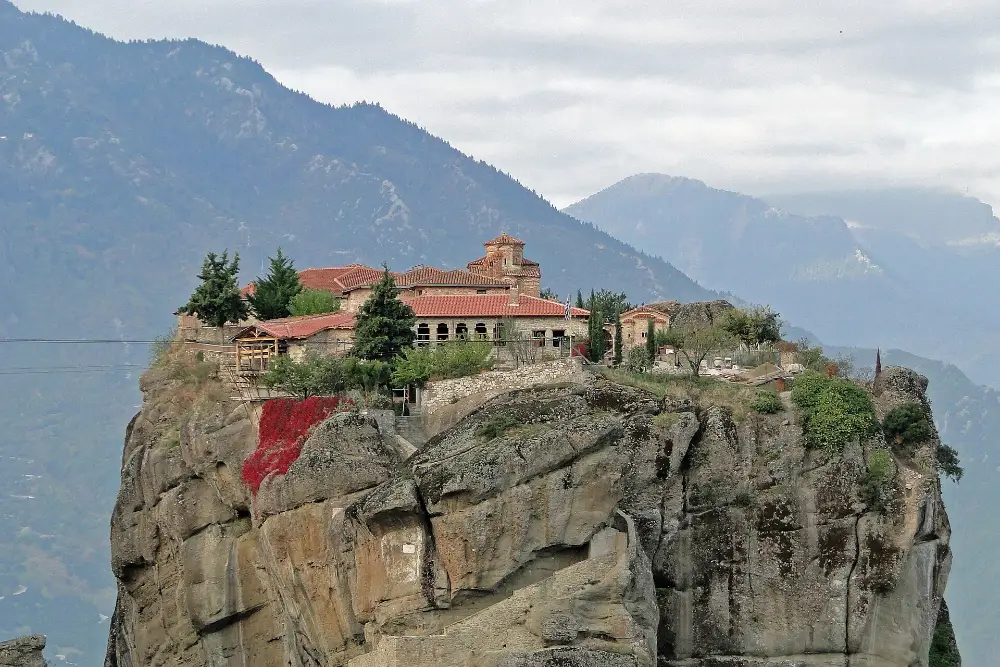
The two that reward going out of your way. St Nicholas Anapausas is the small steep one many tours skip, and it holds frescoes by Theophanes the Cretan, which is reason enough to make the climb. Holy Trinity, or Agia Triada, stands alone on the most isolated pillar in the group. It had a turn on screen in the 1981 James Bond film For Your Eyes Only, standing in for a fictional monastery, and the monks were not pleased about it: the producers had permission from the Ministry of Culture, but the community objected to the film’s violence, and in the end only the exteriors were shot here with the interiors built as a set elsewhere.
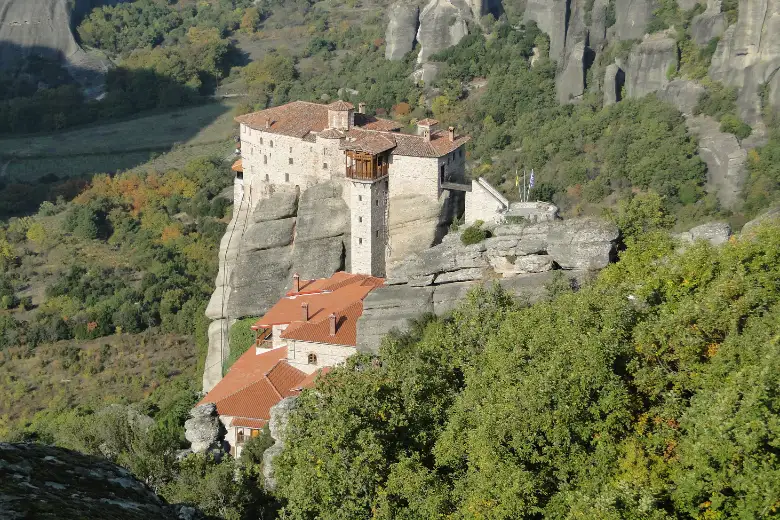
The two convents, and the easiest way in. Rousanou, dedicated to St Barbara, sits lower than the others and is one of the gentler climbs. St Stephen is the one visible straight from Kalambaka and the only monastery you reach across a bridge rather than up a long staircase, which makes it the realistic choice for anyone who cannot manage the stairs.
The one mechanism that decides your day. Each monastery keeps its own opening hours, and each closes on its own day of the week, and those closed days shift between the summer and winter timetables. So you cannot count on all six being open on any single day, and the order you visit them in has to follow their calendar rather than the loop road. We print no grid of closed days deliberately: the published details conflict between sources and every source repeats that the monasteries can change hours without notice. Confirm the ones you are aiming for before you fix your order.
Dress and conduct, which are not negotiable. Everyone needs shoulders and knees covered. Men wear long trousers, and women are traditionally expected to wear a skirt rather than trousers. Most monasteries keep a stack of wrap-around skirts and shawls at the entrance and lend them free to anyone who arrives unprepared. Entry is a small cash fee per monastery, paid in euros, and a card machine is not something to count on. Inside, keep your voice down in the catholicon, and expect photography to be limited or not allowed in the churches. Whether you can take a picture in a given space is a question for the gate rather than a rule you can assume. The wider country practice is in Greek etiquette and customs.
The paths between the pillars, which are the second day. The old monk paths still link the monasteries across the rock, and walking them rather than driving the loop road is how you see the towers from below and between, the angle the coaches never get. Marked trails lead to hermit caves in the cliff faces, to the chapel of Agios Athanasios, and to viewpoints tucked among the pillars. A relaxed morning connects two or three monasteries on foot, with the staircase up to each as the only steep part. Proper shoes matter more than anything else in your bag. The country picture is in hiking in Greece.
Climbing, and the sunset that argues for staying the night. The massif is a climbing destination in its own right, with hundreds of established routes on grippy conglomerate, mostly moderate. Certified local guides run half-day introductions with harness, helmet and rope included, so no experience or gear is needed to get up something. Guides trade under different names from year to year, so book one that is currently certified rather than a name from an old page. For everyone else the payoff is a viewpoint at the right hour: the Psaropetra and Adrachti area out along the loop road is where people gather for sunset, when the light turns the rock amber and the day-trip coaches have already gone. Being here after they leave is the whole argument for sleeping in Meteora rather than day-tripping, and where to do that is in where to stay in Meteora.

