Region
Thessaly, central mainland Greece - the rock pillars above Kalambaka (town, rail terminus) and Kastraki (village), in the Trikala regional unit near the Pindus foothills
From Athens / Thessaloniki
~4-4.5 h from Athens and ~3 h from Thessaloniki by car; also KTEL bus and rail to Kalambaka - the Palaiofarsalos-Kalambaka line has run a rail-replacement bus (via Karditsa and Trikala) since the September 2023 storms
Active monasteries
Six open today - four monk communities (Great Meteoron, Varlaam, Holy Trinity, St Nicholas Anapausas) and two convents of nuns (Rousanou, St Stephen); each keeps its own hours and a different closed day, small cash entry in euros
Dress code
Shoulders and knees covered for all; long trousers for men; a skirt traditionally expected for women, with wraps lent free at the gate
UNESCO status
Inscribed 1988 as a mixed World Heritage site - both cultural and natural value
Best months
April-June and September-October for mild walking weather and thinner crowds; July-August hot and coach-heavy (start early); winter quiet but shorter hours and more closures
Travel details last checked July 2026.
Why Meteora is not an island, and what it actually is
Because most Greece planning is island planning - ferries, ports, which Cyclades to string together - Meteora often gets filed under “another island” by reflex. It is not one. It sits inland, on the Thessaly plain of central Greece, in the Trikala regional unit, where the flat farmland meets the foothills of the Pindus mountains. You arrive by car, by intercity bus, or by rail with a bus for the last stretch into Kalambaka. No boat is involved at any point.
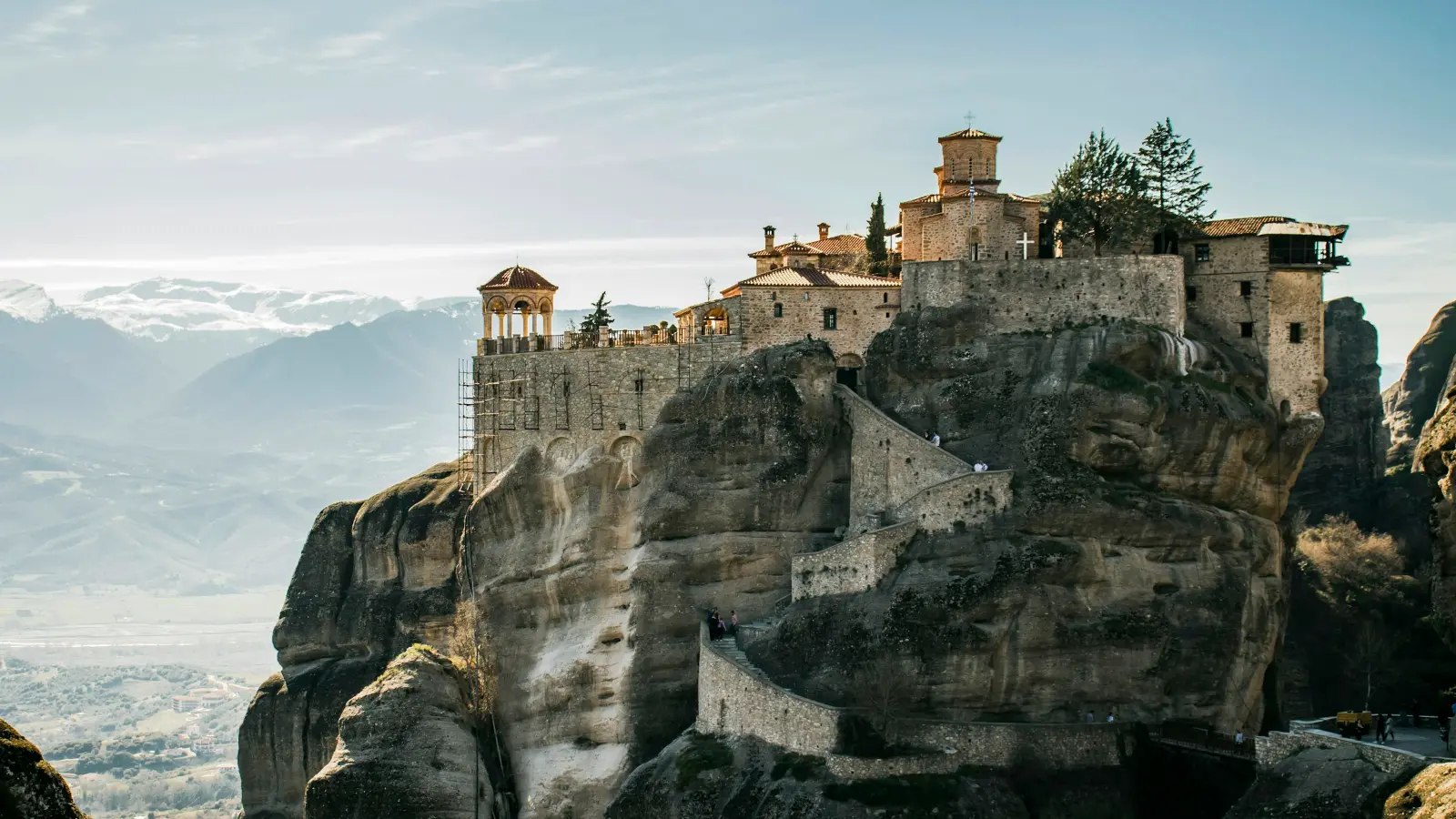
The rock itself explains the rest. The pillars are sandstone and conglomerate - a compacted mix of old river gravel and sand - laid down when a river delta emptied into a sea that once covered the plain. Tectonic uplift raised the whole mass, then millions of years of water, wind and frost cut the softer material away and left the hard cores standing as separate towers. Some rise hundreds of metres above the fields at their base, sheer on most sides, which is exactly why anyone seeking isolation would climb one.
That isolation is the point of the name. “Meteora” comes from the Greek for “suspended in the air,” the same root as “meteor,” and the monks who settled the summits meant it literally. Their houses were meant to sit between the plain and the sky, hard to reach and easy to defend.
That doubling - a natural rock formation crowned with human building - is why UNESCO inscribed Meteora in 1988 as a mixed World Heritage site, listed for both its cultural and its natural value.
The two places you will actually stay sit at the foot of the rocks: Kalambaka, the town directly below the pillars and the end of the rail line, and Kastraki, a smaller village a little closer to the towers. Everything else on this page hangs off that geography.
The six monasteries still lived in by monks and nuns
At its sixteenth-century peak, Meteora held around 24 monasteries and hermitages scattered across the rocks. Six remain active and open to visitors today: four are communities of monks, and two are convents of nuns. They are working religious houses first and sights second, which is the single fact that governs how you visit.
The four monk communities are Great Meteoron, Varlaam, Holy Trinity and St Nicholas Anapausas. Great Meteoron, properly the Monastery of the Transfiguration, is the oldest and largest, founded in the fourteenth century by Athanasios the Meteorite, a monk from Mount Athos, and it sits highest of all on its tower. Varlaam, its near neighbour, still keeps the old rope-and-net winding tower that once hauled up everything and everyone. St Nicholas Anapausas is the small, steep one many tours skip, worth the climb for the frescoes by Theophanes the Cretan inside. Holy Trinity, or Agia Triada, stands alone on the most isolated pillar of the group and had a brief turn on screen in the 1981 James Bond film “For Your Eyes Only,” standing in for the fictional monastery of St Cyril. The monks were not pleased about it: the producers had permission from the Ministry of Culture, but the community objected to the film’s violence, and in the end only the exteriors were shot here, with the interiors built as a set elsewhere.
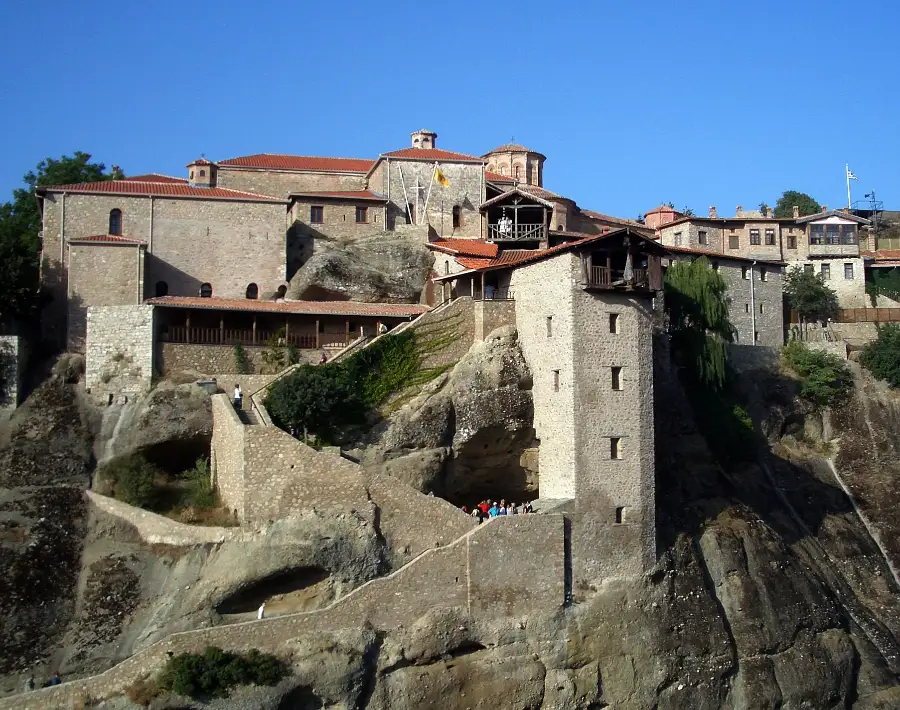
The two convents are Rousanou and St Stephen. Rousanou, dedicated to St Barbara, sits lower and is one of the easier climbs. St Stephen is the one you can see straight from Kalambaka, and the only monastery you reach across a bridge rather than a long staircase.
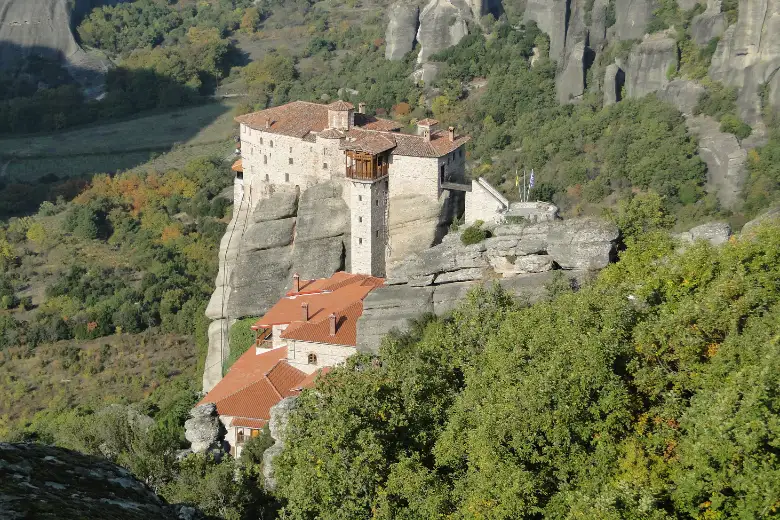
The history behind them is quick and it matters. Hermit monks lived in the caves and clefts of these rocks from roughly the ninth to eleventh centuries. The monasteries proper went up from the fourteenth century onward, partly as refuge during Ottoman and Turkish raids on the plain below, and the only way up was by removable wooden ladders, knotted ropes and baskets hauled on a winch. That is why they sit where they sit. A handful of monks or nuns still live and worship in each, and it is their daily life, not a museum policy, that the dress code and the quiet are there to protect.
How to visit the monasteries respectfully
Dress for a working monastery. Everyone needs shoulders and knees covered; men wear long trousers, and women are traditionally expected to wear a skirt rather than trousers. Most monasteries keep a stack of wrap-around skirts and shawls at the entrance and lend them free to anyone who arrives unprepared.
Beyond dress, a few durable rules apply at every gate. Entry is a small cash fee per monastery, paid in euros, and a card machine is not something to count on. Each monastery keeps its own opening hours, and, the part that really shapes your day, each closes on its own day of the week, and those closed days shift between the summer and winter timetables.
That one mechanism decides your planning. Because the six close on different days, and the pattern changes with the season, you cannot count on all six being open on any single day. Check each monastery’s current schedule before you fix the order you visit them in, rather than assuming you will simply work through the lot. Listing which one shuts on which weekday here would be wrong within a season, so treat the closed day as something to confirm, not memorise.
Inside, treat the church as what it is. Keep your voice down in the catholicon, and expect photography to be limited or not allowed inside the churches - whether you can shoot in a given space is a question for the gate, not a rule you can assume either way. The climbs are real, too: most monasteries are reached by dozens of cut-stone steps carved into the rock, so proper shoes matter more than anything else in your bag. If a rule is not stated clearly at the entrance, ask the monk or nun on duty rather than guessing.
Hiking and rock climbing between the pillars
The rock that carries the monasteries is also one of Greece’s best walking and climbing grounds, and it is the honest reason to give Meteora a second day.
Start on foot. The old monk paths still link the monasteries across the rock, and walking them, rather than driving the loop road, is the way to see the towers from below and between, the angle the coaches never get. Marked trails lead to hermit caves in the cliff faces, to the small chapel of Agios Athanasios, and to viewpoints tucked among the pillars. A relaxed morning connects two or three monasteries on the trails, with the staircase up to each as the only steep part.
For climbers, the massif is a destination in its own right. It holds hundreds of established routes spread across well over a hundred pillars, mostly moderate trad and sport lines on grippy conglomerate. Certified local guides run half-day introductions for first-timers, with harness, helmet and rope included, so you do not need your own gear or any experience to get up something. Guides trade under different names from year to year, so book one that is currently certified rather than a name you saw on an old page.
For non-climbers, the payoff is a viewpoint at the right hour. The Psaropetra and Adrachti area, out along the loop road, is where people gather for sunset, when the light turns the rock amber and the day-trip coaches have already gone. That last part, being here after the coaches leave, is the whole argument for staying the night.
When to go, and the best light of the day
Aim for spring or autumn. Roughly April to June and September to October give you comfortable walking weather, a green or golden plain, and far fewer coach groups than the peak. That is a recommendation drawn from what the place is like, not a temperature reading; for the numbers, Greece weather month by month serves better than a line here.
The more useful lever is the time of day. Day-trippers arrive in a block around midday, so the site is quietest and best-lit near opening in the early morning and again in the late afternoon, once the tours start rolling out in the middle of the afternoon. Summer midday is the opposite of all that: hot on the exposed rock, and at its busiest.
Summer is still when most people come, and that is fine. July and August are hot and coach-heavy, but if that is your window, the move is simple. Start at opening, do your monastery visits in the cool of the morning, and rest through the midday heat before heading back out for the late light.
Winter flips the calculation. The rocks under low cloud or a dusting of snow are quiet and atmospheric, but the monasteries keep shorter hours and more of them close on more days, which is exactly when checking each closed day before you go matters most.
Getting to Meteora from Athens or Thessaloniki
Meteora rises above the town of Kalambaka in mainland Thessaly. From Athens it is roughly four to four and a half hours by car; from Thessaloniki about three. You can also come by intercity KTEL bus, or by train to Kalambaka, subject to the rail situation below.
The train needs a clear-eyed note, because it is the part most out-of-date pages get wrong. The Palaiofarsalos-to-Kalambaka line, which carried the through trains from Athens and Thessaloniki, was cut by the Storm Daniel floods of September 2023, which destroyed some fifty kilometres of track across Thessaly, and as of July 2026 it has not reopened. In its place, Hellenic Trains runs a rail-replacement bus from Palaiofarsalos to Kalambaka, calling at Karditsa and Trikala, so the rail journey still works: you simply change to a bus for the last stretch. A full restoration has been announced, and the date has already slipped more than once, so this is a check-before-you-travel situation rather than a fixed timetable. Confirm the current status with Hellenic Trains before you build a plan around a through train.
A car is the practical way to see Meteora. It lets you drive the loop road that strings the six monasteries together and reorder your day around whichever ones are open, which is most of the point given the closed-day juggling. The roads up are good and the drive between monasteries is short; the catch is parking, tight at the popular monasteries around midday - another reason to be up there early. If you plan to drive, renting a car in Greece covers the mechanics.
Without a car, KTEL intercity buses serve Kalambaka from Athens and other cities, and KTEL Trikala runs a local Kalambaka-Meteora bus that stops at the monasteries, a few times a day rather than turn-up-and-go. How often it runs, and in which months, is not something the operator publishes where we could read it, so confirm both timetables the week you travel.
For the carless, an organized day tour from Athens is the most popular way in, typically a long day by coach, or by train-and-coach, that handles the logistics for you. It works, but it comes with the trade-off the next section is about: from Athens it is a thirteen-to-fourteen-hour round trip.
Where you sleep comes down to two places. Kalambaka is the town directly below the rocks: the rail terminus, and where most of the hotels, tavernas and shops are, so it is the convenient base. Kastraki, a fifteen-minute walk or a short drive away, is the smaller, quieter village, set right among the lower pillars and closer to the trailheads. Town convenience or village calm - either way you are minutes from the climb, which is the reason to stay over at all.

Diagram by Greece Trips. Free to reuse with credit - CC BY 4.0.
Day trip or stay the night?
Stay the night if your schedule can bend at all. Travelers who overnight in Kalambaka or Kastraki say, with remarkable consistency, that it is the better trip, and the reasoning is concrete. With a base at the foot of the rocks you split the six monasteries across two unhurried mornings instead of racing them in one, and you get the sunrise and the late-afternoon light the day-tripper is never there for.
The day trip is not a mistake, though, and it is worth being honest about both sides. From Athens it is a thirteen-to-fourteen-hour round trip, most of it in transit; organized train-and-coach tours make it painless to execute, and it works if Meteora is a single must-see slotted into a fixed Athens-based itinerary with no room to spare. What you trade away is the light and the calm. You arrive in the midday block with everyone else, and you leave before the rock turns amber.
Here is the shape to plan around. One night is enough to catch a sunset, a sunrise and three or four monasteries at a reasonable pace. Two nights lets you add the remaining monasteries and a half-day of hiking or a climb without ever feeling rushed. That second night is where Meteora stops being a photo stop and becomes a stop in its own right. The choice is yours to weigh - just weigh it before you book the day tour, not after.
Plan Meteora as its own stop
Meteora is mainland Greece, not an island: a place you drive or take the train to, where six monasteries are still lived in by monks and nuns on top of the rock. The rules that come with that - the dress, the cash, the different closed day at each - are the price of admission to somewhere still working, and they reward the visitor who plans around them rather than against them.
Give it two days from a base in Kalambaka or Kastraki, and it stops being a stop on the way to the islands and becomes a reason to come inland. Build it into a mainland leg from Athens or a northern loop from Thessaloniki, pair it with Nafplio in the Peloponnese if you want a whole mainland trip with no ferry in it, or see where it sits among all of Greece’s destinations. Then check each monastery’s schedule, pack a pair of shoes you can climb steps in, and go slowly.
Meteora FAQ
Is Meteora an island?
No. Meteora is on the mainland, in the Thessaly region of central Greece, above the town of Kalambaka. It is a cluster of monasteries built on top of tall sandstone rock pillars, reached by road or by rail, not by ferry. The island impression comes only from how most Greece trips are planned.
How many monasteries are there in Meteora, and how many can you visit?
Around 24 monasteries once stood at Meteora; six are active today and open to visitors - four communities of monks and two convents of nuns. Because each keeps its own closed day of the week, and those days shift by season, you usually cannot see all six on the same day.
What is the dress code for the Meteora monasteries?
Dress modestly: shoulders and knees covered for everyone, long trousers for men, and traditionally a skirt for women. Most monasteries lend a wrap-around skirt or shawl at the entrance if you turn up in shorts or trousers. It is enforced because these are working religious houses, not museums.
Can you visit all six monasteries in one day?
It is physically possible but rushed and rarely done. Each monastery closes on a different day and keeps limited hours, so most visitors see three or four in a day and save the rest for a second morning. Check each one’s current schedule before you plan the order.
How do you get to Meteora from Athens?
Meteora’s base is Kalambaka, roughly four to four and a half hours from Athens by car or intercity KTEL bus, and reachable by rail. The direct train has been disrupted since the September 2023 storms and the last stretch from Palaiofarsalos runs as a rail-replacement bus, so check the current status with Hellenic Trains. Many carless visitors take an organized day tour.
How many days do you need in Meteora?
One night is enough to catch a sunset, a sunrise and three or four monasteries without racing. Two nights lets you see all six and add a hike or a climb at an easy pace. A day trip from Athens works but runs a long thirteen to fourteen hours door to door.
Do you need a car to visit the Meteora monasteries?
No, but a car helps. It lets you drive the loop road between the six monasteries at your own pace and work around their different closed days. Without one, you can use the KTEL Trikala local bus, walk the old monk paths between monasteries, or join a guided tour.
Plan by category
The Meteora guides
4 guides, each scoped to a decision you actually have to make.
 Attractions
Things to do
See the attractions → Hotels
Where to stay
Compare the areas → Itinerary
Day by day
See the itinerary → Day trips
Day trips
See the day trips →
Booking
We sell nothing and book nothing for you. Every guide on this page tells you how to arrange each piece yourself - which ferry operator, when to book, what to prebook and what to leave loose.