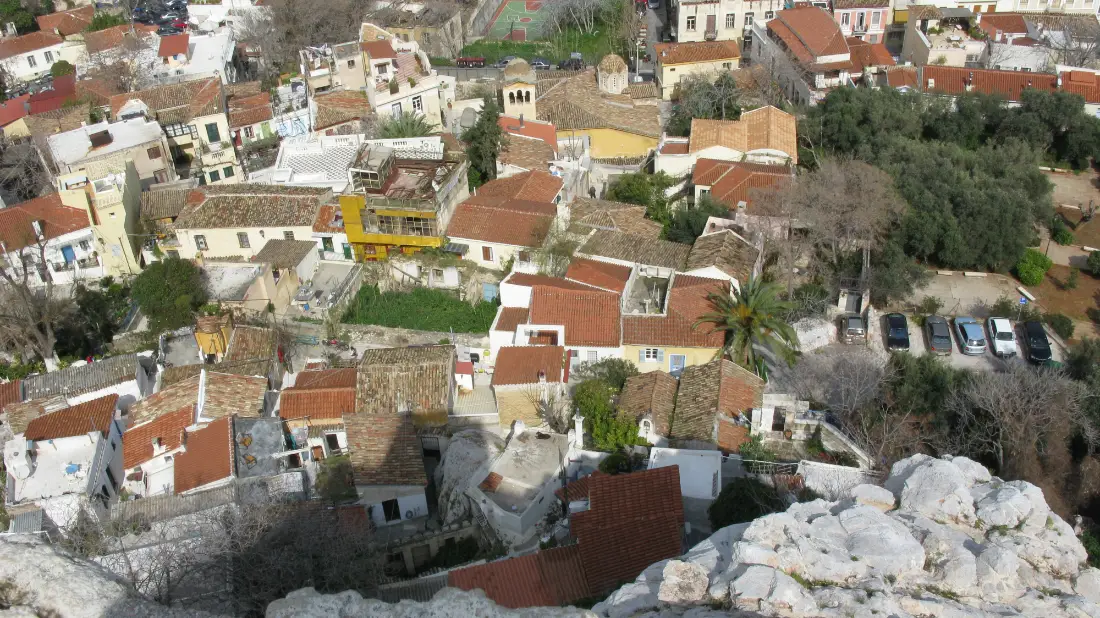
It is the old residential quarter under the north and east flanks of the Acropolis, and it contains two quite different places. There is the commercial spine, a few streets of souvenir shops, sandal makers and open-fronted restaurants that trade hard from mid-morning to late evening. And there is everything else: stepped lanes, courtyards, churches older than most European capitals, and a whitewashed village on the rock itself where people live.
The two are about a block apart. Almost everyone visiting Athens sees the first one, and a surprising number never find the second.
Athens’s official city guide describes Plaka as hugging the base of the Acropolis, running from Filomousson Square, at the intersection of Kidathinaion and Adrianou streets, down to Monastiraki. Its own advice is to wander the lanes rather than follow a route, and its own warning, from the body whose job is to bring you here, is to be prepared for the crowds. Both of those are worth taking seriously.
The rule that changes the walk: turn uphill
Here is the whole trick, and it costs nothing.
The trading streets run roughly level, following the flat ground at the foot of the rock. The quiet ones go up. Every time you take a turning that climbs, you leave the commerce behind within thirty or forty metres, and the noise falls away with it. Take a turning that stays level and you get more of the same shops.
That is not a secret route. It is a consequence of the terrain: a business needs footfall and a delivery van, and neither of those goes up a flight of stone steps. So the ground floor of Plaka’s flat streets is a shopfront and the ground floor of its stepped ones is somebody’s front door.
Which means the useful instruction for a first visit is not a list of streets. It is a habit. When you have a choice, go up.
The other half of the same rule is the hour. Plaka’s spine fills through the middle of the day with the flow off the Acropolis and out of the cruise coaches, and it thins in the early morning and after dinner. Walk it at eight in the morning and it is a residential quarter with the shutters down. Walk it at one in the afternoon in July and it is a queue with shops attached. Nothing about the place has changed; only the hour has.
Anafiotika: a Cycladic village on the rock
The strangest thing in central Athens sits on the northeast slope of the Acropolis, and you can walk into it from Plaka in a few minutes.
Anafiotika is a cluster of low whitewashed houses along narrow stone paths, and it looks like a Cycladic island village because it was built by islanders. The official Athens guide describes it as founded by workers from the island of Anafi, and dates it to the mid-nineteenth century: stonemasons brought to the young capital to build King Otto’s palace, who put up their own houses on the slope in the manner they had grown up with. Its boundaries are marked, loosely, by two seventeenth-century churches, Agios Georgios tou Vrahou to the east and Agios Simeon to the west.
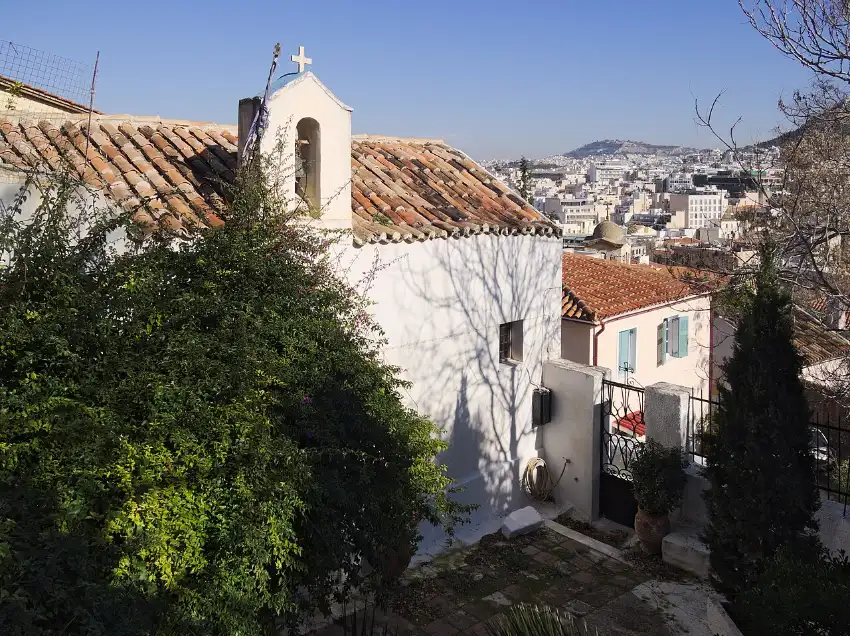
There is a story attached to the place, told everywhere, that a house completed between sunset and sunrise could not be pulled down, and that the quarter therefore went up overnight. We have not found a legal source for it, so we pass it on as the story that is told about Anafiotika rather than as the reason it exists. It is a good story either way, and it is not the reason to go.
Two practical points, and the first one matters more than anything else on this page.
People live there. These are houses with laundry on the line and cats on the wall, not an exhibit, and the lanes between Stratonos and the rock are so narrow that a stopped group blocks somebody’s route home. Walk through, keep your voice down, do not photograph into windows or doorways, and do not sit on a doorstep to rest. The neighbourhood’s whole charm is that it is still lived in, and it stays that way only as long as visitors behave like people passing through a street rather than people in a gallery.
The second: those lanes are unnamed. The houses are numbered as Anafiotika 1, Anafiotika 2 and so on, which means your map app will be confidently useless in there. That is fine. It is a small area on a hillside, the rock is above you and the city is below you, and you cannot really get lost between the two.
Where Plaka sits, and why that shapes everything
The quarter is small, and its edges do more work than its middle.
Uphill, it runs into the rock itself, which is why the Acropolis is visible from an unreasonable number of its corners and why the lanes on that side turn into steps. Downhill and to the west it runs out into Monastiraki, which is a different animal entirely: a square, a flea market, a metro interchange and a much rougher, louder commercial energy. To the northeast it meets Syntagma and the modern city, banks and ministries and traffic. And to the south sits the Acropolis Museum.
That is a genuinely unusual thing for a neighbourhood to be. In about fifteen minutes of walking you can go from a lived-in island village on a rock, through a nineteenth-century quarter, into a Byzantine church, out into a flea market and up to a modern museum, without ever getting on anything.
It also explains the crowds mechanically rather than as a complaint. Plaka is the connective tissue between the single most visited monument in Greece and the two busiest metro interchanges in the city centre. Everyone who comes down off the Acropolis and everyone heading to it passes through, and they mostly pass along the same few level streets. The pressure is not a failure of the neighbourhood; it is a consequence of where it is.
Which is the argument for treating Plaka as a place to be walked deliberately rather than crossed. The people having the worst time in it are the ones using it as a corridor.
What is actually old in Plaka
Under the shopfronts, this is a quarter of genuine antiquity, and the official guide names the pieces worth stopping for.
Agios Nikolaos Ragavas is an eleventh-century domed church at the corner of Prytaniou Street, built over an ancient temple, and its bell was the one rung in 1833 to mark the end of the Ottoman occupation of the city. The Monument of Lysicrates, an ancient structure with Corinthian columns, stands on a small square near Hadrian’s Arch. And the Benizelos Mansion is described by the city itself as the oldest surviving house in Athens, an eighteenth-century building in a pre-neoclassical, Byzantine-influenced style that shows you what Athenian domestic architecture looked like before the neoclassical rebuild swept through.
Then the thing most visitors walk past. The Pikionis pathway, the mid-twentieth-century network of walkways laid around Philopappou Hill and the approach to the Acropolis, was built from salvaged materials, and the city’s own guide reads it as a timeline of Athens assembled underfoot. It is the piece of design in this part of the city that most rewards actually looking down.
Plaka also carries an unusual density of small museums: the Museum of Greek Folk Art, the Museum of Greek Popular Instruments, the Frissiras Museum and the Canellopoulos Museum, with the Acropolis Museum at the quarter’s southern edge. We print no opening days and no admission for any of them, because those change and we did not read them at the institutions themselves. Check the museum you want on the day you want it.
What Plaka is for, and what it is not
Be honest about the shopping, in both directions.
The souvenir trade on the main streets is what it is: mass-produced, heavily marked up in the highest-footfall spots, and aimed squarely at people who have half an hour before a coach. There is also real craft in the quarter, leather sandals in particular, which has been made here for generations. Telling the two apart takes about ninety seconds of looking at how the thing is made and whether anyone in the shop can tell you about it. We name no shop, because Plaka’s ground floor turns over constantly and a page built on shop names is wrong within a season. That is what a listing is for.
The same applies to eating. The open-fronted restaurants with laminated multilingual menus and a man outside inviting you in are a specific business model, and it is one that depends on customers who will not come back. Quieter streets, smaller rooms and shorter menus are the better bet, one block off the flow. Where and what to eat in Greece more broadly is in our food and drink guide.
What Plaka genuinely is: the most walkable historic quarter in the city, the natural place to come down off the rock, and a good evening. The lanes are stepped and uneven in places, worn smooth in others, and how any particular person finds that surface is a question for that person rather than for us. Wear something you can walk on stone in.
Nothing in Plaka is ticketed at the neighbourhood level. The museums inside it sell their own admission at their own doors, and the Acropolis above it is a timed slot from the Ministry’s own service, which our Acropolis page sets out.
How to fit it into a day
Plaka works best as the second half of an Acropolis morning, and that is the sequence to steal.
Take the first entry slot on the rock, come down the eastern side, and let Plaka be the decompression: the churches, then uphill into Anafiotika, then down through the lanes to Monastiraki for the metro. That gives you the quarter in the two windows when it is a neighbourhood rather than a bottleneck, and it puts the climb behind you before the heat.
If you only have the evening, take the evening. After the day-trip traffic has gone, the stepped lanes light up, the tables come out on the quieter squares, and the Acropolis is floodlit above you from almost every corner. It is a different quarter after nine.
How the rest of the city fits around it is in our Athens guide, and if you are doing this with children, the stairs and the crowds both matter, which Athens with kids accounts for.
Last checked July 2026. What gets re-read on this page: the official Athens destination guide’s Plaka and Anafiotika entries, and the monuments and museums it names. No shop, restaurant, price or opening time appears here by design. How we date and correct facts is in our editorial policy.
Common questions
What is Plaka in Athens?
Plaka is the old quarter at the foot of the Acropolis, running from Filomousson Square, where Kidathinaion and Adrianou streets meet, down to Monastiraki. It mixes neoclassical houses, Byzantine churches, small museums and a dense souvenir and restaurant trade, and it holds Anafiotika, a whitewashed island-style village built on the rock itself. Athens’s own destination guide calls it a place to wander rather than to tour, and warns visitors to expect crowds.
Is Plaka worth visiting, or is it a tourist trap?
Both descriptions are true of different streets. The level, high-footfall spine is a hard-trading souvenir and restaurant strip aimed at people passing through once. The stepped lanes one turning uphill are a quiet residential quarter with eleventh-century churches in it. The quarter is absolutely worth your time; the trick is that the good half is thirty metres from the disappointing half, and you get to it by taking any turning that climbs.
What is Anafiotika and how do you get there?
Anafiotika is a small cluster of whitewashed, Cycladic-style houses on the northeast slope of the Acropolis rock, inside Plaka. The official Athens guide dates it to the mid-nineteenth century and credits it to stonemasons from the island of Anafi who came to build King Otto’s palace. It is bounded loosely by two seventeenth-century churches, Agios Georgios tou Vrahou and Agios Simeon. You reach it by walking uphill from Plaka’s lanes towards the rock. The paths are unnamed and the houses are numbered Anafiotika 1, 2 and so on, so navigation apps struggle in there.
Is it acceptable to walk through Anafiotika?
The paths are public and people do walk them. It is also somebody’s street: the houses are lived in, the lanes are barely wide enough for two people, and a group standing still blocks a resident’s way home. Walk through rather than around, keep the noise down, do not photograph into windows or doorways, and do not sit on doorsteps. The reason the quarter is worth seeing is that it is still a neighbourhood.
What is there to see in Plaka besides the shops?
Agios Nikolaos Ragavas, an eleventh-century domed church on Prytaniou Street built over an ancient temple, whose bell rang in 1833 to mark the end of the Ottoman occupation. The Monument of Lysicrates, with its Corinthian columns, near Hadrian’s Arch. The Benizelos Mansion, which the city calls the oldest surviving house in Athens. The Pikionis pathway around Philopappou Hill, laid in the mid-twentieth century from salvaged material. And a cluster of small museums including the Museum of Greek Folk Art, the Museum of Greek Popular Instruments, the Frissiras and the Canellopoulos.
When is the best time of day to walk around Plaka?
Early morning or after dinner. The quarter fills through the middle of the day with visitors coming off the Acropolis and out of the cruise coaches, and it empties again at both ends. Before about nine in the morning it is a residential neighbourhood with the shutters down; after about nine at night the stepped lanes light up and the Acropolis is floodlit above you. The middle of a July afternoon is the version most people photograph and the one worth avoiding.
How long do you need in Plaka?
An hour and a half to two hours covers a proper wander, the churches, a loop through Anafiotika and the walk down to Monastiraki, which is enough for most people. Add a museum and it becomes a half day. It pairs naturally with an Acropolis visit, because it is directly downhill from the exit and because you have already made the climb.