Amorgos
Things to do in Amorgos
Amorgos is far out in the Cyclades and few people make it, which is most of its character. Two things bring the ones who do: a monastery built into a cliff face, and the water a film made famous directly below it.
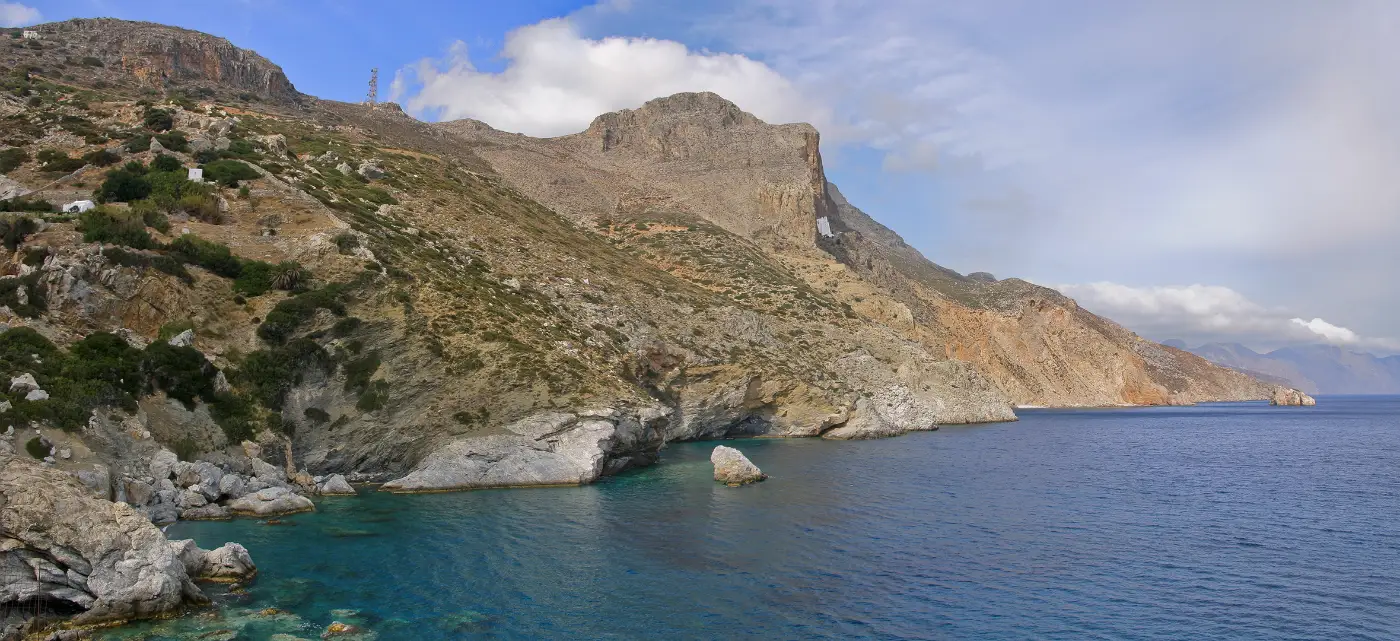
Panagia Hozoviotissa, which is the reason most people put Amorgos on a list at all. A narrow white building of eight floors, carved into a sheer cliff face roughly 300 metres above the sea on the southeast coast, below Chora and above the small beach at Agia Anna. It is one of the oldest and most dramatic monasteries in Greece, and it is still a working one, home to a handful of monks.
Its age is genuinely unsettled, and the honest thing is to say so. The Municipality of Amorgos, on its own pages, gives two dates rather than one: built in 1017 and renovated in 1088 under the Byzantine emperor Alexios I Komnenos. It houses an icon traditionally dated to 812. Founded early in the second millennium, with the municipality’s 1017 and 1088, is as precise as the sources honestly allow, and this page will not tidy that into a single founding year.
The climb. You leave the road and walk up a stepped path to the entrance set into the rock, then up through the floors inside. It is short but steep.
The dress code, which is enforced at the door. This is an active monastery and it publishes its expectation plainly: visitors are asked to be decently dressed, men in long trousers, women in a long skirt, shoulders covered. Travellers often report that wraps and cover-ups are available at the entrance, but arriving already covered is the only version of this that cannot go wrong. Greek etiquette and customs covers the general practice.
The timing, which decides whether you get in. It is a monastery, so its day runs in two halves: a morning window, a long closure through the middle of the day, and a shorter reopening in the late afternoon. Go in the morning, and check the current schedule locally before you climb rather than trusting a time you found in advance, because hours move with the season and the calendar.
The welcome, which is a custom rather than a guarantee. By tradition the monks offer visitors who make the climb a small treat: psimeni raki, the local spirit sweetened with honey and spices, and a piece of loukoumi. Take it as the custom it is.
The Big Blue, and why it matters more than film trivia usually does. Much of Luc Besson’s 1988 film was shot on Amorgos, most memorably at Agia Anna bay directly below the monastery. It turned a quiet, hard-to-reach island into an international name, and it is the reason Amorgos has a diving identity at all: the clear, deep water Besson filmed still draws divers and snorkellers, with a dive operation based up at Aegiali running guided dives and courses and wreck and cavern sites offshore.
Keep it in proportion, though. It is a strong reason to care about the sea here and a good detour for fans who want to stand on the beach from the poster. It is not, on its own, a reason to plan a whole trip around, and you need not hunt for film-themed bars to feel you have paid your respects. The water does that.
Chora, which holds the island’s evening. The whitewashed capital sits inland and uphill, with narrow marble-paved lanes climbing to a Venetian castle, the Kastro, on its rock, a row of windmills along the ridge and small churches tucked between the houses. It has no beach of its own, but it is where the island gathers after dark. Our Amorgos guide has the practicalities, the beaches cover the coast, and where to stay covers the three anchors.