Aegina
Things to do in Aegina
Aegina is the closest of the Saronic islands to Athens and the easiest island day out in Greece, and what is on it is better than that convenience suggests. This is a working island rather than a resort, with a farming interior and a town that carries on out of season, and it holds two genuinely unusual sites within a short drive of each other.
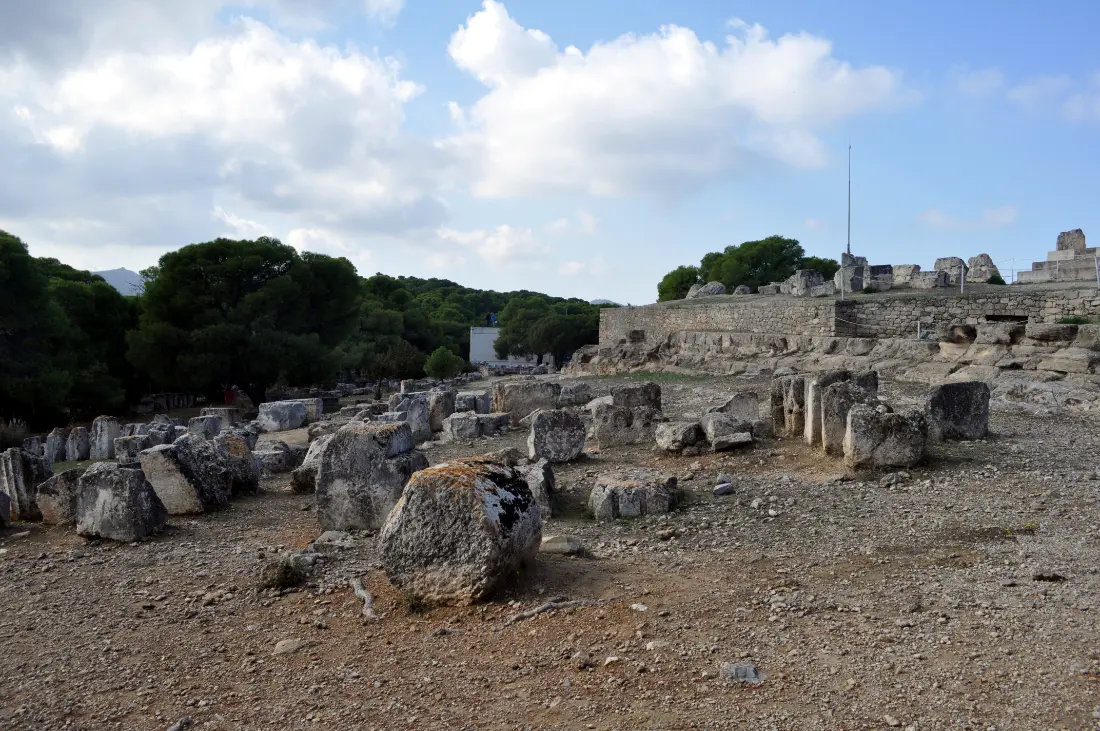
The Temple of Aphaia, which is the reason to come. It stands in pines on a hill in the northeast, built around 500 BC, and it is one of the best-preserved Doric temples anywhere: most of its columns are still up and a good number still carry their architrave. Standing inside a temple whose colonnade is largely intact is a different experience from standing among foundations, and there are very few places in Greece where you can.
The holy triangle, and what can honestly be said about it. Aphaia forms a near-equilateral triangle with the Parthenon and the temple at Cape Sounion, which people call the holy triangle. Whether that was intended is unprovable, and this page does not claim it was. It makes a good view either way, and knowing the three points is worth more standing on the hill than the theory is.
Palaiochora, which is stranger than the temple. Inland stands the abandoned Byzantine and Venetian town, built up a hillside for safety from pirates and emptied in the nineteenth century. What survives is around thirty churches and chapels scattered across the slope with almost nothing else between them. It is unfenced and quiet, and walking a hillside of chapels with no town left around them is the thing people remember about Aegina long after the temple.
Aegina town, which is a proper port rather than a waterfront. A curving front of neoclassical houses, fishing boats selling from the quay, and a single surviving column of the Temple of Apollo on the headland at Kolona with a museum beside it. One column is not much to look at and it is a great deal to think about: it is what is left of a temple on a headland that has been a landmark for the whole gulf.
The pistachios, which are a designation rather than a souvenir. Aegina’s pistachios carry a protected designation and are genuinely better than the imported kind. They are sold everywhere and are the standard thing to carry home, and on an island with a farming interior they are the visible end of what the place actually does for a living. Greek food and drink covers the wider table.
Perdika and Moni, for the afternoon. Perdika in the southwest is the fish-taverna village, and it is the boat point for Moni, an uninhabited islet a few minutes offshore with clear water. That short hop is the best way to end a day here that started at a temple.
Day trip or a night, honestly. Ferries and fast boats run from Piraeus all day and it works as a day trip, but the temple, Palaiochora and a swim make a rushed one. One night turns it into a proper visit, and the town in the evening is the best part, because the day-boat crowd has gone and the port goes back to being a port. Athens to Aegina as a day trip covers the excursion version, our Aegina guide has the island, and the beaches are honest about being modest.