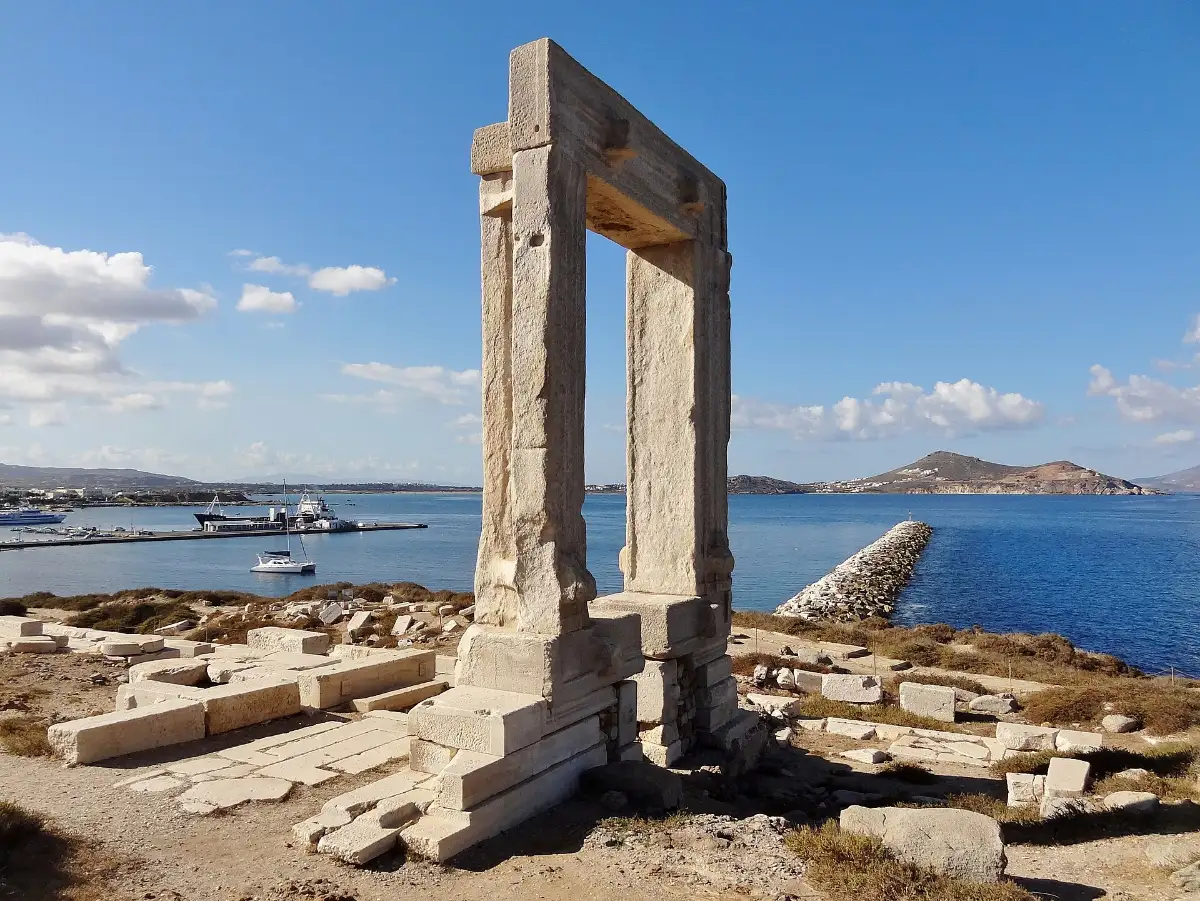
A door with no building
The Portara is a marble doorway standing by itself on a small islet off Naxos Town, and it is the first thing the island shows you: the ferry turns in and there it is, framed against the sky with nothing on either side of it.
It is not a ruin in the ordinary sense. It is the only finished part of a temple that nobody ever finished. Naxos’s own municipal record dates the temple to 530 BC and attributes it to the tyrant Lygdamis, who set it out to the specifications of the great temples of his day.
He never got past the gate.
The rest of Naxos is a working island with a mountain down its spine. This is the ten minutes at the start of it.
Why the door outlived the temple
Here is the fact that makes the Portara make sense, and almost nobody prints it.
The gate is built from four blocks of local marble, each weighing about twenty tonnes. Stand at the doorway and you are standing at one end of a building that was never built, of which this is the only piece that was ever finished.
We are not going to tell you how big that building was going to be, and here is why. Naxos’s own municipal record puts the planned temple at about 59 metres by 28. Wikipedia’s account of the same temple says 38 by 16. Those are not roundings of each other, and we could not open the Ministry record that would break the tie. A number two sources disagree about is not a number, so we print neither.
What you can see with your own eyes is better than either of them.
The marks of the crane are still on the stone. The marble carries carved bosses, small raised lugs that the masons left on so ropes could be hitched to them and the blocks hauled up by wooden crane. Bosses are working handles. They are cut away and the surface dressed smooth at the end of a job, when the building is done.
Nobody ever came back to cut them off. The proof that the temple was abandoned is not in a book. It is on the doorway, in daylight, where anyone standing in front of it can see it.

Diagram by Greece Trips. Free to reuse with credit - CC BY 4.0.
Then it sat there for two and a half thousand years while the island took the temple apart.
Under the Venetians, much of the stone was carried off into Naxos Town and built into the castle. Marble is worth carrying. What stopped them at the gate was arithmetic: four blocks, twenty tonnes each, and no way to move them that was worth the trouble. The Portara survives because it was too heavy to steal.
That is the whole story of the monument, and it is a better one than the postcard. Everything that could be taken was taken. The doorway is what was left when the taking stopped.
Why the temple was abandoned in the first place is less settled than the internet suggests. The common account is that Lygdamis fell and the war with Samos ended the work, and it is repeated everywhere. The municipal record does not say so, and we are not going to state a cause it does not state.
Getting there, and how long it really takes
The islet is called Palatia, and it is joined to Naxos Town by a paved footpath. You walk out along it. That is the whole journey.
From where the ferry lands, it is minutes. If you have an hour between boats, you have time for this and a coffee afterwards, which is genuinely how a lot of people see it. How the boats work, and how much slack to leave, is in the Greek island ferries guide.
Now the honest part, because a page that inflates a small thing is not worth reading.
This is a walk out, a look, and a walk back. There is one thing to see and you see it in a moment. Nobody spends an afternoon at the Portara. It is not a site you tour, it is a thing you stand in front of, and the reason to go is that it is extraordinary to stand in front of, not that there is a great deal of it.
The ground is bare rock and worn marble, and the path onto the islet is open to the weather on both sides. That is a description, not a rating: what the footing is like on the day you go is something you will see when you get there, and it is not ours to score from a desk.
One more thing worth saying plainly, because every other page glides over it. We could not find an admission fee, an opening time, or any published access rule for the Portara. The municipality publishes none of the three. We are telling you what we found and did not find, and not converting a silence into a promise: we are not going to tell you it is free and always open, because no authority we can point at says so.
The sunset, and the crowd that arrives with it
The sun sets through the doorway. That is the reason for the crowd, and it is a real reason: the gate frames it, and a frame around a sunset is why anyone builds a doorway on a headland in the first place.
It is also why, for one hour a day, you will be sharing a small rock with a large number of people and their phones.
The trade is obvious once you say it out loud. Go at the hour everyone goes and you get the photograph and the crowd. Go at almost any other hour and you get the doorway, the sea through it, and nobody. Morning is quiet. So is the middle of a hot afternoon, when the town is asleep and the rock is empty.
We are not printing a time for the sunset, because it moves across the year by a couple of hours and a number on a page would be wrong for most of it. Look it up for the day you are there. What does not change is the pattern: the islet fills in the half hour before, and empties within minutes after.
Worth the walk
The Portara is small, unticketed as far as anyone publishes, and about four minutes from the port.
It is also a door built for a temple that was never built, left standing because nobody could carry it away, and the first thing the island shows every person who arrives by sea.
Go and look at it. Then go and see the rest of Naxos, which is a bigger island than its harbour suggests.
Portara FAQ
What is the Portara in Naxos?
The Portara is a large marble doorway standing alone on the islet of Palatia, just off Naxos Town. It is the only completed part of a temple of Apollo begun around 530 BC under the tyrant Lygdamis and abandoned before it was finished. The gate is four marble blocks of about twenty tonnes each.
Why was the Temple of Apollo never finished?
The usual account is that the work stopped when Lygdamis fell from power and Naxos went to war with Samos. It is repeated widely, but Naxos’s own municipal record does not give a reason, so we report the explanation rather than asserting it as fact.
How do you get to the Portara?
On foot. The islet is joined to Naxos Town by a paved footpath, and it is a few minutes’ walk from where the ferries dock.
Is there an entrance fee for the Portara?
We could not find one published, and we could not find opening hours either. The municipality publishes neither. That is our honest answer: no authority we can point at states a fee, a time, or an access rule, and we are not going to turn that silence into a promise that it is free and always open.
How long do you need there?
Minutes. It is one thing to look at and there is no site to walk around. That is not a criticism of it.
Booking
We sell nothing and book nothing for you. Every guide on this page tells you how to arrange each piece yourself - which ferry operator, when to book, what to prebook and what to leave loose.