Island group
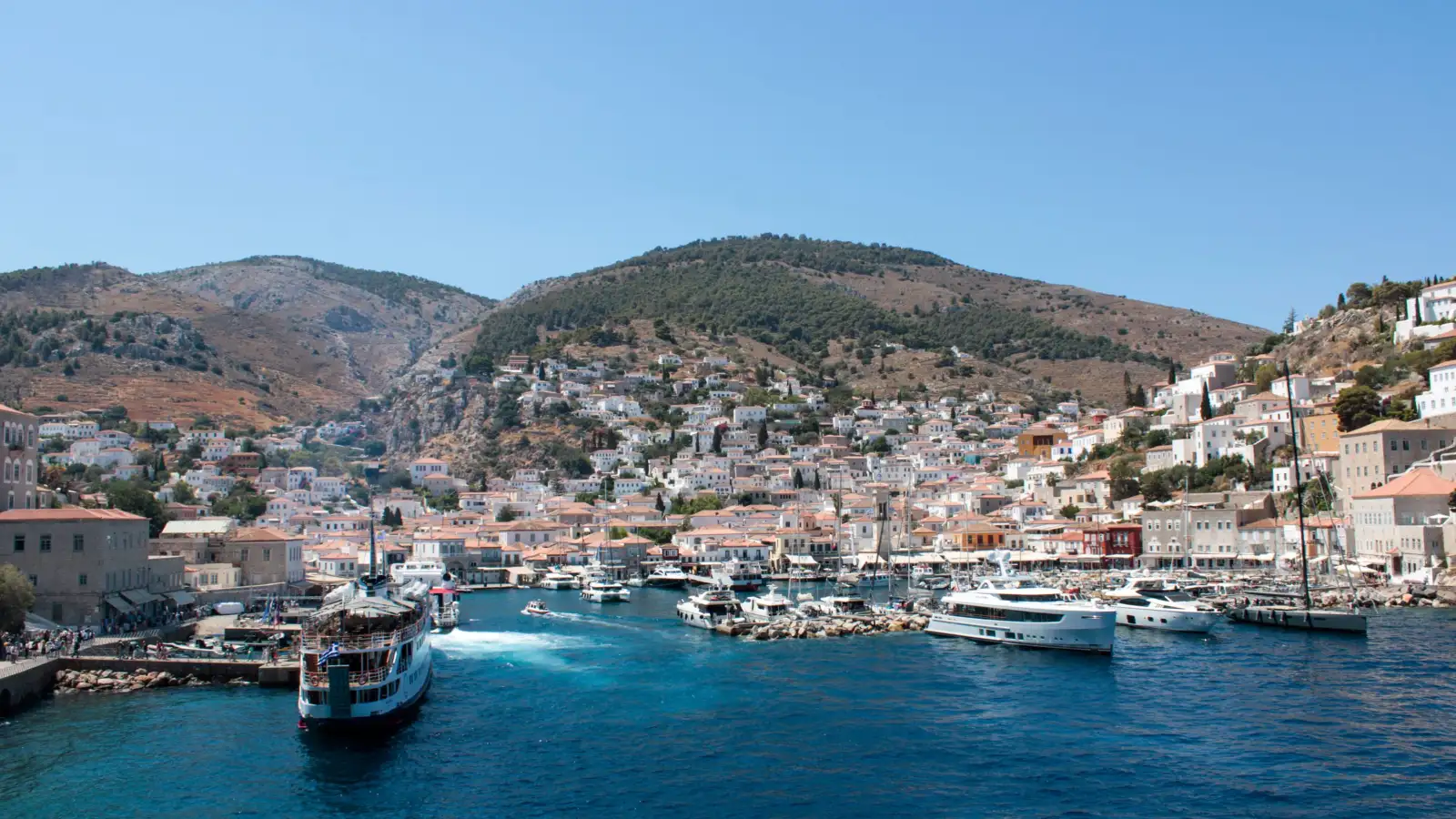
Saronic Gulf (Saronic islands), Attica, Greece; off the east coast of the Peloponnese. Almost all life is in the one harbour town, Hydra Town (Hydra Port), which rises in a stone amphitheatre around the harbour
Car-free
private cars, motorbikes and scooters are all banned, and so are bicycles; transport is on foot, by donkey/mule/horse and by water taxi. The ban is imposed and policed by the authorities
Airport
none. Arrival is by ferry, and the Piraeus route is served only by fast boats, about 1 hr 5 min to 1 hr 30 direct; also reachable via the Peloponnese ports (Ermioni, Porto Heli, Metochi) and the neighbouring Saronic islands (Poros, Spetses)
Swimming
swimming is off rocks, concrete lido platforms and pebble coves - Spilia and Hydronetta by town, Kamini and Vlychos on foot, Bisti and Agios Nikolaos by water taxi. Mandraki, east of town, is the island’s one sandy beach, run as a serviced beach from around April to October
History
18th-19th-century merchant and shipping wealth built the captains’ mansions (archontika); leading role in the 1821 Greek War of Independence. Museums: the Historical Archives Museum (a branch of the General State Archives, founded 1918, open daily, hours not published) and the Lazaros Koundouriotis Mansion (National Historical Museum annex since 2001; 25 March to 31 October, daily 10:00-16:00)
Art heritage
1960s bohemian haven (Leonard Cohen’s house among others); living scene through the Athens School of Fine Arts annex in the Tombazis mansion (since the 1930s) and the DESTE Foundation’s summer contemporary-art shows in the former slaughterhouse, granted by the municipality in 2008 and running annually since 2009 (June to October, closed Tuesdays; 2026: Nari Ward, “Until That Day”)
Best months
late April to June and September to October (warm sea, open town, thinner crowds); July-August hottest and busiest; town lived-in year-round. Miaoulia festival in late June, dates set by the municipality each year
Travel details last checked July 2026.
You can see Hydra in a day from Athens, and most visitors do. It is a quieter, slower island after the last fast ferry leaves and the day boats empty the harbour, though, so this page is written for both the day-tripper and the overnight guest.
A car-free island in the Saronic Gulf
Yes, Hydra is car-free by rule rather than by accident. Private cars, motorbikes and scooters are all banned across the island, and so are bicycles. People and goods move on foot, by donkey, mule or horse, and by water taxi, and the harbour is the island’s one point of arrival and departure.
Picture the geography like this. Hydra lies in the Saronic Gulf, off the east coast of the Peloponnese, close enough to the mainland that a fast ferry from Piraeus reaches it in well under a morning. Almost everyone lives in a single settlement, Hydra Town, also called Hydra Port, which rises around the harbour in a horseshoe of grey-stone houses stacked up the slope like seats in a theatre. Beyond it are a few small coastal hamlets, and behind it bare hills, monasteries and walking paths. There is no second town competing for your attention. The port is the island. For all its fame, Hydra island stays small: one harbour town and a handful of hamlets on a dry, hilly rock.
The rule is imposed and policed by the authorities rather than left to local custom, and it has held for decades, which is a large part of why the stone town is still intact and still looks of a piece. The ban is not a novelty laid on for visitors. It decides how you arrive, how you move once you land, how far you can reasonably go, and the pace the whole day runs at, each of which the sections below take in turn.
That gives Hydra a very different rhythm from the road-and-scooter islands, and it is one reason it reads as the calmest of the Saronic islands within easy reach of the capital.
Getting to Hydra: a fast ferry from Piraeus, and no plane
Hydra has no airport, so every arrival is by sea. The usual route is a high-speed passenger ferry from the port of Piraeus in Athens, a bit over an hour across the Saronic Gulf - direct crossings typically run about an hour and five minutes to an hour and a half - docking right in the middle of Hydra Town. Because no cars can come anyway, it is always a foot-passenger crossing, and the route is served by fast boats rather than conventional car ferries.

Diagram by Greece Trips. Free to reuse with credit - CC BY 4.0.
The Piraeus boats are the mainstay, fast catamarans and hydrofoils built for speed rather than for carrying vehicles. They are not the only way in. Hydra also connects to the mainland Peloponnese through the small ports of Ermioni and Porto Heli, and through the tiny Metochi crossing almost opposite the island, and it sits on the same water as the neighbouring Saronic islands of Poros and Spetses. That matters if Hydra is one stop on a wider loop rather than an out-and-back from Athens.
Treat the crossing as a decision, not a timetable. This is a popular, weather-sensitive summer route, and the fast ferries sell out on peak weekends, so book ahead rather than turning up at the quay and hoping. Strong winds can hold or cancel high-speed sailings, which is worth remembering if you are trying to connect a same-day flight home; leave yourself slack. Any specific fare or departure you are quoted will move between seasons and operators, so confirm it close to the day. How the boats and the ports actually work, across the country, is in Greek island ferries.
The arrival itself tells you where you have come. The ferry noses into the harbour, the ramp comes down, and you walk off straight into the town, or load your bags onto a mule. That is the whole arrivals operation, and the mule is the subject of the next section.
Getting around: on foot, by mule, by water taxi
With no wheels allowed, the harbour is the island’s one transport hub, and you have three ways to get anywhere from it: your feet, a mule, or a boat.
In the town itself, everything is steps and stone lanes, so you walk. The mules and donkeys waiting on the quay are not a photo prop, they are the island’s lorries, carrying building materials, furniture, deliveries and the day’s rubbish up and down the stepped lanes, and, for a fee, your luggage to wherever you are staying. Water taxis run along the coast to the swimming coves and the hamlets you cannot easily reach on foot.
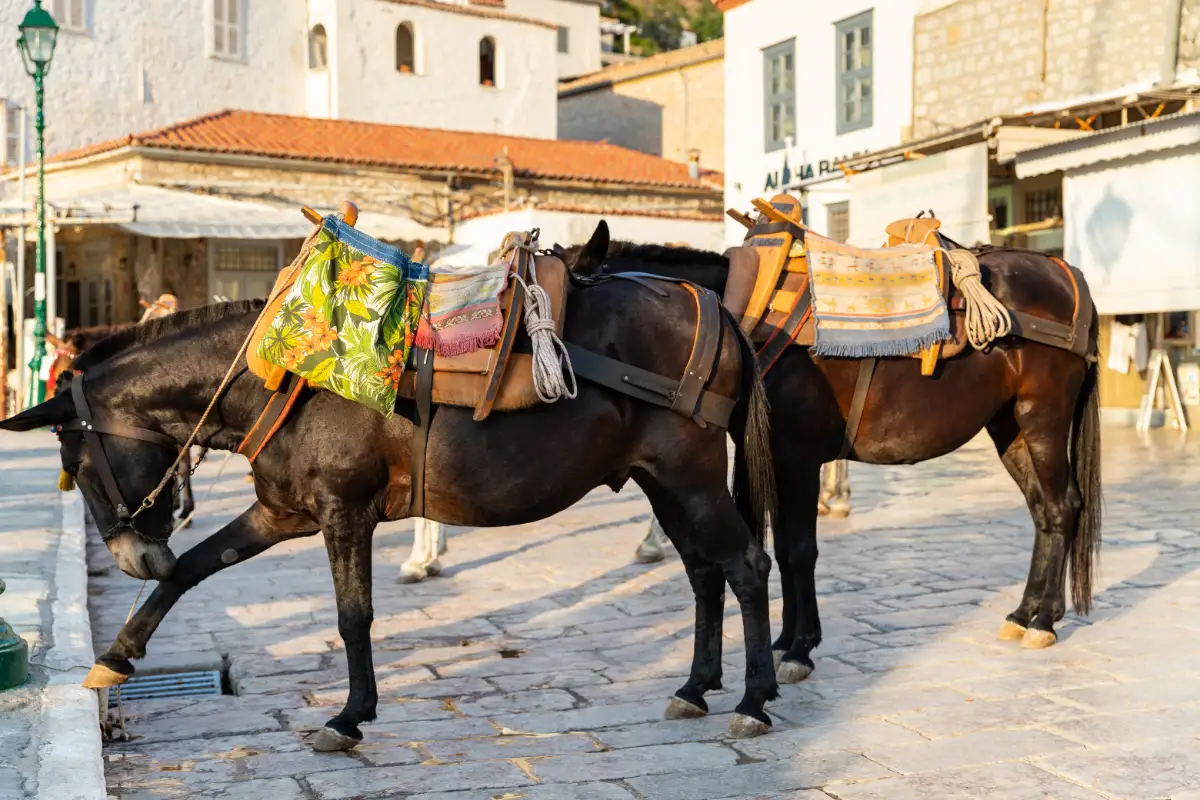
How far you are going decides which you need. The town is small and walkable end to end; the coastal paths west to Kamini and Vlychos are an easy-to-moderate walk; the quieter coves beyond are a water-taxi hop. Walk for nothing and see more of the coast on the way, or pay the boat to reach the far, empty ends quickly.
It is worth being honest about the terrain. Hydra is steps, slopes and cobbles almost everywhere, with no wheeled transport of any kind, so it is hard going for wheelchair users, for anyone pushing a pram, and for anyone who struggles with stairs. The mules move luggage, not people. If a specific need matters to your trip, check what your accommodation actually provides before booking rather than assuming; the wider picture is in accessibility in Greece.
And if you are staying up in the town, either arrange a luggage-mule at the harbour or be ready to carry your bag up the steps yourself, so pack for that.
The harbour town and the captains’ mansions
The stone amphitheatre above the harbour is not just a view, it is a record of where the island’s money came from. In the 18th and early 19th centuries Hydra grew rich on a merchant and shipping fleet that traded across the Mediterranean, and its sea captains put that wealth into the tall grey-stone mansions, the archontika, that still ring the port and climb the slope above it. A small, dry, rocky island ended up with grand houses because it owned ships, not fields.
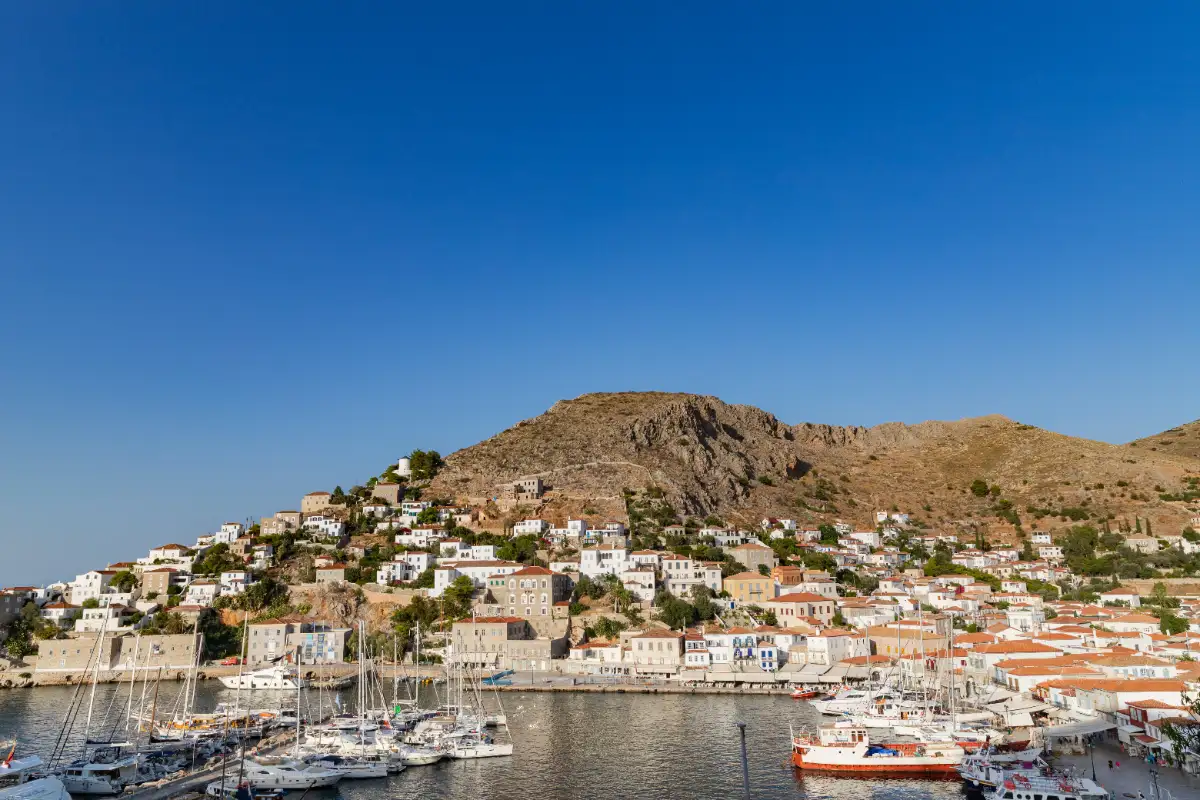
That fleet also put Hydra at the centre of the country’s founding. In the 1821 Greek War of Independence the island’s merchant ships were converted for war, and Hydriot captains and admirals played a leading part in the naval campaign, a history the island has never stopped telling about itself.
You can walk into that story rather than just read it. The Historical Archives Museum, a branch of the General State Archives founded in 1918, sits on the eastern side of the harbour and holds some eighteen thousand documents of the 18th and 19th centuries alongside paintings, weapons, ship figureheads and models, and a portrait gallery of the island’s revolutionary fighters; it opens daily, though it publishes no fixed hours, so ring ahead if your day depends on it. The Lazaros Koundouriotis Mansion, a late-18th-century captain’s house on the west side of the harbour that has run as an annex of the National Historical Museum since 2001, lets you inside one of the archontika to see how these families actually lived; its season is 25 March to 31 October, daily from ten to four, with winter visits by arrangement for groups. Those are the anchors, and unlike the restaurants and rooms that come and go around the harbour, the museums and the history stay put.
Give the town its due beyond the waterfront, too. The harbour is the stage, and most day-trippers never leave it, but the town climbs steeply behind the front into quiet lanes, small chapels and viewpoints where the crowd thins to nothing. That the whole place still reads as one period piece is down to the same enforcement that keeps the cars out.
Why the artists came, and why they still do
Hydra’s bohemian name is usually pinned to one man, and it is worth getting past him. In the 1960s the island became a gathering place for writers, painters and musicians drawn by the light, the quiet and the cheap stone houses you could buy for very little. Leonard Cohen was the most famous of them: he bought a house on Hydra and lived here on and off through that decade, and the house is still a private home you glimpse from the lane rather than a site to visit, so admire it in passing and leave the residents in peace.
The more interesting point is that the art did not leave with the sixties. The thread is still being pulled today, and by durable institutions rather than the pop-up galleries that open and close with the season. The Athens School of Fine Arts has run an annex since the 1930s in the Tombazis mansion, an admiral’s house on the right-hand side of the port, giving generations of Greek artists a working base on the island. And since 2009 the DESTE Foundation has staged a contemporary-art exhibition each summer in Hydra’s former slaughterhouse on the waterfront rocks, a building the municipality granted the foundation in 2008 and which now draws the international art world to a place that once butchered livestock. The space runs from June to October, closed on Tuesdays, and the 2026 show is Nari Ward’s “Until That Day”.
For a visitor, that means the bohemian label is earned in the present tense, not just remembered. In summer you can see serious new work alongside the maritime museums, and the galleries and studios scattered through the lanes are simply part of the walk. The quiet and the light that pulled people here sixty years ago are still doing it.
Swimming on Hydra: you swim off the rocks
Hydra keeps the clear water and loses the sand. There is almost no sandy beach here to plan a day around; instead you swim off flat rocks, small concrete lido platforms and pebble coves, dropping straight into deep, clear water. Set that expectation before you cross, and you will pack a towel and swim shoes rather than arriving with a beach-day plan the island cannot fill.
Think of the swimming as a short map. Right by the town, a few minutes from the harbour, you get into the water off the rocks at Spilia and below Hydronetta, where ladders and cut steps take you off the stone into the deep. An easy coastal walk west brings you to the pebble coves at Kamini and then Vlychos, the everyday swims for anyone staying on the island. The quieter coves at the western end, Bisti and Agios Nikolaos among them, are reached mainly by water taxi, which is exactly why they stay quiet. The water itself is the reason you came in, and what the Greek sea is like sets the expectation for it.
The one honest exception is Mandraki, about twenty minutes’ walk east along the shore or a few minutes by water taxi, where the island’s only sandy beach runs as a serviced one, with sunbeds, parasols and food and drink brought down from the resort behind it, open through the warm half of the year. So the accurate line is not “zero sand anywhere” but “essentially no natural sand, with Mandraki the small exception.”
All of this ties back to the car-free rule. Because there are no roads to the coves, reaching the far ones is always a walk or a boat, and that friction is the whole reason the western swims stay as empty as they do.
When to go
The best windows are late April to June and September to October. In those months the sea is warm enough to swim, the town and its tavernas and boats are open, the walking weather is kind, and the heaviest day-tripper crowds of high summer have eased. It is a recommendation about months, not a promise about temperatures.
July and August are the hot, busy peak. The harbour fills with day boats and fast-ferry crowds, everything wants booking ahead, and the heat sits heavy on a treeless, stepped town. Winter runs the other way: many seasonal places close, but unlike a pure resort island, Hydra is a lived-in town year-round, so it never fully shuts. Spring comes green and mild; autumn holds a warm sea after the crowds thin.
Whichever month you pick, the day keeps the shape you met at the top of this page: the harbour belongs to the day boats until the late-afternoon ferries leave, and then the whole island is its own again. Shoulder season simply hands you more of that quieter Hydra, the same logic that runs through the best time to visit Greece and why shoulder season wins on the islands.
One date worth timing for is the Miaoulia festival in late June, which the municipality runs over several days in honour of Admiral Andreas Miaoulis and which culminates in a re-enactment of the naval Battle of Gerontas and the burning of the Turkish flagship in the harbour, followed by fireworks. The dates move each year, so take them from the municipality rather than from a guide.
Day trip or overnight, and who Hydra suits
You can see Hydra in a day, and it is one of the easiest day trips from Athens. A fast ferry from Piraeus, or a Saronic cruise that also calls at Poros and Aegina, gives you the harbour, one coastal walk or a swim off the rocks, a long lunch and the back lanes above the port. For a lot of people that is a full and satisfying day out.
What a day cannot give you is the other Hydra. It misses the far western coves, the quiet upper town, and above all the evening, the stretch after the last fast ferry has gone, when the day boats have emptied the harbour and the front belongs to the few hundred people who actually live here. That is the Hydra people come back for, and it only appears once the crowds leave.
So the honest recommendation is this: if the shape of your trip allows it, stay at least one night. Hydra is at its best after the day-trippers have gone.
It suits some travellers plainly and will frustrate others, and it is fairer to say which than to sell it to everyone. Hydra is for walkers, for couples, and for anyone drawn to quiet, history, contemporary art and clear water off the rocks. It is a poor fit for anyone who needs a sandy resort beach, big organised nightlife, or step-free, easy-rolling ground, because what the island actually is, a steep, quiet, walked stone town with the sea at its feet, is the opposite of those things.
Then the wider move. Hydra pairs naturally with Athens, its gateway and an easy base on either side of the crossing, and with the other Saronic islands for a short island loop rather than a single stop. Line those up, and see how it fits among all our Greece destinations, and one small carless island becomes the calm heart of a proper trip.
Let the ban set the pace
The rule that keeps the cars out is the same rule that hands you the island’s real pleasure. Because no wheeled traffic is allowed, Hydra is still a stone amphitheatre of captains’ mansions above clear water you reach on foot or by boat, and the day is measured in footsteps, mule bells and the wake of the water taxis. The only thing it asks of you is that you slow to its pace.
So cross from Piraeus, give Hydra a full day or, better, a night, and hang it off an Athens stay or a short Saronic loop. Planned that way, one small car-free island is not a rushed snapshot but the calm centre of a whole trip.
Hydra FAQ
Is Hydra really car-free?
Yes. Private cars, motorbikes and scooters are banned on Hydra, and so are bicycles. Everything and everyone moves on foot, by donkey, mule or horse, or by water taxi, and the harbour is the island’s one transport hub. The ban is imposed and policed by the authorities, not a local courtesy, and it is what keeps the old stone town intact.
How do you get to Hydra from Athens?
Hydra has no airport, so you take a high-speed passenger ferry from the port of Piraeus in Athens, a bit over an hour across the Saronic Gulf - typically about an hour and five minutes to an hour and a half - docking in Hydra Town. It is always a foot-passenger crossing, since no cars can come. Book ahead in summer and allow for wind, which can hold up fast sailings. You can also approach from the Peloponnese ports of Ermioni, Porto Heli and Metochi, or from the neighbouring islands of Poros and Spetses.
Does Hydra have an airport?
No. Hydra has no airport, so travellers fly into Athens International Airport and then reach the island by ferry from Piraeus. From the airport you get to Piraeus by metro, airport bus or taxi, then board the fast ferry across the Saronic Gulf. The last leg is always by boat.
Does Hydra have sandy beaches?
Barely. Swimming on Hydra is done off flat rocks, small concrete lido platforms and pebble coves, straight into very clear, deep water. The island’s one sandy beach is Mandraki, a short hop east of town by water taxi or twenty minutes on foot, run as a serviced beach through the warm months. By the town you swim at Spilia and Hydronetta; on foot you reach the pebble coves of Kamini and Vlychos; the far coves of Bisti and Agios Nikolaos are a water-taxi ride.
Can you visit Hydra as a day trip from Athens?
Yes. Day trips are easy on the fast ferry from Piraeus or on a Saronic cruise, and a day gets you the harbour, a swim off the rocks, a lunch and the back lanes. What a day misses is the far coves, the upper town and the quiet evening after the day boats leave. If your trip allows it, stay a night; that is when Hydra is at its best.
How many days do you need in Hydra?
One night is enough to get the real Hydra: a full day to walk the town and swim, plus the evening the day-trippers miss. Two nights suit anyone who wants to reach the far coves by water taxi, walk up to the Profitis Ilias monastery and take the island slowly. Many people do it as a single day from Athens, which is a fair taste of the place, just not the whole of it.
How do you get around Hydra without cars?
On foot for the town and the near coastal paths, by mule or donkey for luggage and goods (the working animals you see at the harbour), and by water taxi for the coves and hamlets you cannot easily walk to. Because no vehicles run on Hydra, there are no taxis, buses or hire cars: your feet, a mule and the water taxi are the options. It is steps, slopes and cobbles throughout, so it is hard going for wheels and prams.
Plan by category
The Hydra guides
4 guides, each scoped to a decision you actually have to make.
 Attractions
Things to do
See the attractions →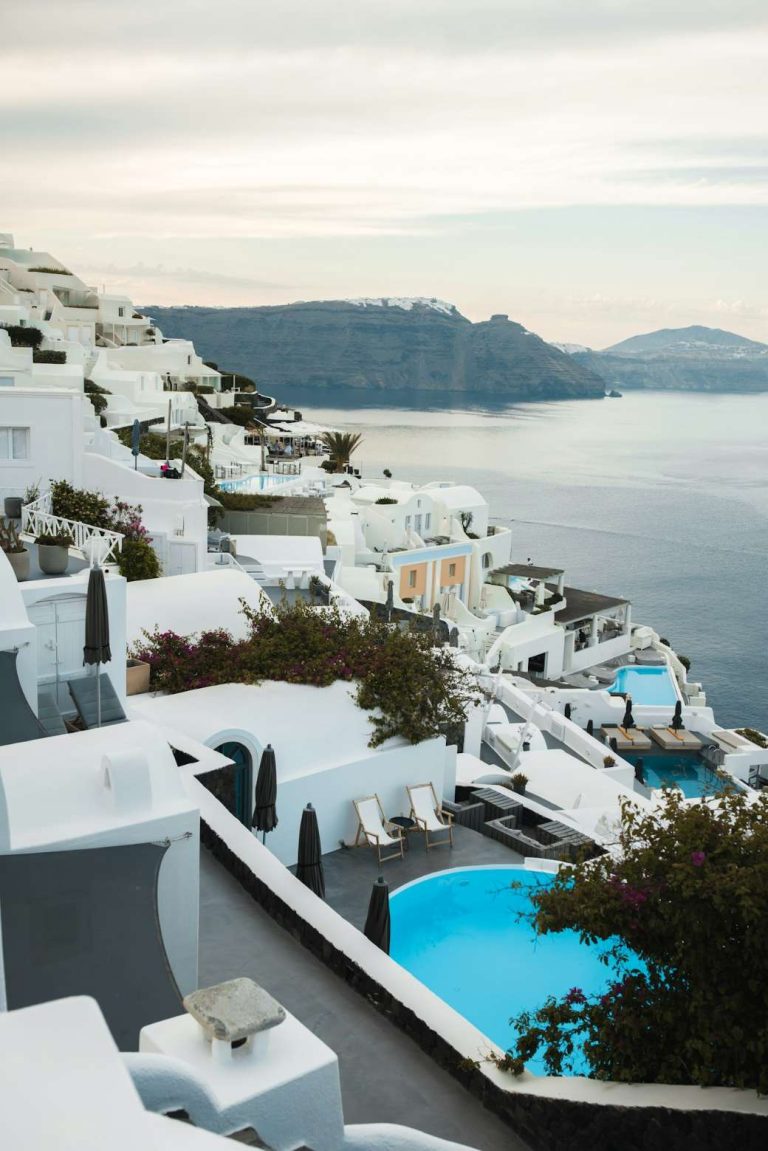 Hotels
Where to stay
Compare the areas →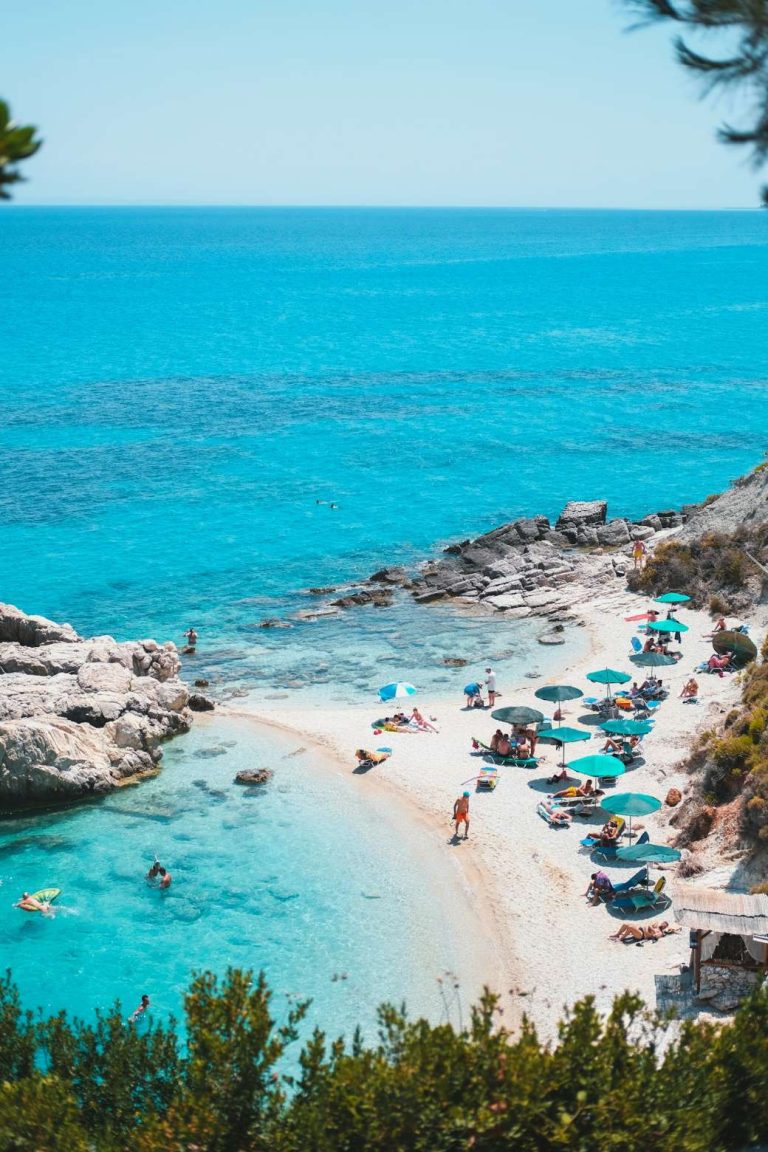 Beaches
The beaches
See the beaches →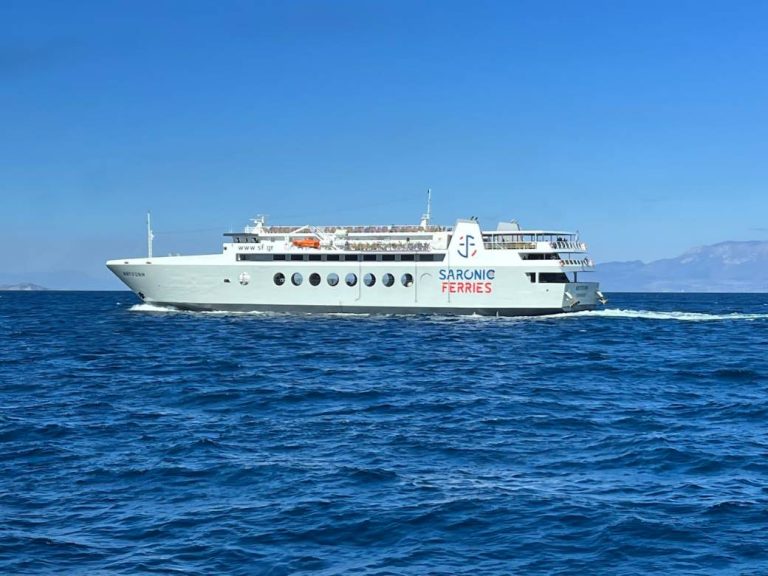 Itinerary
Day by day
See the itinerary →
Booking
We sell nothing and book nothing for you. Every guide on this page tells you how to arrange each piece yourself - which ferry operator, when to book, what to prebook and what to leave loose.