Region
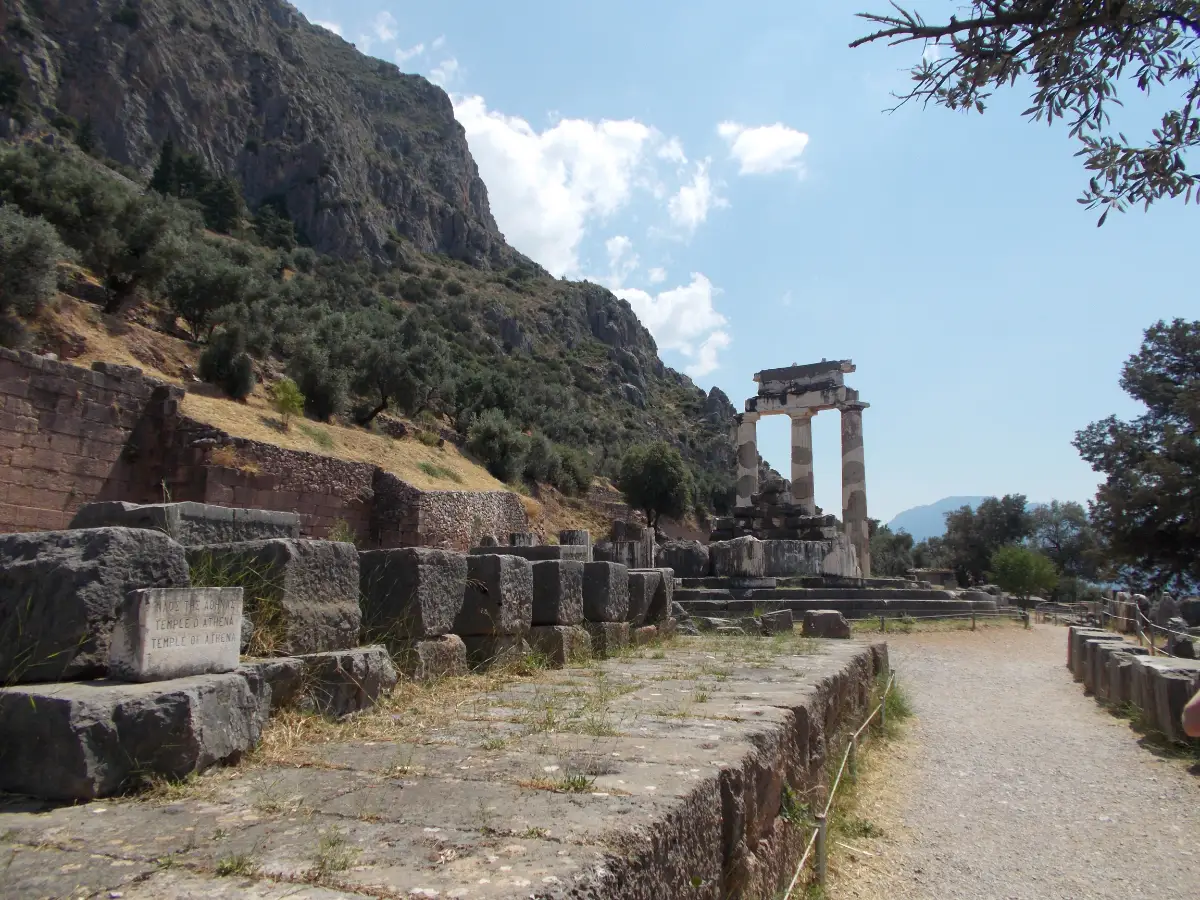
Phocis, Central Greece - lower slopes of Mount Parnassus, above the olive plain that runs to the Gulf of Corinth
From Athens
Roughly 180 km northwest; about 2.5-3 h by car. KTEL Fokidas runs the bus; confirm times and the Athens departure point with the operator, because the city’s intercity terminals are being consolidated
Site + museum ticket
One combined ticket covers the sanctuary and the Archaeological Museum (reduced and winter rates differ; free-admission days apply). No price printed - take it from the official listing
Best months
April-June and September-October (clear mountain light, bearable climb; July-August is hot and shadeless at midday; winter means short hours and Arachova ski-weekend crowds)
Travel details last checked July 2026.
A sanctuary on a mountainside: what Delphi actually is
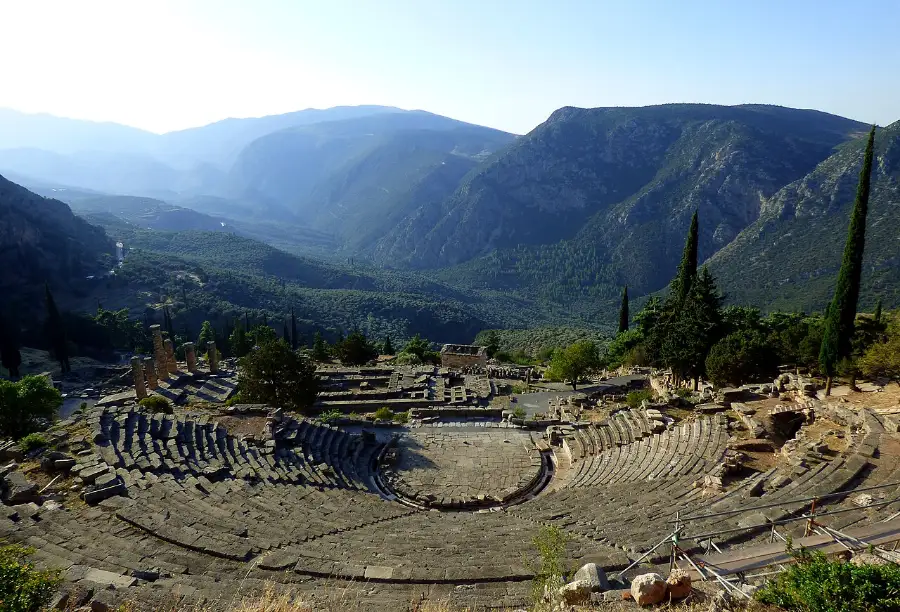
Delphi is the UNESCO-listed sanctuary of Apollo in Phocis, Central Greece - terraced ruins on the lower slopes of Mount Parnassus, roughly 180 km northwest of Athens, above an olive plain that runs down to the Gulf of Corinth. It is a mainland mountainside, not an island stop, and it pairs with Athens and Meteora rather than a ferry schedule.
The ancient layer first, briefly. The Greeks called this the navel of the world - the omphalos, the carved stone that marked the spot, now sits in the museum - and for around a thousand years city-states sent envoys up this slope to put their questions to the Pythia, Apollo’s oracle. The treasuries lining the path were built to bank their thank-you offerings.
The modern layer matters more to your plans. Today’s village was purpose-built in the 1890s, when the older village of Kastri was moved off the ruins so French archaeologists could excavate. That relocation is why a functional town of hotels and tavernas sits ten minutes’ walk from the site gate - a fact worth more than any myth when you are deciding where to sleep.
The deep history lives with the encyclopedias and UNESCO’s World Heritage listing. This page is about the visit, and about where the sanctuary sits among all the Greek destinations on a mainland route.
The decision that shapes the visit: day trip or overnight
Delphi runs on a coach clock. Most visitors arrive on day tours and coaches from Athens that put everyone on the Sacred Way in the same window - from about 10:30 to 15:00 - which happens to be the day’s worst light, worst heat and thickest crowds. That window is an observed pattern, not a schedule, but it repeats across review sites, where-to-stay guides and traveler forums with unusual consistency.
The alternative costs one hotel night. Sleep in the village and you walk into a near-empty sanctuary at opening, climb in the morning cool, take the museum without queues, and get the village’s quiet evening after the buses leave. Experienced travelers run the visit backwards: arrive mid-afternoon, do the museum first, then take the sanctuary at opening the next morning. When a Rick Steves forum thread asked exactly this question - one day or stay over - replies ran six to one for the night, citing that same pre-coach window.
| Day trip from Athens | One night in the village | |
|---|---|---|
| When you walk in | Mid-morning, with the coaches | At opening, near-empty site |
| The climb | Midday sun on shadeless stone | Morning cool |
| What it costs | A long day, 5-6 hours on the road | One hotel night |
| Who it suits | Fixed schedules, Athens-based trips | Anyone whose route can bend |
The verdict, plainly: if your schedule can bend at all, stay the night. If it cannot, the day trip is still worth doing - and the from-Athens mechanics for a single day, tour versus bus versus car with the hour-by-hour shape, live on the Delphi day trip from Athens page.
Getting to Delphi: car, KTEL bus, or a tour
However you ride, Delphi is roughly a two-and-a-half to three-hour road trip from Athens - the real choice between modes is control over your arrival hour.
A car gives you the most. The route runs northwest via Livadeia, a winding but straightforward mountain road that passes Arachova on the final climb. Driving is the only mode that guarantees you are at the gate when it opens and the only one that makes an onward Meteora leg practical. The catch is village parking, which is genuinely tight - more on that in the base section.
The KTEL bus is the cheap, simple option, and it is the cheapest way to reach Delphi from Athens by some distance. Three details are worth confirming with the operator rather than trusting any page, including this one: the fare, the times, and which Athens terminal it leaves from. Athens has been consolidating its long-distance bus terminals, so a station name that was right last season may not be right for your date. Buses stop at the edge of the village, a short walk from the hotels and the gate. Check return times before you commit to a same-day round trip.
A tour needs zero planning, but it locks you into the coach window this page argues against - fine for a one-day visit, pointless if you sleep over. And no useful train route exists, whatever a map app suggests.
| Mode | From Athens | Cost band | Choose it if |
|---|---|---|---|
| Rental car | ~2.5-3 h | Hire + fuel | You want to be there at opening, or Meteora next |
| KTEL bus | Confirm times with the operator | Cheapest mode; confirm fare with the operator | Budget, no driving, overnight stay |
| Organized tour | Full day | Mid to high | One day, zero planning |
Coming from the north, Delphi also slots in after Meteora, a drive of roughly 3-4 hours via Lamia and Amfissa. For car hire and KTEL mechanics across the country, see getting around Greece.
What you’ll see: the sanctuary, the museum, and the Tholos
Treat Delphi as one connected route, not a list of attractions. In walking order:
- The Sacred Way - the zigzag path climbing from the gate past the treasury foundations
- Treasury of the Athenians - the reconstructed marble treasury, the path’s landmark
- Temple of Apollo - the terrace where the oracle sat, with the polygonal wall below it
- The theatre - above the temple, the view back over the whole sanctuary and the valley
- The stadium - at the top, home of the Pythian Games
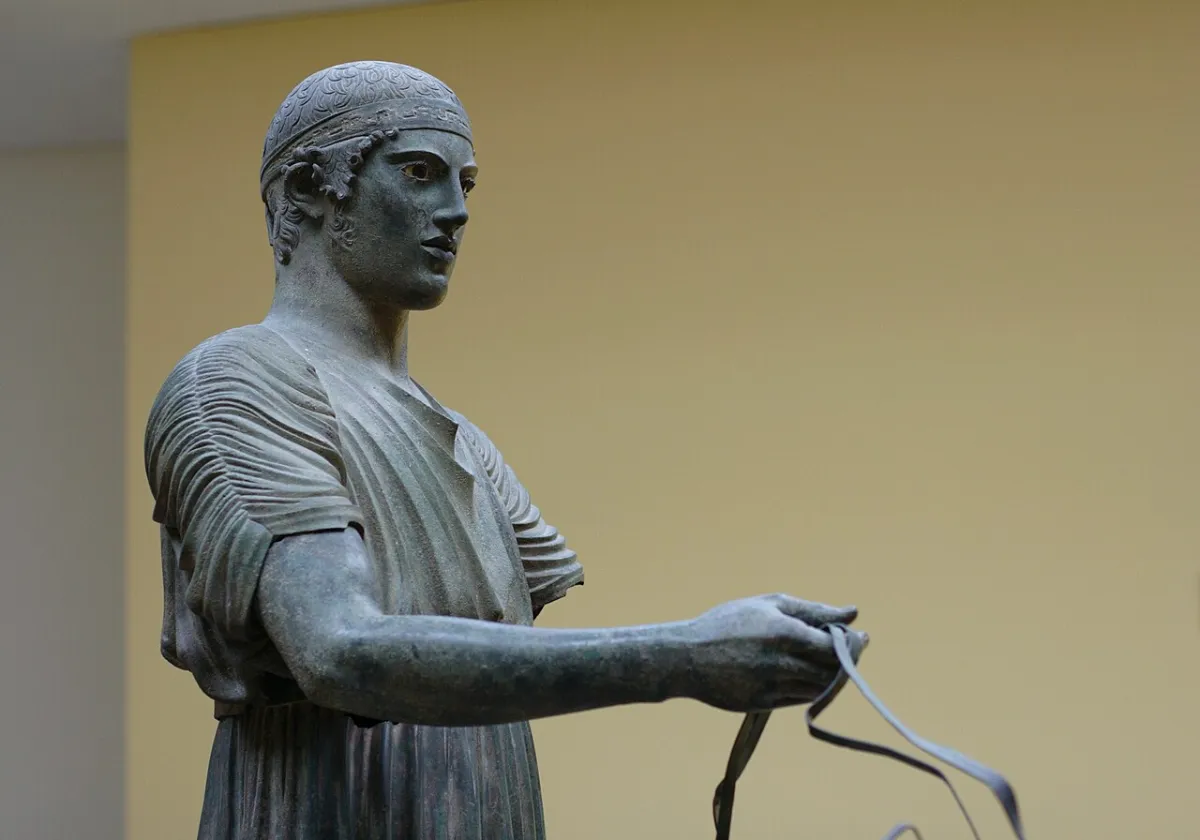
- The Archaeological Museum - the Charioteer bronze, the Sphinx of Naxos, the omphalos
- The Tholos - the circular monument at the Sanctuary of Athena Pronaia, down the road
The sanctuary itself takes two to three hours, and it is a sustained climb: gate to stadium on polished ancient stone with almost no shade. Do it first, in the morning cool. Real shoes, water and a hat are equipment here, not suggestions.
The museum takes one to one and a half hours and is compact and world-class - the Charioteer alone justifies the trip, and the omphalos closes the loop on the navel-of-the-world story. Take it at midday, when the open site is at its hottest and most crowded.
The Tholos is the surprise for most visitors: the round monument on every Delphi postcard is not in the main sanctuary. It stands at the Sanctuary of Athena Pronaia, a short walk down the road from the main gate - 30 to 45 minutes covers it. Check on the day whether the area remains open access outside the ticketed zone. Between the two sanctuaries, the Castalian Spring monuments beside the road have long been fenced off after rockfalls - look from the road, and do not build plans around going in.
One honest note on guidance: the gate does not hand out an official audio guide. Your options are a licensed guide, a guided tour, or a third-party smartphone audio tour, downloaded before you arrive, since signal on the slope varies.
Hours, tickets, and when to walk in
One combined ticket covers both the archaeological site and the museum, with reduced and winter rates lower. We print no price: admission is revised by the Ministry and a figure on a travel page is stale before you read it. E-tickets are sold on hhticket.gr, the official platform - queues are rarely Acropolis-length, but summer mornings go smoother with a ticket in hand.
Free-admission days exist at Greek state sites, and they are predictably the busiest days of their season. The current list is the Ministry’s to publish, so take it from the official listing rather than from a guide.
Hours swing hard with the calendar, and they contract sharply in winter. Check the official listing for your date rather than a blog’s grid - the unofficial ones lag, and the museum has at times kept a schedule of its own.
The hour you enter matters more than any grid. Walk in at opening, or late in the afternoon in summer. In winter, the short day makes morning the only real option.
How long Delphi needs
Plan four to five hours inside the gates: two to three for the sanctuary’s climb from the Sacred Way to the stadium, one to one and a half for the museum, plus the short walk down to the Tholos. Call it a half day, or with lunch in the village, a comfortable full one.
How those hours land depends on the earlier decision. The coach window compresses the half day into the hottest, busiest stretch; a self-driving day-tripper who leaves Athens by 6:30 does far better. The overnight version is the unhurried one - museum on the arrival afternoon, sanctuary at opening, on the road by noon - and it costs exactly one night.
Two nights are for specialists: Parnassus hiking, a Galaxidi evening, or Hosios Loukas on the way out. For most routes, one night is the sweet spot - which is exactly how Delphi slots into a 10-day Greece route with a mainland leg.
Where to base: Delphi village, Arachova, or the coast
Delphi village is plain, and it is still the right answer for most visitors. It is a functional 1890s town of two steep one-way streets, where parking is genuinely difficult and hotel parking is not something to count on - arrive early or drop bags first. Its real glory is not the architecture but the balcony view, the olive plain of Amfissa running down to the gulf. Every hotel sits within a 10-20 minute walk of the gate, and that walk is the whole point of staying. Pick it if the site is why you came.
Arachova, about 12 km east on the Parnassus road, a drive of about a quarter of an hour, is the handsome one: a stone mountain town with livelier tavernas and boutique stays. In winter it becomes a ski-resort scene - Greeks call it a winter Mykonos - and weekend prices spike accordingly. It needs a car, and it costs you the walk-to-the-gate morning. Pick it if the evening matters as much as the ruins.
Galaxidi and Itea sit roughly 30-40 minutes down on the gulf: Galaxidi a quiet neoclassical harbour town built for slow fish-taverna dinners, Itea its workaday seaside neighbour. Pick the coast if you are driving and want the sea in the evening.
| Base | From the gate | Character | Pick it if |
|---|---|---|---|
| Delphi village | 10-20 min on foot | Plain, functional, perfectly placed | Being there at opening is your plan |
| Arachova | ~15 min by car | Stone town, lively, pricier winters | You have a car and want evenings |
| Galaxidi / Itea | 30-40 min by car | Quiet harbour / workaday coast | You want the sea and the slow version |
This hub stays at area level - no hotel picks - and for what each base does to your budget, what a Greece trip costs has the bands.
When to come: spring light, autumn calm, and a winter warning
April to June and September to October are the months to aim for. Spring gives the site its best self - clear mountain light, green slopes, comfortable climbing weather. Autumn keeps the same virtues with emptier weekdays.
July and August work, but honestly: the site keeps long summer hours, and midday on that shadeless marble is a physical mistake the coach schedule forces on most visitors. If summer is when you can come, the opening-hour or late-afternoon entry stops being a nicety and becomes the plan.
Winter is the quiet secret with a catch. The sanctuary under Parnassus snow is genuinely atmospheric and near-empty, but opening hours contract sharply, and Arachova’s ski weekends fill rooms and lift prices across the area. Midweek is the winter move.
The year-round rule stands regardless: the hour you enter beats the month you choose. For the wider picture, see best time to visit Greece and the Greece weather month by month breakdown.
Beyond the sanctuary: Parnassus, the olive plain, and the sea
The setting is half the point, and it is the extra night’s real payoff. Delphi sits inside Parnassos National Park, and the classic walk climbs to the Corycian Cave - the cave of Pan and the nymphs on the plateau above the site - a half-day round trip on the E4 trail corridor and a real mountain walk, not a stroll. In winter, the Parnassos ski centre above Arachova is mainland Greece’s main ski scene.
Below the site, the olive grove of Amfissa - among the largest in Greece - runs all the way to the gulf; it is the view the village balconies buy you. Chrisso, the old village about 6 km downhill, makes a quiet stop in it.
The sea is closer than it looks: Galaxidi’s neoclassical harbour is around 40 minutes away for a fish-taverna evening. And a second UNESCO site waits nearby - Hosios Loukas monastery, roughly 35-40 minutes toward Distomo, whose Byzantine mosaics justify the detour on the drive back toward Athens. Check its visiting pattern before relying on times.
Where Delphi fits in a Greece route
The classic mainland shape treats Delphi as a hinge, not an out-and-back. Athens for two or three days, one night in Delphi with the sanctuary at opening, then on to Meteora for a night or two before looping back - it turns two exhausting day trips into one flowing leg.
The Delphi-Meteora drive runs about 3-4 hours, and there is no practical direct public-transport link - drivers do this loop, while bus travelers usually connect via Lamia or return through Athens. If islands come next, the loop deposits you back in Athens for the ferry or the flight.
For sizing the Athens end, see how many days for Athens; for the full menu of route shapes, start from all itineraries.
Delphi FAQ
Is Delphi worth visiting?
Yes. It packs a mountainside sanctuary, one of Greece’s best museums and the Tholos into a single half day, in a setting no other ancient Greek site matches. The honest caveat is timing: in the midday coach window it feels processed, and at opening it feels like yours.
Can you do Delphi as a day trip from Athens?
Yes - it is roughly two and a half to three hours each way by car, bus or tour, and the site plus museum fit a half day. Day tours land in the 10:30-15:00 crowd window, though, so if your schedule bends at all, one night in the village is the better visit. The Delphi day trip from Athens page owns the one-day logistics.
How long do you need at Delphi?
Plan 4-5 hours inside the gates: 2-3 for the sanctuary’s climb from the Sacred Way up to the stadium, 1-1.5 for the museum, plus the short walk down to the Tholos. Arriving in the afternoon? Do the museum first and save the sanctuary for opening the next morning.
Should you stay in Delphi or Arachova?
Stay in Delphi village if the site is why you came - the town is plain, but every hotel is a short walk from the gate, and being there at opening is the point. Pick Arachova for a prettier, livelier stone-town base if you have a car, and expect ski-weekend prices in winter. Galaxidi, on the gulf, is the quiet coastal third option.
How much do Delphi tickets cost?
One combined ticket covers both the archaeological site and the museum, with reduced and winter rates lower and several free-admission days a year. Buy at the gate or on hhticket.gr, the official e-ticket platform. We print no price, because admission is revised and the official listing is the only place a current one is worth having.
Is there an audio guide at Delphi?
No official audio guide comes with your ticket. Your options are hiring a licensed guide, joining a guided tour, or using a third-party smartphone audio tour, downloaded before you arrive, since mobile signal on the slope varies.
When is the best time to visit Delphi?
April to June and September to October: clear mountain light, comfortable climbing weather and thinner crowds. In July and August, go at opening or late in the afternoon and skip the shadeless midday. Winter is atmospheric and empty midweek, but hours shrink and Arachova’s ski weekends fill rooms. More in best time to visit Greece.
Plan by category
The Delphi guides
1 guide, scoped to a decision you actually have to make.
 Attractions
Things to do
See the attractions →
Booking
We sell nothing and book nothing for you. Every guide on this page tells you how to arrange each piece yourself - which ferry operator, when to book, what to prebook and what to leave loose.