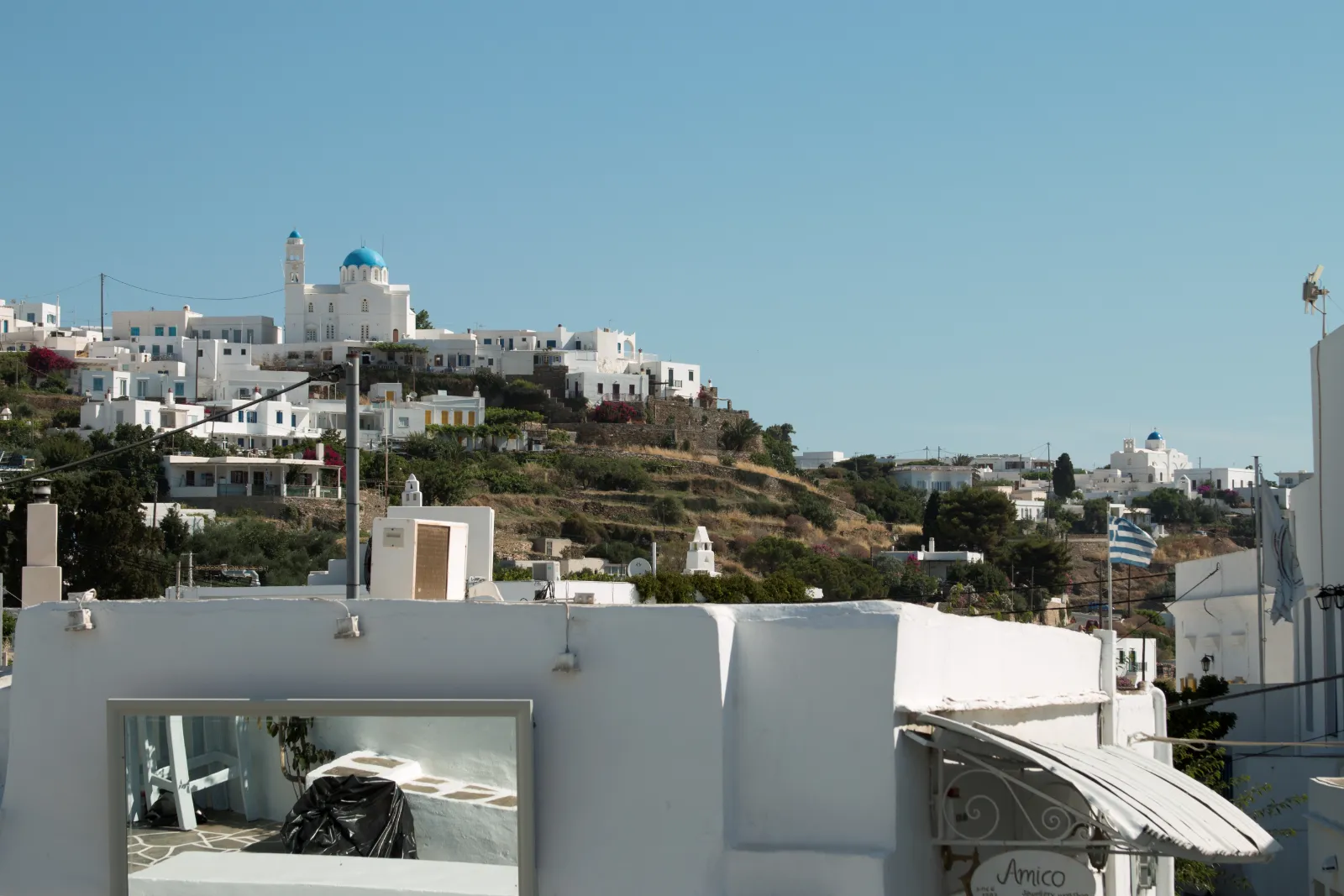
Apollonia, the capital, sits inland in the middle of the island: a knot of whitewashed lanes with the bars and tavernas along a stepped street everyone calls the Steno.

Diagram by Greece Trips. Free to reuse with credit - CC BY 4.0.
Apollonia and Artemonas, the two halves of the middle
Artemonas, next to it, is the handsome one, with neoclassical houses and a slower pace.
They are a short walk apart and they do different jobs, which is why staying in one and eating in the other is the normal shape of an evening here.
That sentence is the practical case for reading this page at all. On Sifnos the choice is not which village to see; it is which one to sleep in.
Why the food matters here
Our own guide opens the island with it: people come for dinner and stay for the paths.
We name no restaurant. Sifnos has a cooking reputation, and the way a reputation like that survives contact with a real week is that the good places change hands and the lists go stale. What does not change is where the tables are, which is the Steno.
The other village, which beats both for looking at
Kastro, on the east coast, is the old capital and the most striking place on Sifnos: a fortified village built as a continuous ring of houses whose outer walls formed the defence, with Venetian coats of arms still set in the stonework and a whitewashed church on a rock below it.
It is a village that is also a wall, and walking it is the clearest hour on Sifnos. Go at both ends of the day if you can: the light does completely different things to a white village on a headland at breakfast and at dusk. Kastro has its own page.
Pottery, and the paths
Sifnos has made pots for centuries, and the workshops along the coast at Vathi and elsewhere are still working. The island’s cooking pots are the practical end of the same tradition - still a trade rather than a display.
The other thing Sifnos has, unusually, is a marked network of old stone footpaths, restored and signed, linking villages, monasteries and bays. On an island this size that turns walking into a proper way of getting about rather than an excursion.
From Apollonia in the middle, that network is why a car is less essential here than the map suggests.
The coast
A compact, walkable Cycladic island of white villages on a spine of hills, with a coast of small bays rather than long beaches - small and sheltered rather than long and sandy. Set expectations accordingly and the island is a pleasure.
What we do not print
No taverna, bar or hotel names. No opening hours. No walking times between Apollonia and Artemonas beyond our own guide’s short walk.
These are villages that have not been rebuilt for visitors, which is our guide’s phrase and worth keeping: it is a description of character, not a certification of anything.
Common questions
What is the Steno? The stepped street in Apollonia that the bars and tavernas run along. Everyone calls it that.
Should I stay in Apollonia or Artemonas? Our guide’s answer is that people commonly do both - stay in one and eat in the other. They are a short walk apart.
Is Apollonia by the sea? No. It sits inland, in the middle of the island.
Next
Our Sifnos guide has the ferries and the timing, things to do in Sifnos covers the villages and the paths, and Kastro covers the old capital.