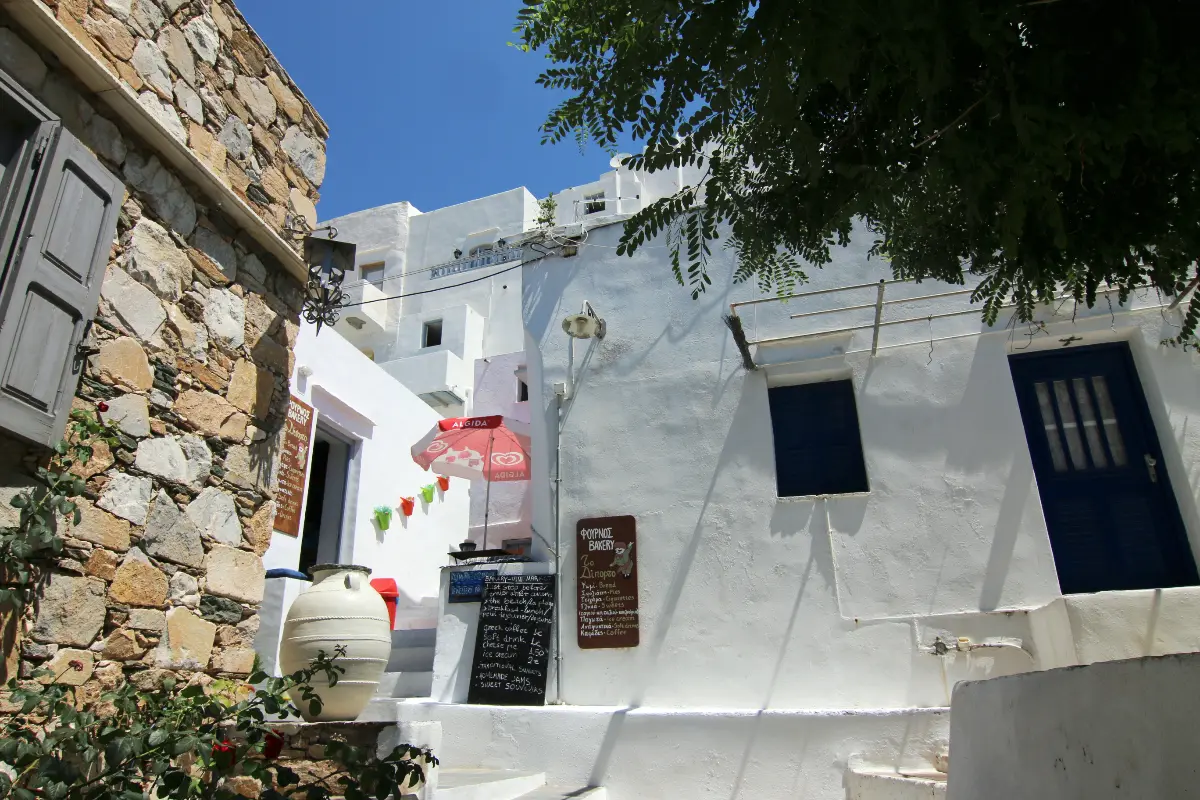
Kastro, on the east coast, is the old capital and the most striking place on Sifnos: a fortified village built as a continuous ring of houses on a headland, with Venetian coats of arms still set in the walls and a whitewashed church on a rock below it.

Diagram by Greece Trips. Free to reuse with credit - CC BY 4.0.
The plan is the defence
The idea is the same one Mesta uses on Chios: rather than building a wall around a settlement, the settlement is the wall. The outer ring of houses forms the perimeter, so the village presents a continuous face outward and there is no separate fortification to maintain.
On a headland, that geometry does most of the work by itself.
What survives in the walls
Venetian coats of arms are still set in the walls - which is the detail that dates the place without a plaque, and the thing to look for as you walk the ring.
The whitewashed church on a rock below the village is the view everyone photographs, and it reads best from the village above rather than from beside it.
Sifnos around it
Sifnos is the island the rest of Greece rates for its food, with a pottery tradition, a network of stone footpaths and hill villages that have not been rebuilt for visitors.
It is a compact, walkable Cycladic island of white villages on a spine of hills, with a coast of small bays rather than long beaches - which is the honest expectation to set.
Apollonia, the capital, sits in the middle of the island. Artemonas, next to it, is the handsome one, with neoclassical houses and a slower pace.
The paths
Sifnos has, unusually, a marked network of old stone footpaths, restored and signed, linking villages, monasteries and the coast.
That is rare in the Cyclades and it is the reason walkers pick this island. Kastro is one of the places those paths connect.
The pottery
Sifnos has made pots for centuries, and the workshops along the coast at Vathi and elsewhere are still working. The island’s cooking pots are the practical end of the same tradition - which is also why the food reputation and the pottery reputation are the same story.
Practical notes
We print no opening hours - Kastro is a village, not a site with a gate, but the church and any museum keep their own arrangements.
Walking between villages is the point here. Take the paths rather than the road where you can.
Common questions
Why is it called Kastro? It is the old capital and a fortified village - the name is the castle.
Is it inhabited? We describe the fabric rather than making a population claim our sources do not carry.
Kastro or Apollonia? Different jobs. Apollonia is where the island eats and gathers; Kastro is the one you go to look at and walk.
Next
Our Sifnos guide has the practicalities, things to do in Sifnos covers the villages and the paths, and the beaches cover the small bays.