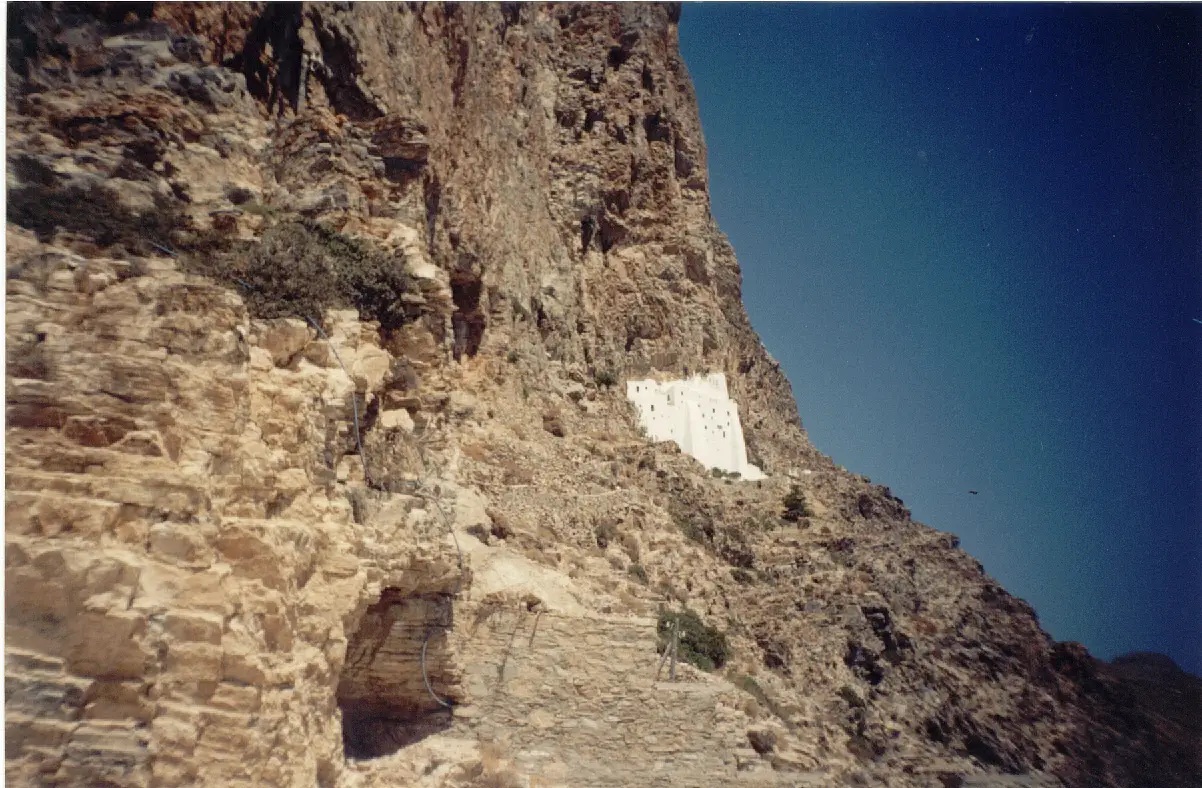
Agia Anna is the small beach below the Hozoviotissa monastery, at the foot of the same cliff, and the sea underneath is the water The Big Blue was filmed in.

Diagram by Greece Trips. Free to reuse with credit - CC BY 4.0.
What is above it
The Monastery of Panagia Hozoviotissa is the reason most people put Amorgos on a list at all.
It is a narrow white building of eight floors, carved into a sheer cliff face roughly 300 metres above the sea on the island’s south-east coast, below Chora and above the small beach at Agia Anna. It is one of the oldest and most dramatic monasteries in Greece, and it is still a working one, home to a handful of monks.
Its age is genuinely unsettled, and the honest thing is to say so. The Municipality of Amorgos, on its own pages, gives two dates rather than one: built in 1017 and renovated in 1088 under the Byzantine emperor Alexios I Komnenos. It houses an icon traditionally dated to 812, and Wikipedia settles for the cautious “built early in the second millennium”. Founded early in the second millennium, with the municipality’s 1017 and 1088, is as precise as the sources honestly allow.
Hozoviotissa has the visiting practicalities.
What was filmed here
Luc Besson’s Le Grand Bleu, 1988, shot partly on Amorgos, most famously at Agia Anna bay.
With Agia Anna at the foot of the same cliff, just out of frame - which is a fair description of the beach’s whole relationship with its own fame. Divers keep coming because of the film.
What the beach itself is
Small. Our own guide files Amorgos beaches as dramatic, mostly rocky, worth the effort, and that is the honest expectation to arrive with.
We print no length, no sand-versus-shingle verdict for this particular cove, no facilities and no sunbed claim. Nothing here is certified safe or suitable either - a small rocky bay under a 300-metre cliff is not somewhere a page written months earlier should be reassuring you about.
Why so few people make it
Amorgos is a long way in, and that is most of its character.
The island’s three anchors are Katapola, Aegiali and Chora, and Agia Anna sits below Chora on the south-east coast.
Seven numbered waymarked paths published by the Municipality of Amorgos, graded easy to hard, cover the walking. The Old Strata (path 1) runs Chora to Langada above Aegiali by way of the monastery, graded hard at four to five hours - which is the walker’s way to arrive at the top of this cliff rather than the bottom.
When to go
Late May to June and September into early October. July and August are the hottest, busiest and windiest.
Common questions
Is Agia Anna the Big Blue beach? It is the bay the film is most famously associated with on Amorgos, and the water below the monastery is what was filmed.
Is it sandy? Amorgos beaches are dramatic and mostly rocky. Come expecting that.
Can you combine it with the monastery? They are on the same cliff - the monastery above, the beach below.
Next
Our Amorgos guide has the ferries and the timing, Hozoviotissa covers the monastery, and the beaches cover the rest of the coast.