Karystos is at the far southern tip of Evia, and it is unusual among Greek towns for being planned: laid out on a grid in the nineteenth century under Bavarian influence, with wide straight streets running down to the sea.

Diagram by Greece Trips. Free to reuse with credit - CC BY 4.0.
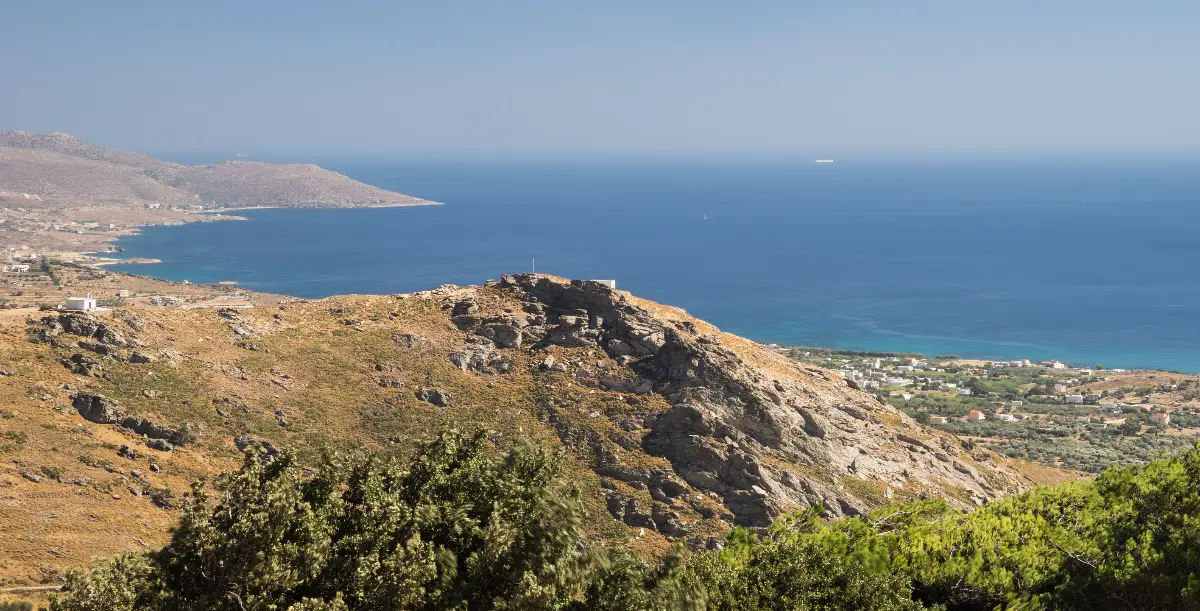
Behind it rises Mount Ochi, bare, windy and covered in granite, which is where everything interesting is.
In the town
- Bourtzi, a small Venetian sea fort on the waterfront, square and squat, right at the end of the promenade.
- The archaeological museum beside it, small, with material from the region.
- A long seafront of tavernas and cafes, and a decent town beach.
Karystos is windy. It faces the open Aegean and the meltemi comes straight in, which makes it a windsurfing spot and can make a beach day work differently from expected.
Mount Ochi and the dragon houses
The mountain above holds the strangest thing in southern Evia: the drakospita, or dragon houses.
These are structures built from enormous unmortared granite slabs, with corbelled roofs, standing on the high ground. The largest, near the summit of Ochi, is a substantial building whose roof slabs weigh several tonnes each.
Nobody is certain what they were: temples, quarry workers’ shelters and watch posts have all been argued. They are usually dated to antiquity, and the name comes from the folk explanation that only dragons could have lifted the stones.
Reaching the summit one is a walk of a few hours from the road, on open exposed ground.
The marble
Karystos was the source of cipollino marble, green-veined and much prized in Rome, quarried on the slopes above. Abandoned quarries still hold half-finished columns lying where they were cut and never moved, some enormous. They are reachable on foot and are among the more atmospheric ruins in Greece.
Getting there and how long
Ferry from Rafina near Athens, about an hour and a half, or a long drive down the length of Evia.
Two nights, one of them for the mountain.
Last checked August 2026. Ferry schedules change by season - see our editorial policy.
Common questions
What are the dragon houses of Evia?
Drakospita: structures built from enormous unmortared granite slabs with corbelled roofs on the high ground of Mount Ochi. Their purpose is not settled.
Why are they called dragon houses?
From the folk explanation that only dragons could have lifted stones of that weight into place.
What is cipollino marble?
The green-veined marble quarried above Karystos and prized in Rome. Abandoned quarries still hold half-finished columns lying where they were cut.
How do you get to Karystos?
By ferry from Rafina near Athens, about an hour and a half, or by road down the length of Evia.
Is Karystos windy?
Yes. It faces the open Aegean and takes the meltemi directly, which makes it a windsurfing spot.