Kalymnos has had two economies, and both are unusual. For a century and a half it was the sponge-diving island of the Aegean, sending fleets across the eastern Mediterranean. Since the late 1990s it has been one of the most important sport-climbing destinations in Europe.

Diagram by Greece Trips. Free to reuse with credit - CC BY 4.0.
The two are connected only by the rock. Kalymnos is steep, dry limestone, which made farming hard, sent people to sea, and left behind exactly the cliffs climbers want.
The climbing
The west coast above Masouri and Armeos is the centre of it: hundreds of bolted routes on tufa-streaked limestone, with the sea below and Telendos island filling the view opposite. The season runs spring and autumn rather than high summer, because the rock bakes.
This is not a niche the island tolerates; it is now a large part of what Kalymnos is, and the villages along that coast are set up for it.
The sponges
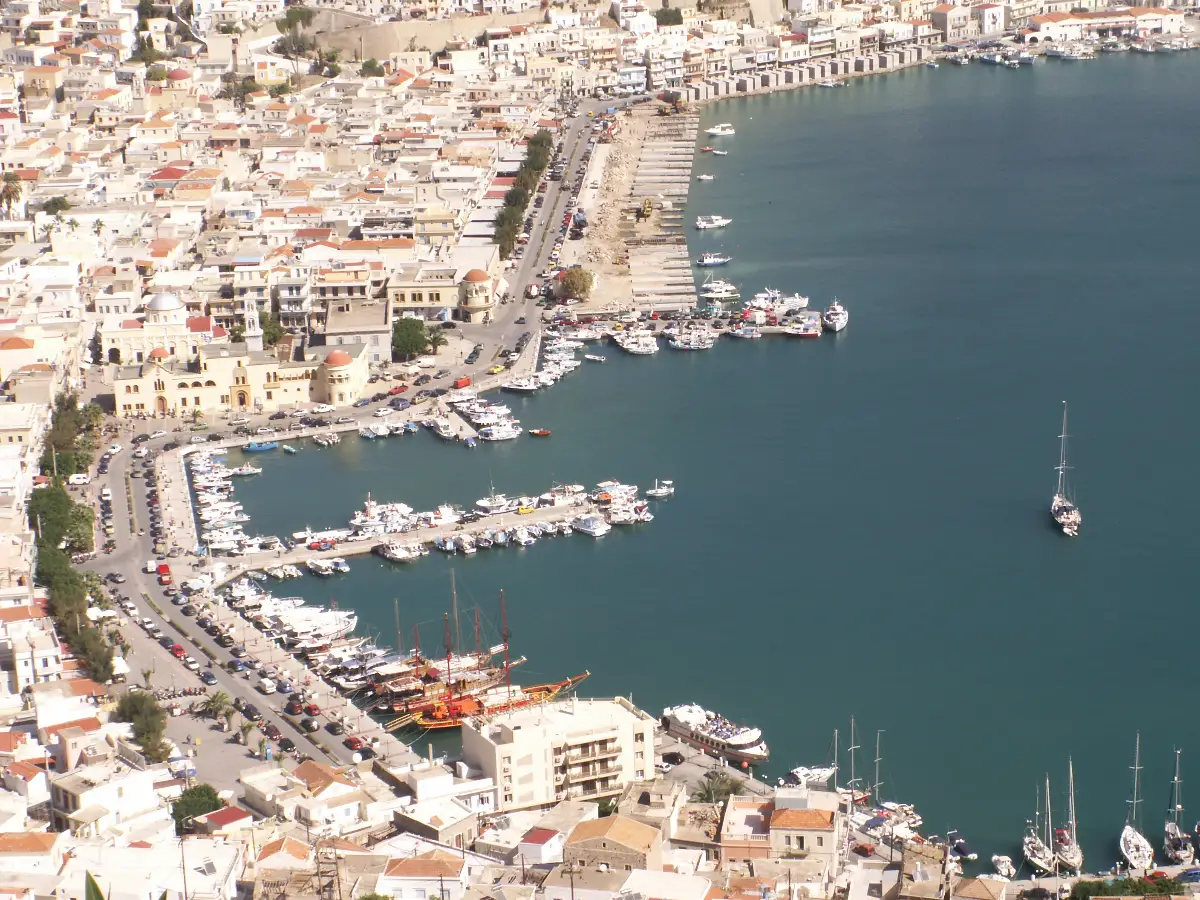
Pothia, the port and capital, is a working town stacked around its harbour, and the sponge trade is still visible in it: workshops, a nautical museum, and the boats. The history is genuinely hard, with a heavy toll from diving accidents before the physiology of decompression was understood, and the island does not romanticise it.
The rest of the island
- Telendos, the near-vertical islet across a narrow strait from Masouri, reached by a small boat in minutes. There are no cars, a few tavernas and more climbing.
- Vathys, on the east coast, a fjord-like inlet with a citrus valley behind it.
- Emporios at the northern end, quiet and a long drive.
- Beaches are small, mostly pebble, and often below the road.
Getting there and how long
Kalymnos has a small airport with domestic flights, and ferries connect it to Kos, which has the international airport and is a short hop away. That Kos connection is how most visitors arrive.
Three nights for a general visit. Climbers come for a week or two and stay on the west coast.
Last checked August 2026. Flight and ferry schedules change - see our editorial policy.
Common questions
What is Kalymnos known for?
Sponge diving historically, and sport climbing today. The limestone above the west coast is one of the major climbing areas in Europe.
When is the climbing season on Kalymnos?
Spring and autumn rather than high summer, because the rock and the west-facing cliffs get extremely hot.
How do you get to Kalymnos?
Usually via Kos, which has the international airport and a short ferry hop. Kalymnos also has a small airport with domestic flights.
What is Telendos?
A steep islet across a narrow strait from Masouri, minutes away by small boat, with no cars, a few tavernas and more climbing.
Does Kalymnos have good beaches?
They are small and mostly pebble. The island’s draws are the rock, the port town and the strait rather than the sand.
Next
Read Kos, Nisyros, or Astypalaia.