
The short answer
You have two real options and they suit different trips. Fly if the day matters more than the money: Athens to Santorini is about 45 to 50 minutes in the air, and Santorini has its own airport. Sail if you want the arrival, the deck and the cheaper seat: from the port of Piraeus the crossing runs roughly 5 hours on a high-speed catamaran and 7 to 8 hours on a big conventional ferry, with the full published spread running from just under 5 hours to about 11 and a half.
The mistake that costs people their first day is not choosing wrong between boat and plane. It is arriving at the wrong port, or booking a fast boat in a week when the wind takes it out. Both are avoidable, and this page is mostly about that.
Fly if you are short on days, travelling late in the season, or connecting from a long-haul arrival. Sail if you want the Cyclades to arrive slowly, you are carrying a car, or you are building an island-hopping route.
Athens to Santorini at a glance
| What you’re deciding | By ferry | By plane |
|---|---|---|
| Journey time | ~5h high-speed, 7–8h conventional | ~45–50 min in the air |
| Leaves from | Piraeus, mainly; Rafina seasonally | Athens airport (ATH) |
| Door to door | Add the transfer to Piraeus, plus boarding | Add airport time both ends |
| Carries a car | Conventional ferries, yes | No |
| Weather risk | Real; fast boats stop first in a meltemi | Lower, but not zero |
| The arrival | Sailing into the caldera | A short bus or taxi ride from the airport |
| Best for | Island-hopping, deck time, budget | Short trips, shoulder season, tight connections |
Journey times above are ranges by boat type, not a timetable.
Start with the port, because this is where the day goes wrong
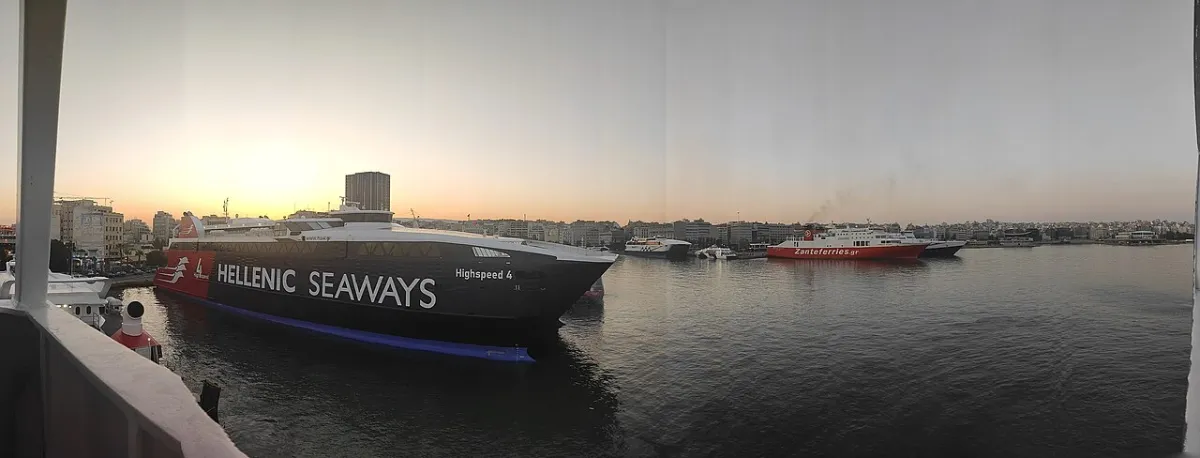
Most Santorini sailings leave from Piraeus, the big port south-west of Athens. Some leave from Rafina, on the east coast of Attica, seasonally.
That distinction decides your morning, because the two ports are on opposite sides of the city:
- Piraeus is closer to central Athens and connected to it by metro. If you are staying in the city, this is almost certainly your port.
- Rafina sits about 25 km from Athens airport - a 20-to-40-minute drive - and requires no crossing of the city at all. If you are landing and sailing the same day, a Rafina departure can be dramatically simpler than dragging luggage across Athens to Piraeus.
Piraeus is also vast. It is a working commercial port with numbered gates, E1 to E12, spread along a long waterfront, and the walk between gates is a real walk with a suitcase. Arriving at Piraeus is not the same thing as arriving at your ferry. The Piraeus Port Authority publishes gate and terminal maps at olp.gr - find your gate before you find your taxi.
Our full breakdown of the three Athens ports and what each serves is in the Greek island ferries guide, and the transfer itself is covered in airport transfers in Greece.
Fast boat or big boat: the choice you actually make
Once you have the port, the second decision is the vessel, and the two classes are genuinely different journeys.
The high-speed catamaran does it in around five hours. It is enclosed, it is pricier, seats are assigned, and you feel the sea - this is the boat where a rough day is felt as a rough day. It is also the first thing cancelled when the wind gets up.
The big conventional ferry takes seven to eight hours. It is slower, cheaper and steadier, it has open decks you can stand on, and it carries cars. In a summer meltemi - the northerly that blows hardest in July and August - the heavy conventional boats keep running well after the light fast craft have been grounded.
That last point is the one worth internalising. If your trip has no slack in it - a flight home the next morning, a booking that cannot move - the slower boat is often the safer boat, not merely the cheaper one. We wrote what to do when a ferry is cancelled because this happens often enough to plan for.
When flying is the right call
Flying is not the lazy option on this route. It is the correct option for several ordinary situations:
- You have a week or less. Five hours each way is most of two days out of seven. Fifty minutes each way is not.
- You are travelling in the shoulder or off-season. Ferry frequency thins as the season winds down while flights hold up better.
- You are connecting from a long-haul flight. Staying airside at ATH and taking a short domestic hop beats a transfer to Piraeus after ten hours in the air.
- The forecast is ugly. Aircraft are not immune to wind at Santorini, but they are far less exposed than a catamaran.
Santorini’s airport is JTR, and the flight from Athens is roughly 45 to 50 minutes, flown by Aegean and Sky Express among others. Route networks change season to season, so check what is actually flying on your dates rather than trusting any list, including this one. Which islands you can reach this way at all is covered in which islands have an airport.
The arrival, and why people still choose the boat
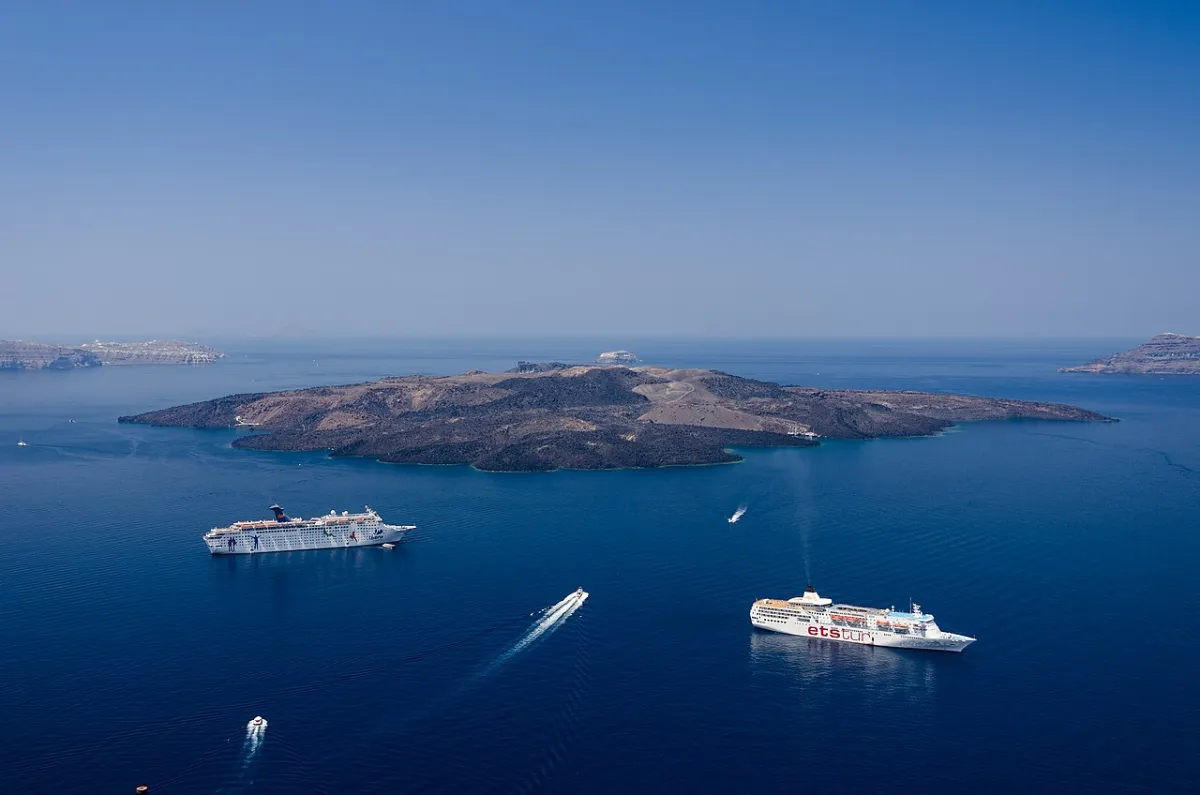
There is a reason a lot of people who could fly still sail. Santorini is the rim of a drowned volcano, and the ferry takes you inside it. You come through the gap in the ring and the cliff wall goes up on your left, several hundred metres of banded rock with the villages sitting along the top edge like snow. You do not get that from seat 14A.
The practical footnote: the ferry port is Athinios, on the water at the base of the cliff, and it is not the town. Everything above happens up a steep switchback road. Have your onward transfer sorted before you dock - Athinios at the moment a big boat empties is not a calm place to start improvising.
Booking, and how far ahead
The risk on this route is not the fare. It is a sold-out sailing that breaks the rest of your route.
Off-peak, you can usually buy a day or two ahead, or at the port on the morning you sail. In July and August, book weeks to a few months out - Athens to Santorini is one of the two or three busiest crossings in the country, and a full boat on the day you needed to move is a genuinely expensive problem when the next island, and the room you booked on it, will not wait.
If you are carrying a car, book earlier still and book a conventional ferry - the fast craft do not take them. Whether you even want a car on Santorini is a separate question, and mostly the answer is no; see which islands need a car.
The broader “what has to be locked in before you go” list lives in what to book ahead.
Doing it as part of a bigger route
Athens to Santorini is rarely a trip on its own. It is usually the first or last leg of a Cyclades run, and the sequencing matters more than any single crossing: the goal is that every boat moves you forward rather than doubling you back through Athens.
Santorini sits at the southern end of the chain, which makes it a natural finish. From here you can carry on to Crete rather than backtracking, or work north through Naxos and Paros. The full method is in the island hopping guide.
One habit worth stealing: fly out of the far end. A one-way route that starts in Athens and flies home from Santorini beats a round trip that spends a whole day sailing back the way you came.

Diagram by Greece Trips. Free to reuse with credit - CC BY 4.0.
Coming back: Santorini to Athens
Santorini to Athens is the same crossing in reverse, and it is searched almost as often as the outbound one. Everything above applies, with three differences worth planning around.
- The return sailing is the one that meets your flight home. Leave a whole day of margin, or a night in Athens. A cancelled boat on the way out costs you a beach day; a cancelled boat on the way back costs you the flight.
- Athira and the caldera port. Boats leave from Athinios, on the cliff road below Fira, and the road down is slow and busy at sailing time. Allow far more than the distance suggests.
- Piraeus arrival is not the airport. Add the metro or taxi leg across Athens on top of the crossing, and check when a ferry is cancelled before you cut it fine.
Frequently asked questions
How long is the ferry from Athens to Santorini?
About 5 hours on a high-speed catamaran and 7 to 8 hours on a big conventional ferry. The full published range across all services runs from just under 5 hours to about 11 and a half, depending on the vessel and how many islands it calls at on the way.
Is it better to fly or take the ferry from Athens to Santorini?
Fly if your trip is short, if you are travelling outside high summer, or if you are connecting from a long-haul arrival - it is roughly 45 to 50 minutes against five hours or more. Sail if you want the caldera arrival, you are carrying a car, or Santorini is one stop on an island-hopping route.
Which port do Santorini ferries leave from in Athens?
Mainly Piraeus. Some sailings use Rafina seasonally, which is far more convenient if you are coming straight from Athens airport - Rafina is about 25 km from the airport and needs no crossing of the city. Check which port your specific ticket names before you travel.
How far ahead should I book the Athens to Santorini ferry?
In July and August, weeks to a few months ahead. Off-peak you can usually buy a day or two before, or at the port. Book earlier if you are taking a car, which also means booking a conventional ferry rather than a high-speed one.
Do Athens to Santorini ferries get cancelled?
Yes, when the wind is strong enough - the summer meltemi is the usual cause, and high-speed catamarans are stood down well before the heavy conventional ferries are. If your onward plans have no slack, the slower boat is the more reliable one. See when a ferry is cancelled.
Where does the ferry arrive in Santorini?
At Athinios, the port at the foot of the caldera cliff. It is not the town, and the road up is a steep series of switchbacks - arrange your onward transfer before you arrive rather than after you dock.
Next
Go deep on the island itself in the Santorini travel guide, plan the wider trip with the island hopping guide, or compare the destination against the obvious alternative in Santorini vs Mykonos.