
Where
The sanctuary of Apollo on the lower slopes of Mount Parnassus, Phocis, Central Greece
From Athens
Roughly 180 km northwest; about 2.5 to 3 hours each way by road, via Livadeia and Arachova
By bus
KTEL Fokidas runs the Athens service. Historically from the Liosion terminal, but Athens is consolidating its intercity terminals, so confirm the departure point with the operator. No times or fares printed
Time on site
4 to 5 hours: 2 to 3 for the sanctuary climb, 1 to 1.5 for the museum, about 30 minutes for the Tholos at Athena Pronaia
Tickets
One combined ticket covers the archaeological site and the Archaeological Museum. No price or opening hours are printed here; take them from the official listing for your date
The timing rule
Leave Athens before 07:00. Coaches and day tours hold the site from roughly 10:30 to mid-afternoon, an observed pattern rather than a schedule
Travel details last checked July 2026.
The sanctuary sits on the slope of Mount Parnassus in Phocis, roughly 180 km northwest of the city, and the drive takes about two and a half to three hours each way. That is the whole shape of the day: five to six hours of mountain road wrapped around four or five hours of walking, climbing and looking. Everything that goes right or wrong on this trip is decided by how you handle the road end.
It is worth doing. It is also the Athens day trip most often done badly, because most visitors arrive inside the same three-hour window as everybody else and see the site at its hottest, its most crowded and its worst-lit.
This page is about the mechanics of the day. What is at Delphi, how long it takes, where to sleep and whether to stay over at all are on our Delphi guide.
The arithmetic, before you pick a mode
Do the sums once and the rest of the decisions make themselves.
Call it three hours out and three hours back. Call it two to three hours for the sanctuary, which is a sustained climb from the gate up to the stadium on old stone, and another hour to an hour and a half for the Archaeological Museum. Add the short walk down the road to the Tholos, add lunch, and you have a day that starts early and gets back late.
The number that decides everything is your departure time from Athens, not your arrival time at Delphi.
Leave central Athens at half past six in the morning and you are at the gate not long after it opens, with the sanctuary to yourself, in the cool, in the good light. Leave at nine and you arrive into the middle of the coach window. Our Delphi guide records what visitors, guides and forum threads report with unusual consistency: the tour coaches hold the Sacred Way from around half past ten to mid-afternoon. That is an observed pattern rather than a published schedule, and we are not going to dress it up as a timetable. It is still the single most reliable thing anyone can tell you about the shape of a Delphi day.
Which means the honest hierarchy of this trip is not car, bus, tour. It is early, later, and too late.
Car, bus or organised tour
Three ways to do it, and they buy you three different things.
A rental car buys you the departure hour, which on this trip is the only variable that matters. It is the only mode that gets you through the gate before the coaches, the only one that lets you decide on the day to stay for the late light, and the only one that makes an onward leg to Meteora practical rather than theoretical. The route runs northwest via Livadeia and climbs through Arachova on the final approach, a winding mountain road that is straightforward but not fast. What it costs is a long day of driving, most of it on a road that will not let you make up time. Renting a car in Greece and driving in Greece cover the rest.
The KTEL bus is the cheap and simple version. KTEL Fokidas runs the Athens service, and the bus sets you down at the edge of Delphi village, a short walk from the gate.
Now the part every other page gets wrong by being too confident. We print no departure times, no frequency and no fare for that bus, because we did not read them at the operator, whose own site refused our connection twice, and because the operator’s own material says the timetable changes between summer and winter. And there is a second reason, which is bigger: Athens is in the middle of consolidating its intercity bus terminals into a single new central station, replacing the Liosion and Kifissos terminals the services have historically used. The sources we found disagree about when and exactly where. Delphi buses have long left from Liosion, and that is where a page written last year will send you. Confirm the terminal with KTEL Fokidas before you set out, and settle your return departure before you commit to the outbound.
An organised tour buys you zero planning and takes your departure hour away in exchange. A coach day is built around the coach window this page is telling you to beat, so you get the site at the busiest hour by design. It is a genuinely reasonable choice if you would rather not drive, do not want to solve a timetable, and are happy to see a busy sanctuary with a guide explaining it. It is a poor choice if the reason you are going is the place rather than the information.
| Mode | What it buys you | What it costs you | Pick it if |
|---|---|---|---|
| Rental car | The departure hour, and an empty site | A long day at the wheel on a mountain road | The 8am gate is the point, or Meteora comes next |
| KTEL bus | Cheap, simple, nobody drives | The timetable owns your day at both ends | You are on a budget and will build the day round the return |
| Organised tour | No planning at all | The coach window, by design | You want a guide and do not want to solve logistics |
The verdict, plainly: if you can drive and will leave before seven, drive. If you cannot, take the bus and treat the return departure as the fixed point of the day. Take the tour if the guiding is what you are buying.
What the day looks like on the ground
The site is one connected route rather than a list, and it climbs.
From the gate the Sacred Way zigzags up past the treasury foundations and the reconstructed Treasury of the Athenians to the terrace of the Temple of Apollo, then on up to the theatre, and finally the stadium at the top. It is shadeless old stone most of the way. Do it first, in the morning, before the day heats up and before the groups land, and take water and something on your feet you can climb worn marble in.
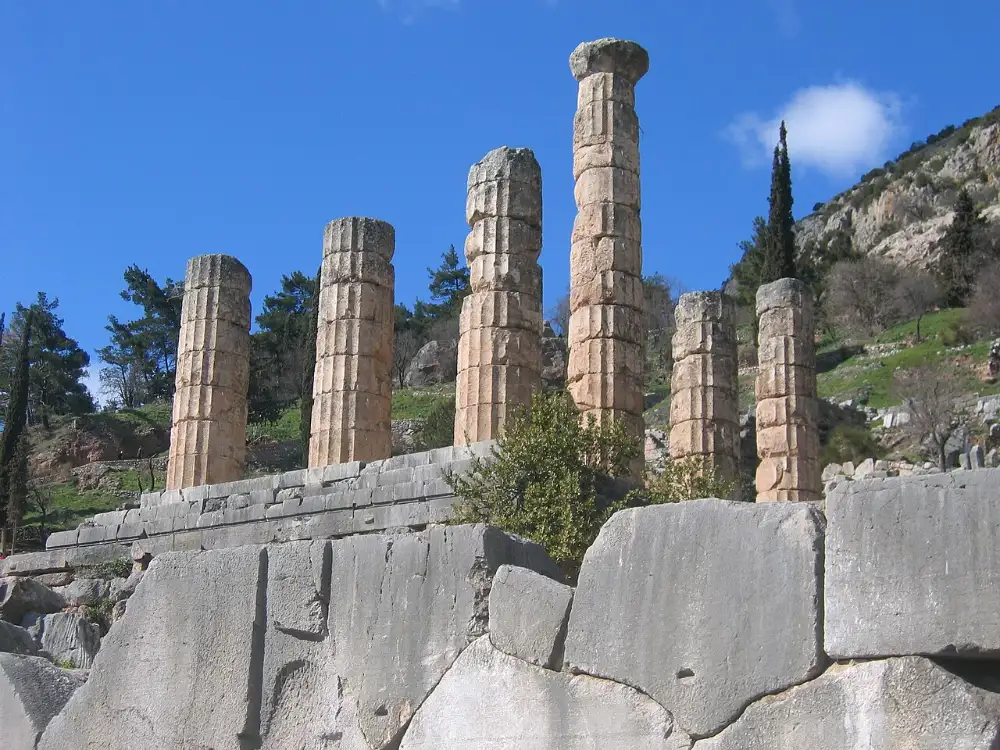
Then the museum, which is compact and holds the Charioteer along with the omphalos, the carved stone that marked what the Greeks called the navel of the world. Take it in the middle of the day. It is indoors, and the open site is at its hottest and its fullest at exactly the hour the museum is at its most comfortable. One combined ticket covers both the site and the museum, so the order is entirely yours to choose.
And the piece that catches day-trippers out: the Tholos, the circular monument on every Delphi postcard, is not in the main sanctuary. It stands at the Sanctuary of Athena Pronaia, a short walk down the road from the main gate. Budget half an hour or so for it and know before you go that it is a separate stop, because a surprising number of people leave without seeing the building they came for.
If your day runs backwards, arriving in the early afternoon rather than the morning, invert it. Museum first, sanctuary after about four when the coaches have gone and the light comes back. That is the second-best version of this day, and it beats a midday sanctuary comfortably.
The two things this page will not print
No opening hours and no ticket price.
Delphi runs a summer schedule and a winter schedule and steps between them, and the two official sources for the site have shown different seasonal grids to us. Prices are revised by the Ministry. A travel page that prints a grid is publishing a number that rots quietly, and the cost of getting it wrong here is not an inconvenience, it is a five-hour round trip to a closed gate.
What is durable, and what you can plan on: one combined ticket covers the archaeological site and the Archaeological Museum. Hours are longer in summer and considerably shorter in winter, and last admission comes before closing. Greek archaeological sites also close on certain public holidays, which our guide to public holidays and what closes covers.
Take the actual hours and the actual price from the official listing for the date you are going, and buy from the state’s own e-ticketing rather than from whichever official-looking domain ranks highest that week.
When the day trip is the wrong call
Be honest about the trade, because the road is a real cost.
Six hours in a vehicle to spend four hours at a site is a fair deal if Delphi is one thing on a busy Athens week. It is a poor deal if you have the flexibility to sleep in the village, because one hotel night converts the whole trip: you walk into the sanctuary at opening with nobody in it, take the museum without a queue, and get the village in the evening after the coaches have gone. Our Delphi guide argues that case properly and sets out where to stay.
The day trip is the right call when your schedule is fixed to Athens, when Delphi is a single day carved out of a city trip, or when you are travelling with people for whom a hotel move is more disruptive than a long drive. It is the wrong call when your route could bend by one night, and when the reason you are going is the place at its quietest.
There is also a middle version worth knowing: on a longer mainland route, Delphi is a hinge rather than an out-and-back, sitting naturally between Athens and Meteora. If that is your shape, this page is the wrong page and a ten-day Greece route is the right one.
Site entry is sold by the Hellenic Ministry of Culture’s own e-ticketing service, and the bus is sold by KTEL Fokidas directly. We sell nothing and take no commission here. For the wider budget, what a Greece trip costs has the bands.
Leave early, and settle the return first
Two things decide this day, and neither of them is at Delphi.
Leave Athens before seven if you are driving, because the coach window is the difference between a sanctuary and a queue. And if you are on the bus, fix your return departure before you book the outbound, and confirm which Athens terminal you are leaving from with the operator rather than with a page written last season.
Everything else about Delphi, including the case for not doing it in a day at all, is in our Delphi guide.
Last checked July 2026. What gets re-checked on this page: the operator and the Athens departure terminal, which is moving; the combined-ticket mechanism; and the road times, which are carried from our Delphi guide. No fare, no timetable and no opening hour appears here by design. How we date and correct facts is in our editorial policy.
Common questions
Can you do Delphi as a day trip from Athens?
Yes, comfortably. Delphi is roughly 180 km northwest of Athens and the drive is about two and a half to three hours each way, with the site and museum taking four to five hours between them. That makes it a long day rather than an impossible one. The thing that decides whether it is a good day is your departure hour: leave before seven and you are inside the sanctuary before the tour coaches arrive.
How long is the drive from Athens to Delphi?
About two and a half to three hours each way, running northwest via Livadeia and climbing through Arachova on the final approach. It is a winding mountain road, straightforward but not quick, and it will not let you make up lost time. Budget five to six hours of road into the day before you plan anything else in it.
Is it better to drive, take the bus, or book a tour to Delphi?
Drive if you can, because a car is the only mode that buys you the departure hour, and the departure hour is the whole trip. Take the KTEL bus if you would rather not drive and will build the day around the return departure. Book a tour if what you actually want is a guide and no logistics, accepting that a coach day lands you on the Sacred Way in the busiest window by design.
Which Athens bus station do Delphi buses leave from?
KTEL Fokidas runs the service, and it has long departed from the Liosion terminal. Confirm it with the operator before you travel rather than trusting any page, including this one: Athens is consolidating its intercity terminals into a single new central station replacing Liosion and Kifissos, and the sources disagree on the timing. We print no departure times and no fare, because the operator’s site refused our connection and its own material says the timetable changes between summer and winter.
What time should you arrive at Delphi?
At opening, if you can manage it. Visitors, guides and forum threads consistently report the tour coaches holding the site from around half past ten until mid-afternoon, which is also the hottest and flattest-lit part of the day on a shadeless slope. That is an observed pattern rather than a published schedule. The second-best window is late afternoon, after the coaches leave, with the museum taken at midday instead.
How long do you need at Delphi?
Four to five hours inside the gates covers it: two to three for the sanctuary’s climb from the Sacred Way to the stadium, one to one and a half for the Archaeological Museum, plus about half an hour for the Tholos down the road. No official source publishes a visit duration, so treat those as planning estimates. With lunch in the village it becomes a comfortable full day.
Where is the Tholos, and is it on the same ticket?
The Tholos, the round monument on every Delphi postcard, is not inside the main sanctuary. It stands at the Sanctuary of Athena Pronaia, a short walk down the road from the main gate, and a lot of day-trippers leave without realising they have missed it. One combined ticket covers the archaeological site and the Archaeological Museum. Check the current access arrangements for the Athena Pronaia area on the day, and take the ticket details from the official listing rather than from a travel page.
Booking
We sell nothing and book nothing for you. Every guide on this page tells you how to arrange each piece yourself - which ferry operator, when to book, what to prebook and what to leave loose.