What it is
the civic, commercial and legal centre of classical Athens, now an archaeological park with a site museum, below the north-west side of the Acropolis
Not to be confused with
the Roman Agora (a separate site a few hundred metres east, separate admission) and the Acropolis (a third site, separate admission)
Excavated by
the American School of Classical Studies at Athens, continuously since 1931, under the authority of the Greek state
Headline monument
the Temple of Hephaistos, among the most completely preserved Doric temples anywhere, on the hill along the western edge
Site museum
the Stoa of Attalos, a Hellenistic colonnade rebuilt in the 1950s on its original foundations to serve as museum and workspace
Also on site
the Church of the Holy Apostles, the Panathenaic Way, and the foundations of the council house, the Tholos and the lawcourts
How long
about 90 minutes. Our estimate from the size of the site; no authority publishes one
Ground
packed earth, gravel and low uneven stone, rising to the temple, with partial tree cover. We describe it and do not grade it
Tickets and hours
set and published by the Hellenic Ministry of Culture, seasonally variable. Deliberately not reprinted here
Travel details last checked September 2026.
The Acropolis is the rock, with the Parthenon on it. The Roman Agora is a small walled market a few hundred metres east, built under Roman rule. The Ancient Agora - this page - is the flat, wooded ground below the rock’s north-west side, and it was the civic, commercial and legal centre of classical Athens. The American School of Classical Studies at Athens, which has excavated here since 1931, describes it as the business, political and legal centre of the city, bringing together citizens and foreigners, litigants and jurors, merchants and philosophers.
That is the whole distinction, and it is worth holding: the rock was where Athens worshipped, and the Agora was where Athens argued.
What the Ancient Agora actually was
An agora is not a ruin type. It is a function, and this one held the function for around a thousand years.
Walk it and you are walking a square that was simultaneously a marketplace, a law court, a council chamber, a mint, a religious precinct and a place to loiter. The lawcourts sat here. The council house sat here. The Tholos, where the executive committee of the council ate and slept so that some part of the government was always awake, sat here. Socrates was tried and condemned somewhere in this space, and the philosophers who taught in Athens taught in and around it because it was where the people were.
What the excavation has produced is a record over an unusually long span. The American School states that its work since 1931 has brought to light the history of the area over a period of 5,000 years, from Neolithic pottery through to the nineteenth-century houses that were cleared to expose the classical level.
That last part is the uncomfortable half of the story, and almost nobody prints it: a nineteenth-century neighbourhood stood on this ground and was bought and demolished so the classical city could be dug. The park you walk through is a deliberate choice about which Athens to show.
Across it runs the Panathenaic Way, the processional route that climbed from the city gate through the Agora and up to the Acropolis. Plotting its course was what allowed the excavators to fix the square’s boundaries. Stand on it and the geography of the whole city organises itself: the market below, the temple on its hill to one side, the rock straight ahead.
The Temple of Hephaistos, and why it is still standing
On the low hill along the western edge stands the one building here that almost nothing happened to.
The Temple of Hephaistos is among the most completely preserved Doric temples anywhere: colonnade standing, entablature in place, much of the roof structure still supported. It is more intact than the Parthenon, which is the sentence that catches people out, because most visitors have already spent a morning on the rock looking at a monument in scaffolding and then walk down here to find a temple with its roof on.
The reason is boring and decisive. It was converted into a Christian church and used as one for well over a millennium, which meant it was maintained, roofed and defended instead of being quarried for its stone. Buildings that stop being used in Greece become building material. This one never stopped being used.
It is Doric and peripteral, a colonnade on all four sides, begun in the middle of the fifth century BC and finished decades later than it was started. You cannot go inside, and you do not need to. The point of this building is that you can walk around it and see, at full height, what every other classical temple in Greece is a fragment of. Give it ten minutes from three sides before you go anywhere else.
For the temple on the rock and how entry there works, the Acropolis page has the mechanics. This page does not repeat them.
The Stoa of Attalos is a reconstruction, and that is the interesting part
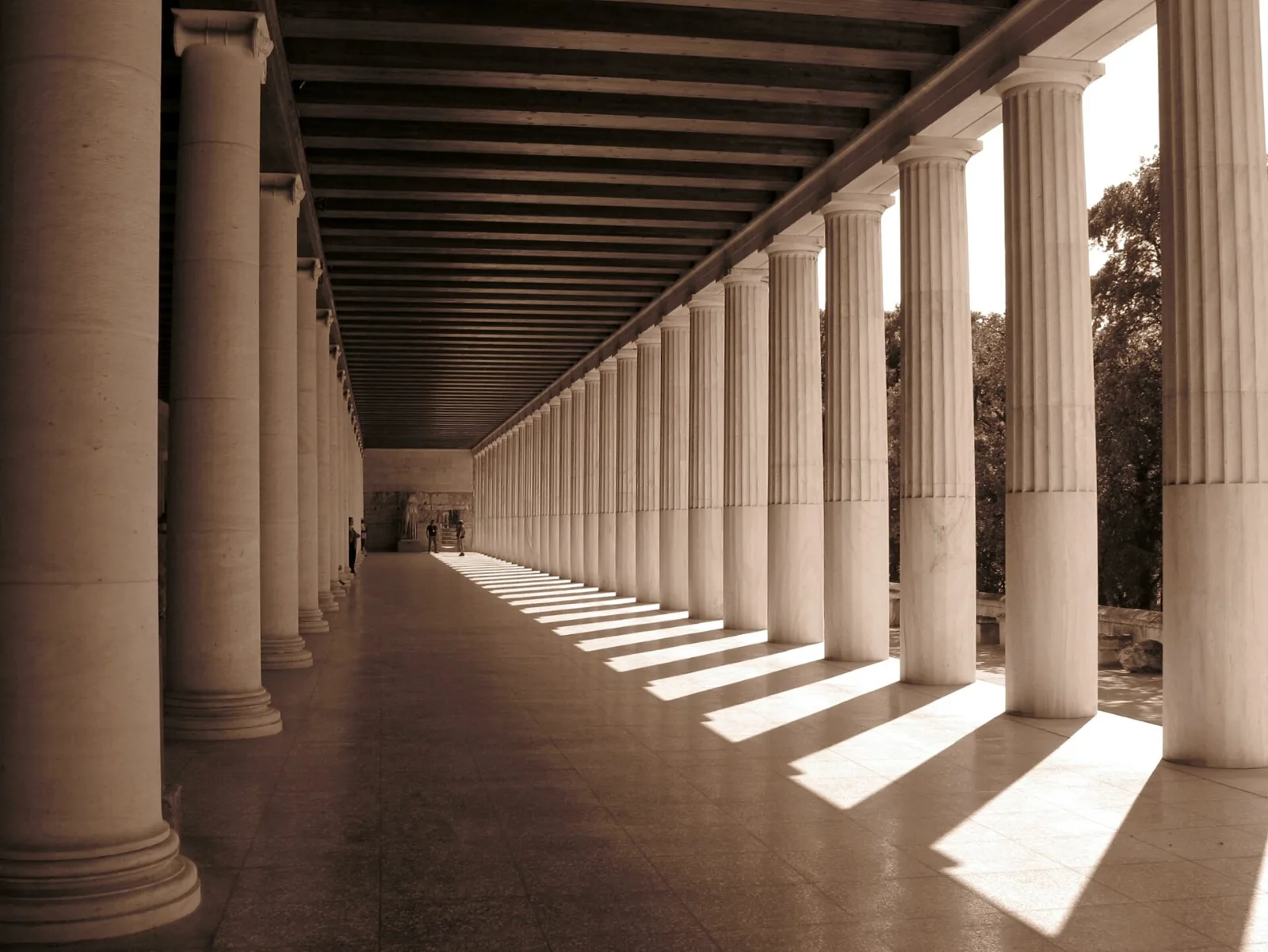
The long two-storey colonnade down the eastern side looks wrong the first time you see it. Crisp marble, complete roof, shopfronts in a neat row. It looks like a film set because in a sense it is one.
The original was a Hellenistic stoa of the second century BC, lined with shops, a gift to Athens from a king of Pergamon. It was destroyed and its foundations survived. In the 1950s the American School rebuilt it on those foundations, and the School’s own account of why is plain: after the initial phase of excavation, the area was landscaped and the Hellenistic Stoa of Attalos was rebuilt to serve as museum and workspace. It now houses the excavated artefacts and the excavation records.
So the building is not pretending to be ancient. It is a working archaeological facility that happens to be shaped like the building that stood there, and it is the site museum.
Two things follow for a visit. The first is that this is the only shade on the site with a roof over it, and in July that decides your route. The second is that the museum is where the Agora stops being a lawn with foundations in it: the ostraka, the potsherds with politicians’ names scratched on them and used to vote people into exile, are the object that explains the place better than any wall does. Somebody wrote a name on a broken cup to get a man thrown out of the city, and the cup is in a case in front of you.
The colonnade is also the answer to a practical question. If you have small children, this is where a hot hour becomes survivable, and Athens with children sets out the wider sequencing.
The Byzantine church nobody expects
Near the middle of the site stands a small domed church, the Church of the Holy Apostles.
It is here because the Agora did not become a ruin and then a park. It became a neighbourhood, and the church served it. When the excavation cleared the ground down to the classical level, this building was kept.
It is worth two minutes for what it says about the site rather than for what it is. Everything else here has been dug down to; this one thing was left standing at its own level. It is the only structure on the site that shows you how high the ground used to be.
How to walk it, and how long it takes
Give the Ancient Agora about ninety minutes. That is our estimate from the size and shape of the site, not a figure any authority publishes, so treat it as a plan rather than a promise.
The sequence that works is dictated by shade and by the museum. Come in through whichever gate your route gives you, walk the Panathenaic Way first while you still have the site’s geography in your head, take the Hephaisteion on its hill, then drop to the Stoa of Attalos and spend the hottest part of the visit inside it.
Underfoot it is packed earth, gravel paths and a good deal of low, uneven stone, and the ground rises to the temple. There are trees, which the rock above has none of, and there are stretches with no cover at all. We are describing the ground rather than grading it: what a particular person can manage on a particular surface is not a judgment this page is in a position to issue. If that is the question that decides your day, accessibility in Greece is the longer answer, and the site’s own staff are better than any page.
On timing, the useful rule is the one the rock teaches. The Agora is at its emptiest early and its worst in the two hours after the Acropolis empties, because a large share of its visitors are people who have just come down the hill. Doing it the other way round, Agora first, is the least crowded morning in central Athens that does not involve setting an alarm.
Tickets for the archaeological sites are sold by the Hellenic Ministry of Culture, at the site and through the Ministry’s own e-ticketing service. We sell nothing and take no commission on this page. The ticket covers the site and its museum in the Stoa of Attalos, and since the Athens combined ticket ended on 1 April 2025 it covers nothing beyond them. Check the current terms at the point of sale before you pay. What the rest of a trip costs is in what a week in Greece actually costs.
What this page will not tell you
No price, no opening hours, no closed days. The Ministry sets them, revises them seasonally and publishes them itself, and a travel page that reprints a Greek archaeological timetable is wrong within a season and confidently wrong, which is worse.
Two things are worth knowing about the calendar rather than the clock. Greek archaeological sites keep different hours in summer and winter, and the changeover is not a single date you can look up once. And there are days in the year when state sites close or open for nothing at all, which public holidays and what closes covers, along with the way the Greek day is shaped.
Read the Ministry’s own page for the site on the morning you are going. That is not us passing the problem back to you; it is the only source that is right on the day.
Why it is worth the ninety minutes
The Acropolis is the thing you came for and the Agora is the thing you remember.
The rock gives you a monument. This gives you a city: the ground where the arguments happened, a temple that survived by being useful, a reconstructed colonnade full of the objects those arguments were conducted with, and enough trees to sit under while you work out what you have just seen.
It is also the cheapest hour and a half in central Athens in a sense that has nothing to do with the ticket. Ninety minutes here changes what the rest of the city looks like. The rest of Athens is on the hub, and where it fits in a first Greek trip is on the route.
Last checked September 2026. What we re-read before every update: the excavator’s account of the site and of the Stoa of Attalos rebuild, and the Ministry’s own published visiting arrangements, which we deliberately do not reprint. How we date and check facts is set out in our editorial policy.
Common questions
What is the Ancient Agora of Athens?
The Ancient Agora was the civic, commercial and legal centre of classical Athens: a large open square below the north-west side of the Acropolis holding the lawcourts, the council house, the mint, shops, shrines and the ground where citizens met. The American School of Classical Studies, which has excavated it since 1931, calls it the business, political and legal centre of the city. It is now an archaeological park with a site museum.
Is the Ancient Agora the same as the Roman Agora?
No, and this is the most expensive confusion in central Athens. They are two different sites, a few hundred metres apart, with separate entrances and separate admission. The Ancient Agora is the classical civic centre below the Acropolis. The Roman Agora is a smaller walled market built under Roman rule, east of it, and is best known for the Tower of the Winds. Neither is the Acropolis, which is a third site again.
What is there to see in the Ancient Agora?
Three things carry the visit. The Temple of Hephaistos, among the most completely preserved Doric temples anywhere, standing on the hill along the western edge. The Stoa of Attalos, a Hellenistic colonnade rebuilt in the 1950s on its own foundations to serve as the site museum. And the Church of the Holy Apostles, a small Byzantine church left standing when the rest of the ground was excavated. Between them run the foundations of the council house, the lawcourts and the Panathenaic Way.
Why is the Temple of Hephaistos so well preserved?
Because it was in continuous use. It was converted into a Christian church and served as one for well over a thousand years, which meant it kept a roof and was maintained rather than quarried for its stone. Temples that fell out of use in Greece were generally taken apart for building material. This one never fell out of use, which is why it still has its colonnade, its entablature and much of its roof structure while the Parthenon does not.
Is the Stoa of Attalos original?
No. The building you walk into is a modern reconstruction, built in the 1950s by the American School of Classical Studies on the foundations of the second-century-BC original, and it was rebuilt specifically to serve as the excavation’s museum and workspace. It holds the finds and the excavation records. Knowing it is a reconstruction makes it more interesting rather than less: it is the only place in Athens where you can stand inside a classical building at full height.
How long do you need at the Ancient Agora?
Allow about ninety minutes, which is our estimate from the size of the site rather than a published figure. That covers the Panathenaic Way, the Temple of Hephaistos, the site museum in the Stoa of Attalos and a slow loop of the foundations in between. Cut it to an hour if you skip the museum, but the museum is the half that explains the other half.
Should you do the Acropolis or the Ancient Agora first?
The Agora, if you can face the early start twice. Most of its visitors arrive having just come down off the rock, so it is busiest in the hours after the Acropolis empties and quietest first thing. Doing the Agora first also means you climb to the Acropolis already knowing what the city below it was, which is the right order for understanding rather than for photographs.
What is the best time of day to visit the Ancient Agora?
Early morning, for shade as much as for crowds. The site is open ground with trees but long stretches of no cover, and the one roofed space is the Stoa of Attalos, which is why the museum belongs in the hottest part of your visit rather than the coolest. In July and August, plan the visit around the colonnade.
Booking
We sell nothing and book nothing for you. Every guide on this page tells you how to arrange each piece yourself - which ferry operator, when to book, what to prebook and what to leave loose.