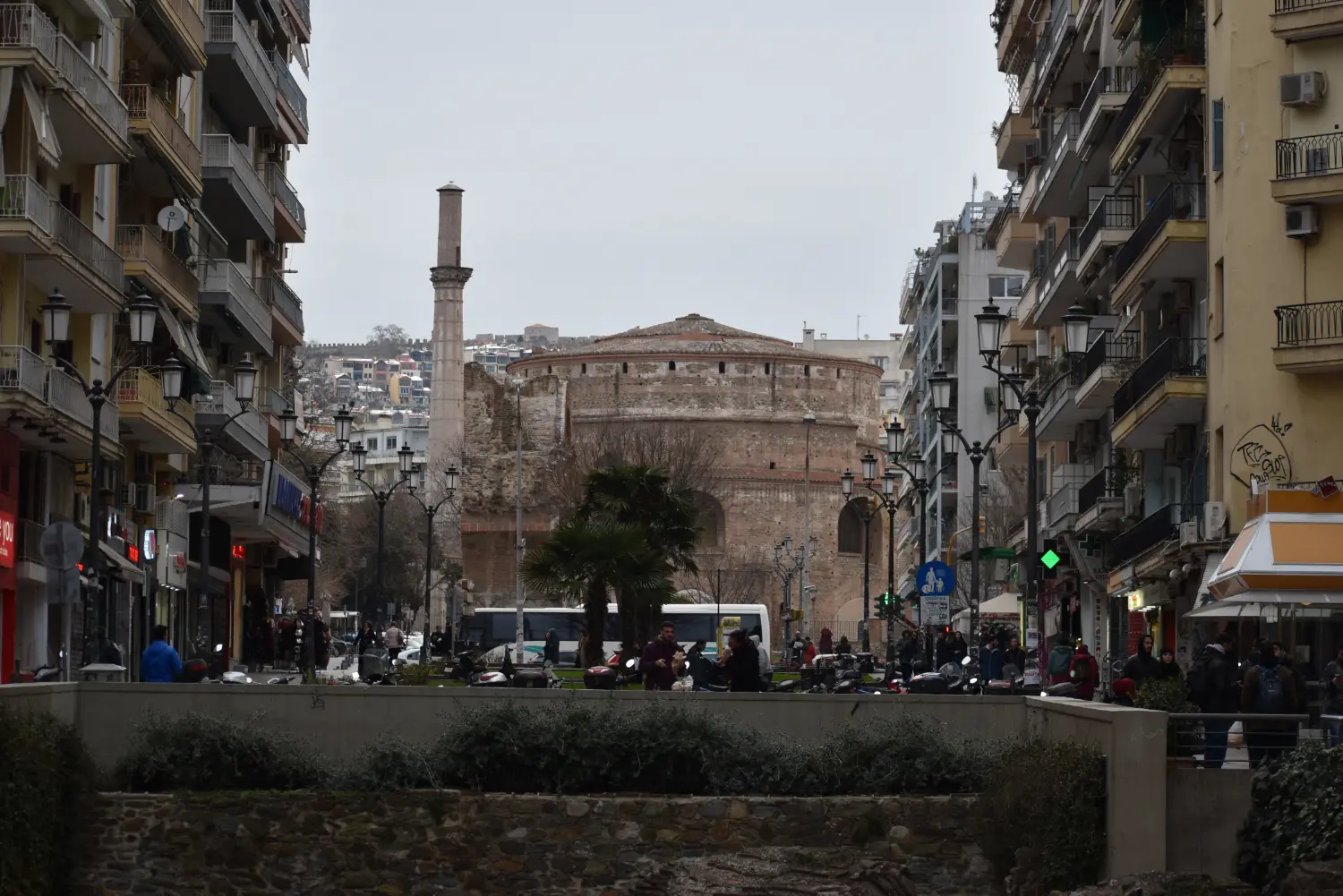
Nobody is certain what he built it for. A mausoleum for himself and a temple are the two usual suggestions, and he was never buried in it.
What happened afterwards is the reason to go.

Diagram by Greece Trips. Free to reuse with credit - CC BY 4.0.
The building changed religion twice and kept the evidence
- Roman, early fourth century, as part of Galerius’ palace, aligned with the Arch of Galerius a short walk away.
- Christian church, from the late fourth or fifth century, when it was given an apse and decorated with gold-ground mosaics that are among the earliest surviving Christian mosaics anywhere.
- Mosque, from the late sixteenth century under Ottoman rule, when the minaret was added.
- Monument and museum today, occasionally used for services and concerts.
The minaret is the point most visitors miss. It is one of the very few left standing in Greece - most were removed after 1912 - and it survives here precisely because the building was reclassified as an ancient monument rather than a religious one.
What to look at inside
The interior is a single vast domed space, and it is often emptier of visitors than it deserves.
- The mosaics in the dome and the vaults: gold ground, architectural fantasies, and figures of saints. They are fragmentary - a great deal has been lost - and what remains is high up, so look up and give your eyes a moment.
- The scale. The dome is around 30 metres across, and the walls are thick enough to contain internal passages.
- The apse, the Christian addition, which broke the original perfect cylinder.
The building has been repeatedly damaged by earthquakes, notably in 1978, and restoration has been running for decades. Expect scaffolding somewhere.
How long, and when
Thirty to forty minutes is enough unless you are there for the mosaics specifically.
It is indoors and cool, which makes it a good middle-of-the-day stop in a Thessaloniki summer.
What is next to it
The Arch of Galerius - locally just Kamara - is a few minutes’ walk down the same axis, and the two were part of one imperial complex. The arch’s surviving piers carry dense relief sculpture of Galerius’ Persian campaigns, and it stands in the open at a busy junction with the city walking past it.
Together they make a short, self-contained Roman walk in the middle of a modern shopping district, which is the thing that makes Thessaloniki unusual.
Getting there
The Rotunda is in the centre of the city, a few minutes on foot from Kamara and the university area, and walkable from anywhere in the lower town - see where to stay in Thessaloniki.
It is a UNESCO World Heritage listing as part of the city’s Palaeochristian and Byzantine monuments.
What to take from this page
Go for the layering rather than for a single object: a Roman drum with Christian mosaics in its dome and an Ottoman minaret outside it, standing between apartment blocks. Half an hour, indoors, cool.
Last checked August 2026. Opening hours and restoration access change - see our editorial policy.
Common questions
What is the Rotunda in Thessaloniki?
A large cylindrical brick building of the early fourth century AD, built as part of the palace complex of the emperor Galerius, later a Christian church, later a mosque, and now a monument and museum.
Why does the Rotunda have a minaret?
It was converted to a mosque under Ottoman rule in the late sixteenth century. The minaret survived the removals that followed 1912 because the building was treated as an ancient monument rather than a place of worship.
Are the Rotunda mosaics worth seeing?
Yes. The gold-ground mosaics in the dome and vaults are among the earliest surviving Christian mosaics anywhere, though they are fragmentary and set high up.
How long do you need at the Rotunda?
Thirty to forty minutes for most visitors.
Is the Rotunda near the Arch of Galerius?
Yes, a few minutes’ walk along the same axis. Both belonged to the same imperial complex.
Is the Rotunda a UNESCO site?
It is included in the UNESCO listing of the Palaeochristian and Byzantine monuments of Thessaloniki.
Next
Read things to do in Thessaloniki, where to stay in Thessaloniki, or the Thessaloniki travel guide.