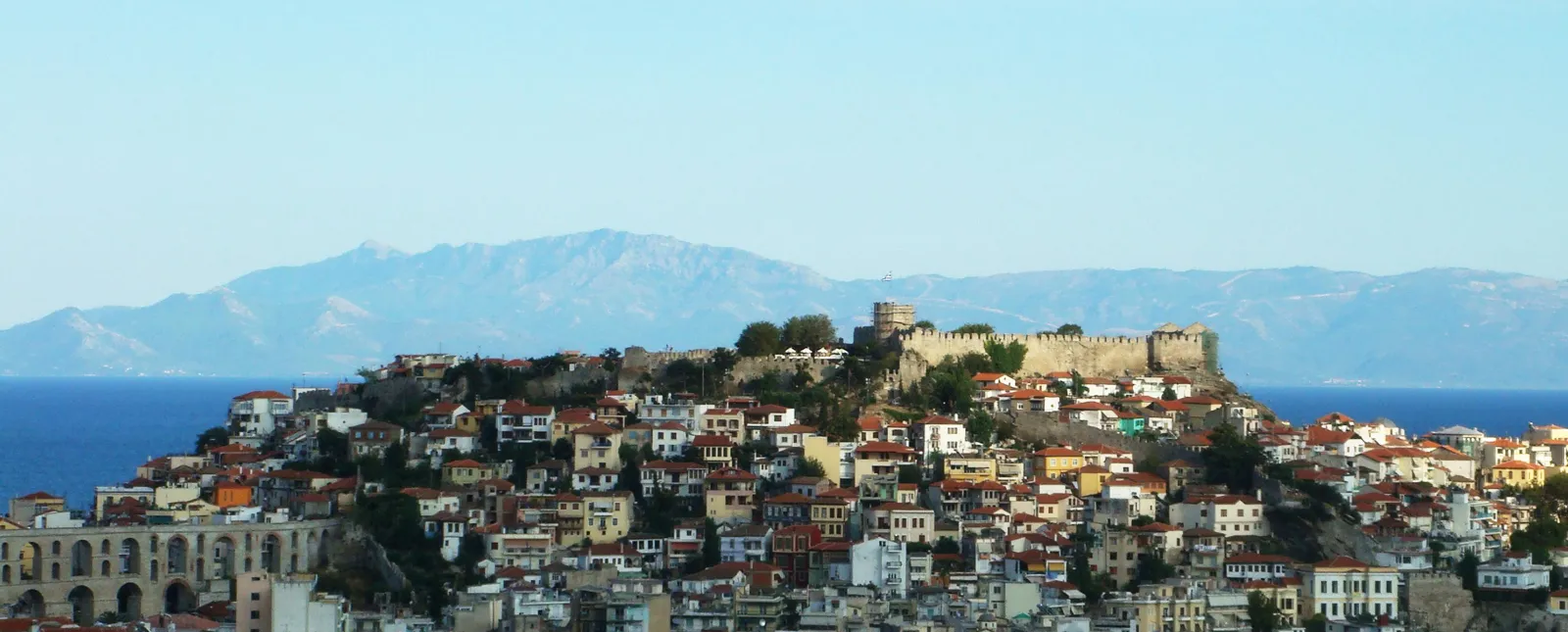
The old quarter, Panagia, occupies the headland at Kavala: stepped lanes, Ottoman-era houses with overhanging upper storeys, and the castle on the summit.

Diagram by Greece Trips. Free to reuse with credit - CC BY 4.0.
The castle is Byzantine in origin, with a round keep you can climb for the view over both bays.
The Imaret
Also in the quarter is the Imaret: a large Ottoman charitable complex of domes and courtyards, one of the most substantial Ottoman buildings in Greece.
It is now a hotel. We name it because it is a significant piece of architecture and our own guide names it as such - not as somewhere to stay. This page describes buildings; where to stay is a different question with a different standard behind it.
The aqueduct below
The Kamares runs on two tiers of arches straight across a modern street between the old town and the new. It follows a Roman line and was rebuilt in the sixteenth century under Suleiman, and it is used as a landmark, a meeting point and a roundabout.
Walking under it is the moment people remember about Kavala - and it is the boundary between Panagia and the modern city.
The town below the quarter
- The archaeological museum, holding finds from Amphipolis and the region.
- The tobacco warehouses, large early-twentieth-century industrial buildings that were the city’s wealth; one holds a museum of tobacco.
- A working fishing harbour, and a waterfront the city uses in the evening.
What Kavala is the base for
Philippi, twenty minutes inland - a major Roman city where Paul preached and where the battle was fought.
Thassos, by ferry from the quay or from Keramoti nearby. The Nestos delta, east: a wetland and river gorge.
Two nights, one of them for Philippi.
Practical notes
Getting there: Kavala airport at Chrysoupoli serves the city and Thassos. Thessaloniki is about two hours by road.
We print no museum or castle hours or ticket price. Our own guide flags that museum and site hours change.
The quarter is stepped. That is the character and also the constraint - look at the approach rather than taking our word for it.
Common questions
What is the Kamares? The two-tier arched aqueduct crossing the middle of Kavala, on a Roman line and rebuilt in the sixteenth century under Suleiman.
Can you go into the castle? There is a round keep you can climb for the view over both bays. We print no hours.
What is the Imaret? A large Ottoman charitable complex of domes and courtyards, one of the most substantial Ottoman buildings in Greece, now a hotel.
Next
Our Kavala guide has the practicalities, Philippi covers the Roman city, and where to stay covers the areas.