You are not checking an opening time. You are checking a sea and a calendar.
The Hellenic Ministry of Culture’s record for the fortified islet says two things that decide the day. The island is closed from 1 November to 31 March. And “the visit to the monument depends on the weather conditions and the itineraries of the boats that perform the transports on the island”.
Shuttle boats run from Plaka, Elounda and Agios Nikolaos. The site ticket and the boat fare are two different payments to two different parties.

Diagram by Greece Trips. Free to reuse with credit - CC BY 4.0.
The colony is the reason you go, and it is the last chapter
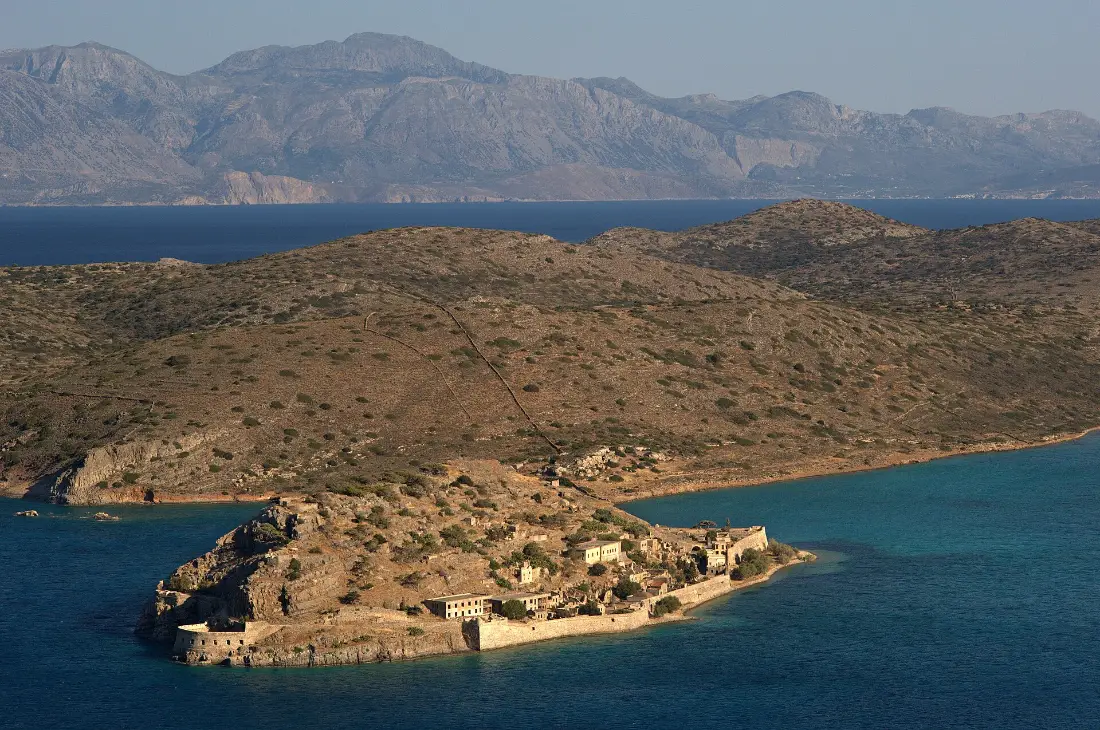
Spinalonga is a barren rocky islet of about 85,000 square metres lying in the mouth of the natural harbour of Elounda. It was fortified in antiquity to protect the ancient city of Olous, rebuilt by Venice at the end of the 16th century as a bastion sea-fortress, surrendered to the Ottomans in 1715, settled afterwards as a Muslim town, and from 1904 to 1957 it held a leper hospital.
That history is Greece’s own. It comes from the state’s nomination of the Fortress of Spinalonga to the UNESCO Tentative List, which is better sourced than any of the pages that rank for this island.
The order is what makes the place legible. The Venetians built here one of the most important bastion-type sea-fortresses in the Mediterranean, designed by Genese Bressani and Latino Orsini. It held out after the rest of Crete had fallen, and was given up only after a siege in 1715, when the remaining 600 inhabitants were taken captive. Muslims then settled the islet and built on the Venetian foundations. By 1881 the village housed 1,112 people and was the largest Muslim commercial centre of Merabello Bay, with roughly 200 homes and 25 shops or workshops by the end of the century.
Then the turn. In 1904, during the period of the Cretan State, Spinalonga was chosen as the site of a Leper Hospital. It shut down in 1957.
So the houses you walk past were not built for the colony. A merchant town raised them two centuries before the first patient arrived, and the colony inherited a village rather than building one. Nobody tells you that, and it changes every doorway on the island.
Of the patients, Greece’s nomination says they “organised their home, fell in love, married, had children”. That is the state’s sentence rather than ours, and it is better than anything we would have written.
A large share of the people on your boat are there because of Victoria Hislop’s novel The Island (2005) and the Greek series made from it. The fortress, the town and the hospital are real. The characters are not.
One point of precision, since much of the field blurs it: Spinalonga is on Greece’s UNESCO Tentative List, which is a nomination. It is not inscribed on the World Heritage List.
The boat decides your day, not the gate
Spinalonga is reached only by boat. Shuttle boats run from Plaka, Elounda and Agios Nikolaos. A visit depends on the weather and on the itineraries of the boats that carry visitors across, neither of which the site itself controls.
Read that twice, because your crossing is not in the state’s gift. The site belongs to the Ministry. The boat does not. Which means the question that decides your day is never what time the gate opens. It is whether the sea will let you across.
The three shores are geometry, and geometry is durable where a timetable is not. Plaka is the village directly across the channel from the islet, and it is the shortest crossing. Elounda sits in the bay to the south. Agios Nikolaos is further round the Gulf of Mirabello, and a boat from there is a longer trip that operators sell as a cruise rather than as a ferry.
We print no crossing times, no fares and no frequencies. The state publishes none of them, and the guides that do print them disagree with each other, which is the clearest evidence available that nobody sourced them. Ask at the quay.
The two payments are the thing people get wrong. The site is ticketed by the Ministry and the crossing is sold by a commercial operator, so they are two transactions to two different parties, and travellers consistently report paying the entrance on the island itself. Some operators sell the entrance together with the fare and some do not. We could not confirm any operator’s practice at a primary, so we will not tell you what yours includes. Ask at the quay what your fare covers, before you board. That question is the right one whichever way the answer goes.
And sail in the morning. A wind that gets up over the Gulf of Mirabello in the afternoon can end the day’s sailings, and the Ministry has already told you the visit depends on the weather. Do not put Spinalonga on the day you fly home. Getting yourself to the right quay is a driving question, and driving in Greece covers the rest of it.
The island shuts for the winter
Spinalonga runs a summer season and shuts through the winter, opening in those months only on request for groups. The season is broadly the April-to-October window that governs most of this coast.
The planning consequence is blunt, and it is the most valuable line on this page. A Crete trip in the depths of winter cannot include Spinalonga, and a trip at the edges of the season may not. If the island is the reason you are booking a hotel in Elounda, then your trip has a season: confirm the dates with the Ministry, and the sailings at the quay, before you book around it.
We do not print the daily opening hours. They sit on the record, they are reissued, and they are not the constraint in any case. The boat is.
Which days Greek sites shut for the calendar is a separate question with its own answer in public holidays and what closes, the rhythm of the Greek working day is in siesta and opening hours, and the shape of the shoulder months is in when to visit Greece.
One honest note about the season that lets you in. It is the same season that fills the quays. When the island is open, everybody is there.
What you actually pay, and to whom
| What you pay | Who takes it | What to do about it |
|---|---|---|
| The site ticket | The Hellenic Ministry of Culture | The current price is on the Ministry’s record. Travellers report paying the entrance on the island itself |
| The boat fare | A commercial boat operator | Ask at the quay what it includes, before you board |
This page prints no price, and the reason is worth one sentence. The entrance fee rose recently, and at least one prominent guide is still printing a figure less than half the Ministry’s current one. That is what a baked-in number does to a travel page after a season or two. We print the mechanism and name the record instead. What a Greek trip costs in the round is in what a Greece trip costs, and how you actually pay for things is in money in Greece.
Reduced and free admissions exist and they are real. The Ministry’s own text on who qualifies is a wall of translated legal prose, and paraphrasing eligibility rules is how a reader gets turned away at a gate holding a page that said they would be fine. The categories are the Ministry’s and they are published on its record.
The bundle question stays open, because we could not close it. Some operators sell the site entrance with the crossing and some do not. Ask at the quay.
An hour on a walled loop
The islet is small, barren and rocky. The Venetian bastions face the sea. The town’s houses climb the west and south sides in a stepped pattern, and many well-built two-storey houses and shops are still standing. The route around is a circuit, on the stepped ground of an old town, on a rocky islet, in the Cretan summer. We will describe that and leave the judgement about it to you.
Allow an hour to ninety minutes on the island. No primary publishes a visit duration, so treat that as what visitors and guides consistently report rather than as a rule. The asymmetry inside it is worth knowing: guided groups are often taken back off inside the hour, while an independent visitor can stay and catch a later boat. That is the whole argument for doing it yourself.
Carry water and a hat. We are not going to tell you what the island does or does not sell, because we could not confirm it at a primary and a confident guess would be worse than the gap. Carrying your own water is right either way.
Take a guide, or an audio guide. The buildings on Spinalonga do not explain themselves, and a shell of a house looks like a shell of a house until somebody tells you that a merchant built it and a patient lived in it. The same is true at Knossos and for the same reason. That is the difference between an hour that means something and an hour of photographs.
Sail early, and go between April and October
The island is not the constraint. The sea and the calendar are, and both of them are in the Ministry’s own record rather than in anybody’s opinion.
Spinalonga is shut from November to March. And the visit depends on the weather and on the boats, which the state says in writing, and which in practice means one thing: sail in the morning, and never on the day you fly home.
Go for the fortress, and stay for the town underneath the story. The colony is the last chapter of this island rather than the whole book, and the people sent to it organised a home there.
From here: Crete, end to end.
Last checked July 2026. What gets re-checked on this page: the season, the three departure points, the Ministry’s weather-and-boats statement and the ticket mechanism. How we date and re-check facts is set out in our editorial policy.
The two payments are the thing to settle before you board, so ask the operator at the quay what the fare covers while you are buying it.
The site ticket is the Ministry’s and the crossing is not, which is why this page sends you to the quay rather than pretending the two arrive together.
Common questions about Spinalonga
How do you get to Spinalonga?
Only by boat. Shuttle boats run from Plaka, which sits directly across the water from the islet, from Elounda in the bay to the south, and from Agios Nikolaos further round the Gulf of Mirabello. The caveat that matters is that a visit depends on the weather and on the itineraries of the boats, neither of which the site controls. We print no crossing time, fare or frequency, because the state publishes none. Check at the quay on the day.
Is Spinalonga open in winter?
No, and almost nothing else will tell you so before you book. The site runs a summer season, broadly April to October, and shuts through the winter, opening in those months only on request for groups. The planning consequence is hard: a Crete trip in the depths of winter cannot include Spinalonga, so if the island is why you are going to the northeast coast, your trip has a season. Confirm the exact dates with the Ministry before you book around it, because the shoulder weeks are where this catches people.
What was Spinalonga?
A fortified islet at the mouth of the Elounda harbour. It was fortified in antiquity to protect the ancient city of Olous, rebuilt by Venice at the end of the 16th century as a bastion sea-fortress, held after the rest of Crete had fallen and surrendered to the Ottomans in 1715, settled afterwards as a Muslim town, and from 1904 to 1957 it was a leper hospital. The source is Greece’s own nomination of the Fortress of Spinalonga to the UNESCO Tentative List, which is a nomination and not an inscription on the World Heritage List.
Is the boat ticket the same as the entrance ticket?
No. The site is ticketed by the Hellenic Ministry of Culture and the crossing is a commercial boat operator’s fare, so they are two payments to two parties, and travellers consistently report paying the entrance on the island itself. Some operators sell the entrance along with the crossing and some do not, and we could not confirm any operator’s practice at a primary. Ask at the quay what your fare includes, before you board. That answer is right whichever way it goes.
Do I need to book a boat to Spinalonga in advance?
We did not find a booking rule at any primary source, and we are not going to invent one. What we can tell you is the mechanism: the boats are commercial and seasonal, they run to their own timetables, and in high summer the quays at Plaka and Elounda are busy. Ask the operator. The advice that holds regardless is to go in the morning, because the Ministry itself says the visit depends on the weather, and an afternoon wind over the Gulf of Mirabello can end the sailings.
How long do you need on Spinalonga?
About an hour to ninety minutes on the island itself. No primary publishes a duration, so that range is what visitors and guides consistently report rather than a rule. The useful asymmetry: guided groups are often taken back off the island inside an hour, while an independent visitor can simply wait for a later boat and take the walled circuit at their own pace.
Is Spinalonga the island from The Island by Victoria Hislop?
Yes, and it is why the boats are full. Victoria Hislop’s 2005 novel The Island is set on Spinalonga, and the Greek television series made from it filled the quays at Plaka and Elounda. The honest half is that it is a novel: the fortress, the Ottoman town and the leper hospital are real, and the characters are not. Reading it before you go changes what you see on the island, and it does not make it a documentary.
Booking
We sell nothing and book nothing for you. Every guide on this page tells you how to arrange each piece yourself - which ferry operator, when to book, what to prebook and what to leave loose.