
Diagram by Greece Trips. Free to reuse with credit - CC BY 4.0.
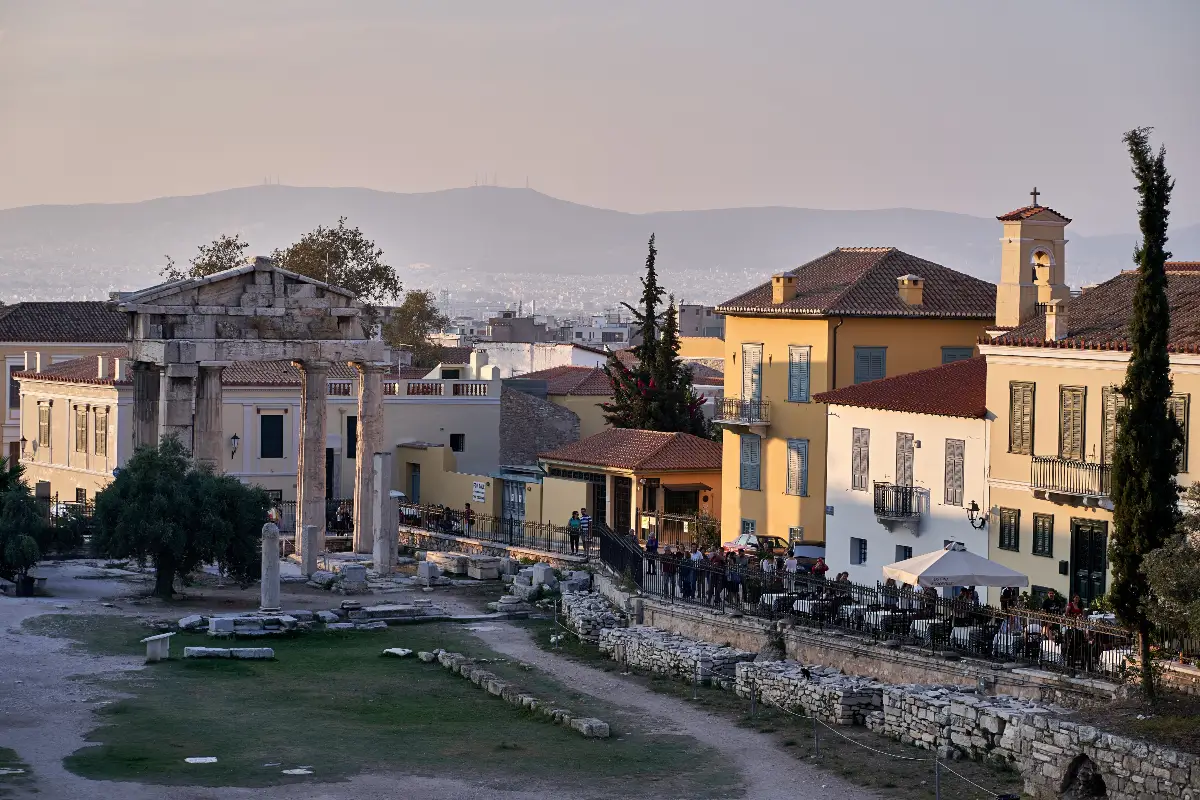
This one is later, smaller, and easier to see in full. It was the market square built under Roman rule, when the commercial life of the city shifted east of the old agora.
The Tower of the Winds is the reason to come
The octagonal marble tower standing in the site is the piece worth crossing town for. Each of its eight faces carries a carved wind figure, and the building worked as a combined weathervane, sundial and water clock. It is one of the most complete surviving buildings of its kind anywhere, and it is standing, not a foundation you have to imagine.
The rest reads quickly: the paved court, the line of the colonnades that once ran round it, the monumental gate at the western end, and a later Ottoman-era building along one edge, because this quarter kept being used long after the Romans left.
Why so many people walk past it
The site sits behind railings on a street most visitors use as a shortcut between the Plaka lanes and Monastiraki square, and from outside it can read as a rubble field with a tower in it. You can see a fair amount through the fence, which is exactly why some travellers decide not to go in.
The counter-argument is simple: this is a fifteen-minute site with one exceptional object in it, and it is quiet at hours when the Acropolis is not. If you are walking past anyway, going in is an easy yes.
How it fits with the other sites
The combined ticket that once covered this site with the Acropolis and several others ended on 1 April 2025, so the Roman Agora is now a ticket of its own. Take the current terms from the ticket office rather than from a blog, this page included.
In an itinerary the honest order is the Acropolis first, the Ancient Agora second, and the Roman Agora as a short stop between the two quarters. Things to do in Athens puts them in sequence.
Practical notes
- It is small. Fifteen to twenty minutes is a full visit for most people.
- There is very little shade, the same rule as every open site in the centre: early or late in summer.
- The ground is uneven marble and gravel, with low kerbs around the excavated areas.
- Hours and ticket terms change, so check before building a morning around it.
Last checked September 2026. Opening hours and ticket prices change - see our editorial policy.
Common questions
Is the Roman Agora the same as the Ancient Agora?
No. They are two separate archaeological sites a few hundred metres apart, with separate entrances and separate admission. The Ancient Agora is the classical civic centre below the Acropolis; the Roman Agora is the later market square to its east.
What is inside the Roman Agora?
A paved court with the remains of its colonnades, a monumental gate, an Ottoman-era building along one side, and the Tower of the Winds, an octagonal marble tower that served as weathervane, sundial and water clock.
How long does the Roman Agora take?
Fifteen to twenty minutes. It is among the quickest ancient sites in central Athens to see properly.
Where is the Roman Agora in Athens?
Between Plaka and Monastiraki, a short walk from either, on the streets that link the two quarters.
Is the Roman Agora worth it?
For the Tower of the Winds, yes, particularly if you are walking between Plaka and Monastiraki anyway. As a standalone destination it is thin beside the Acropolis or the Ancient Agora.
Next
Read things to do in Athens, the Ancient Agora, or Plaka.