
Diagram by Greece Trips. Free to reuse with credit - CC BY 4.0.
If Plaka is the city dressed for visitors, Monastiraki is the city still doing business, and the two are five minutes apart on foot.
What is actually on the square
The square itself stacks several centuries in one view, which is the reason to stand in it rather than pass through:
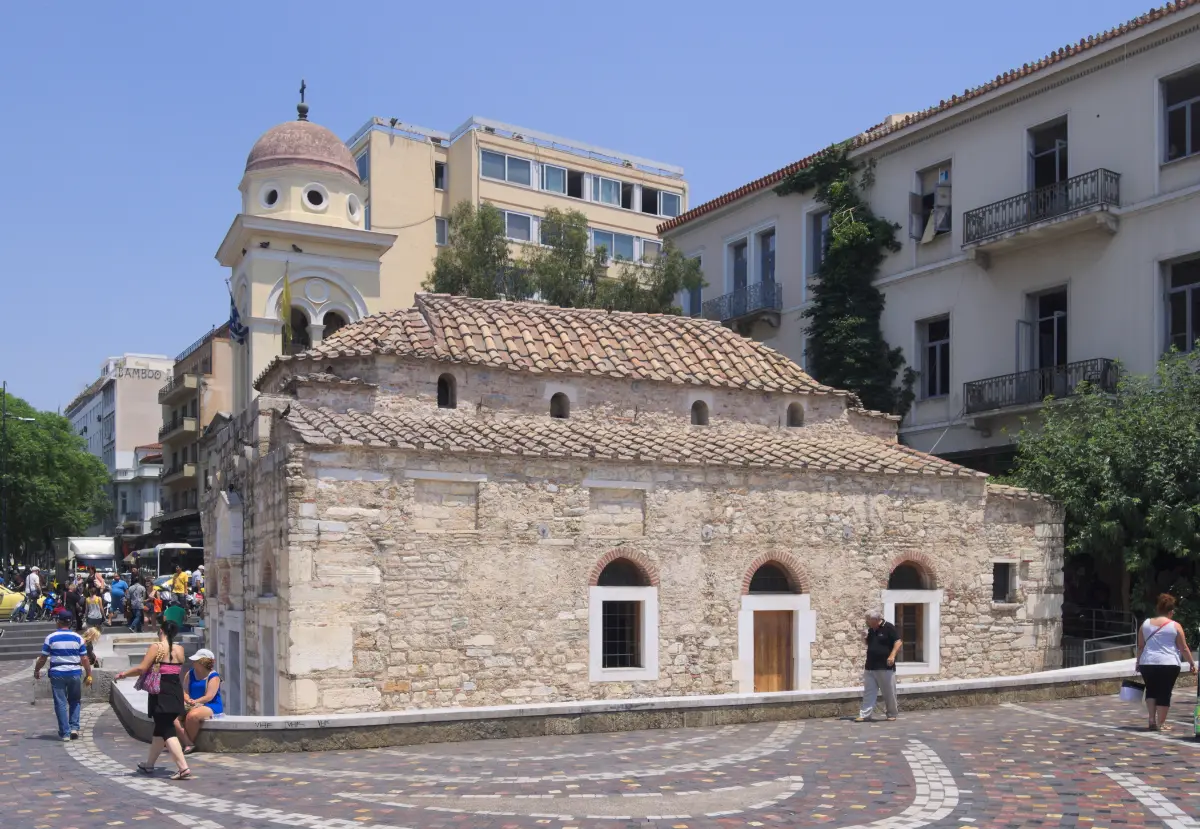
- A small Byzantine church in the middle of the square, the monastery whose name the quarter carries in diminutive form.
- An Ottoman-era mosque on one side, now a museum building rather than a working mosque.
- The wall of Hadrian’s Library along the other side, a Roman complex you can see over the fence and enter as a separate archaeological site.
- The metro entrance, which puts you three stops from the port at Piraeus and one from the Acropolis.
Above all of it, the rock. The angle from this square is the one that shows the Acropolis as part of a living city rather than an isolated monument.
The flea market, and what it really is
The name promises more than the streets deliver on a weekday. Most of Ifestou street, running west from the square, is souvenir stalls: sandals, magnets, cheap leather. It is enjoyable enough as a walk and thin as shopping.
The part that rewards attention is Avissynias Square and the lanes around it, where the antique and bric-a-brac dealers work. Old brass, furniture, records, photographs, military surplus and genuine junk, sold by people who know exactly what they have. It is at its fullest on Sunday morning, when the market spills out properly and half of Athens comes to look.
The rooftop view
The bars and restaurants on the roofs around the square hold the most photographed dinner view in Athens: the lit Acropolis at eye level, close enough to fill the frame. They know it, and the drinks are priced accordingly.
You do not have to buy anything to get most of it. The square at night, and the streets climbing towards Plaka, give you the same rock under the same floodlights.
When to go
Sunday morning for the market, late afternoon for the light on the rock, and the evening for the rooftops. Weekday middays are the worst of it: full sun, tour groups moving between sites, and the stalls at their most generic.
The quarter is a hinge rather than a destination, which is its real use. From this square you can walk into the Ancient Agora, up through Plaka to the Acropolis, or west into the old workshop streets in about ten minutes each. Things to do in Athens sets out that geography.
Practical notes
- Crowds and pickpockets. It is a busy interchange square, so treat bags as you would in any European transport hub.
- The metro station is one of the most useful in the city, with the line to the port and the airport line a change away.
- Prices swing wildly between the tourist strip and the lanes two streets back, in both directions.
Last checked August 2026. Details change - see our editorial policy.
Common questions
What is Monastiraki known for?
Its flea market, its square under the Acropolis, and the rooftop bars looking straight at the rock. It is also a major metro interchange linking the centre with Piraeus and the airport line.
Is the Monastiraki flea market worth visiting?
The souvenir strip is skippable. The antique and bric-a-brac lanes around Avissynias Square are the real market, and Sunday morning is when they are at their fullest.
What is the difference between Plaka and Monastiraki?
Plaka is the quieter old quarter of lanes and neoclassical houses climbing towards the Acropolis. Monastiraki is the noisier commercial square and market district on its western edge.
Can you see the Acropolis from Monastiraki?
Yes, and it is one of the best angles in the city, especially from the rooftops around the square in the evening.
How do you get to Monastiraki?
By metro to Monastiraki station, or on foot from Plaka or Syntagma in ten to fifteen minutes.
Next
Read things to do in Athens, Plaka, or where to stay in Athens.