So the way home is a boat, and then a bus. You are not walking back to your car, which means the boat’s departure is the deadline the entire day is built around. Your start time at the top is not a preference. It is the last sailing, minus however long the walk takes you.
The park also has a season, and the season is a decision rather than a date: an authority opens it in spring, closes it in autumn, and can shut it at short notice. Settle that question before you plan anything else.
Last checked July 2026.

Diagram by Greece Trips. Free to reuse with credit - CC BY 4.0.
The way out is a ferry, and the ferry is the deadline
Agia Roumeli, the village at the bottom of the gorge, has no road connection. That is not our inference. ANENDYK, whose boats serve the south coast of Crete, describes the village it calls at as being “without a road connection”, sitting at the end of the national park. Everything else about a Samaria day follows from that one line.
From Agia Roumeli the boats run in two directions: east to Loutro and Chora Sfakion, west to Sougia and Paleochora. Those ports are on the road network, and buses run from them back over the White Mountains to Chania. That is the way home, in three moves. Walk out, take the boat, take the bus.
We do not print the departure time, and you should be wary of any page that does. The timetable belongs to the operator, it changes with the season, and a wrong time here is a walker sleeping in a village they had not planned to sleep in. ANENDYK publishes the south-coast schedule. Read it the day before you walk, not the week before you fly.
Then build the day backwards from it. This inverts the logic of every hike you have done, where the deadline, if there is one, sits at the start. Here it sits at the end. A group that sets off late, or that walks more slowly than it expected to, does not simply arrive tired: it arrives at a jetty after the boat has gone.
If that happens, Agia Roumeli has been receiving walkers off this path for decades and there is accommodation in the village. That is a description of the place, not a guarantee that a bed will be free on the night you need one.
The wider mechanics of Greek boats, and why the sea decides more than the schedule does, are in our guide to how Greek ferries actually work, and the bus and boat chain across the country is covered in getting around Greece.
Two things get bought for a Samaria day: the park ticket, which the authority issues through its own portal, and the boat out, which belongs to the operator. Both live with the bodies that run them, and this page sends you to them rather than standing in between.
The season is a decision, not a date
The gorge sits inside a national park, and the park is managed by NECCA, the Natural Environment and Climate Change Agency, known in Greek as OFYPEKA. The agency decides when the park admits walkers and when it does not. The pattern is a season that runs from spring to the end of October, with the park shut through the winter, which is the frame our Crete guide sets out alongside the rest of the island’s calendar.
The pattern is not the rule, and 2026 proved it. The gorge did not open on 1 May, the date most guides print as though it were a fact about the calendar. Winter storms had brought landslides near the Portes and left standing water reported up to two metres deep, and the agency said the park would reopen only once repair works were finished and inspections had been carried out, with the Greek Geological and Mineral Research Authority involved. It opened on 19 May.
The same machinery works in August. The park closes on rainy days because of the risk of rockfall, and Crete’s summer brings fire risk of its own. The consequence is behavioural rather than statistical: keep a spare day behind a Samaria plan, and do not put it on your last day on the island.
Where the live answer actually lives, and it is not here:
- The park authority, NECCA, which runs the park through its Management Unit in Chania.
- The authority’s own ticket portal, which is where a given day’s admission shows up.
We publish no live status for this park and never will. A travel page telling you the gorge is open today is out of date by the time you read it, which is the same reason we date and re-check every fact on this site, as our editorial policy explains. If you are still choosing your month, when to come to Greece covers the wider calendar.
What the 13 kilometres actually are
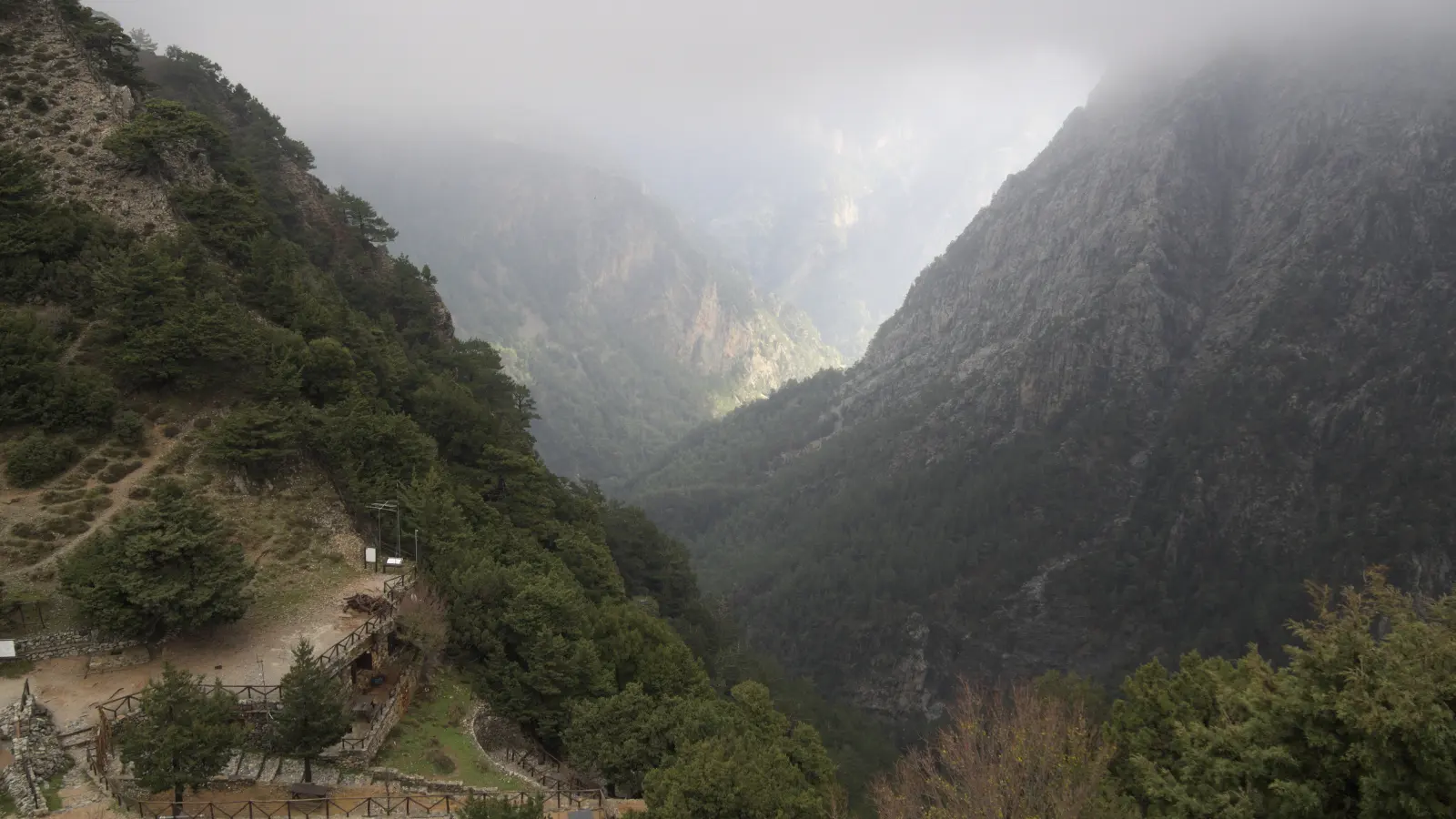
The walk begins at Xyloskalo, the stepped path off the edge of the Omalos plateau at around 1,230 metres, and the first stretch is where most of the height goes. Below it the path settles onto the floor of the gorge: a dry riverbed of loose stone, crossed and recrossed on stepping stones, with the walls rising on either side.
About two thirds of the way down you pass Samaria itself, the village emptied when the gorge became a national park, its houses still standing among the pines. Below that the walls close in at the Portes, the Iron Gates, where they stand a few metres apart. The kri-kri, the Cretan wild goat, lives on the rock above the path, and you may or may not see one.
Then the gorge opens out and the walk changes character. The last part is flat, wide and largely without shade.
Which brings us to the distance nobody warns you about. The walk inside the national park is generally given as 13 km. Agia Roumeli is roughly 3 km beyond the park gate, so it is about 16 km on your feet, and the last three arrive when you thought you had finished. Five to seven hours is the range walkers report, longer with stops, and it is a range rather than a schedule. Whatever number you settle on for yourself, subtract it from the boat, and give yourself more margin than the arithmetic says.
We describe the ground and we do not rate it. Whether this walk is for you is a judgement about your knees, your day and a body we have never met, and it is not a judgement this page is in a position to make.
What we can tell you is how the park is described as behaving, which says more than an adjective would. The authority’s own ticket portal states that the money from your ticket goes to maintaining the main path and to supervising the area along it, so this is a patrolled route rather than an unmanaged one. Beyond that, walkers and regional guides consistently describe wardens along the route in radio contact, tickets checked on the way out, springs maintained along the path, and a cut-off after which late arrivals are turned back within the first stretch rather than given a shorter walk. Treat all of that as how the park is reported to run, not as a system that will catch you. Ask at the gate what applies on your day.
What you carry is your business, though the shape of the day argues for itself: a long descent on stone, then a hot, open finish. Our what to pack for Greece guide covers the general kit, and the rest of the island’s sights are in things to do in Crete.
Why almost nobody drives themselves
Drive to Xyloskalo and your car spends the day at 1,230 metres on the north side of the White Mountains while you finish on the south coast, with no road between the two. Retrieving it means the boat, then a bus, then another bus. This is not a failure of planning. It is the geometry of a one-way walk, and no amount of organisation dissolves it.
Which is why the common solution is a bus that leaves Chania or Rethymno early, drops walkers at the top, and meets the ferry on the other side. That is the practice, described rather than recommended, and we name no operator. The independent version works too: public KTEL buses run up to Omalos in the morning, and the return chain is the boat and then a bus from Chora Sfakion, Sougia or Paleochora. More moving parts, and every connection is yours to make, so check both legs with the operators before you commit to the independent version.
| How you get up | How you get back | What it costs you in freedom |
|---|---|---|
| Organised bus from Chania or Rethymno | The company meets the boat on the south coast and drives you back | You walk to their clock and you leave when they leave |
| Public bus to Omalos | Boat, then a public bus from Chora Sfakion, Sougia or Paleochora | Every connection is yours to make, and the day is longer |
| Your own car to Xyloskalo | Boat, bus, bus, and back up the mountain to the car | The car sits on the wrong side of a mountain range all day |
If there are two of you and one rental car, this is the day to leave it at the hotel. Where that hotel sits is a separate decision, and where to stay in Crete makes the case for the west: Chania is the usual base for this walk.
There is also a shorter version of the day, and it solves the same problem. Take the boat to Agia Roumeli, walk up into the gorge as far as the Portes, and come back down to the beach. Same ferry, a fraction of the distance, and no one-way problem at all. It is an option that exists, and who it suits is not for us to say.
Check the park, then work backwards from the boat
Two habits make this day work, and both of them happen before you leave the hotel.
Check the park first, and check it with the park. The season and the day’s status belong to the authority that runs it, not to any guide, this one included, and a page that tells you the gorge is open today was written months ago. Then work backwards from the boat. The walk has a deadline at the bottom of it, and it is the rare day out where being slow is a connection problem rather than a late dinner.
Given both of those, the honest place for Samaria in a trip is early in the week rather than at the end of it, with a day behind it that can absorb a closure. That is a smaller sacrifice than it sounds, and it is the difference between a walk you take and a walk you were counting on. The rest of the island, and where this day fits into it, is in our Crete guide.
Last checked July 2026. Three things get re-checked on this page before every update: the park’s opening status and the authority that sets it, the operator and the routes off the south coast, and the distances and timings of the walk.
Common questions
How do you get back from the Samaria Gorge?
By boat. The walk ends at Agia Roumeli, which ANENDYK, the operator serving that coast, describes as a village without a road connection, so the ferry is the way out: east to Loutro and Chora Sfakion, or west to Sougia and Paleochora, and then a bus back over the mountains to Chania. Read the operator’s timetable the day before you walk, and set your start time by it. A slow walk here is a missed connection, not just a tired evening.
Is the Samaria Gorge open?
That question belongs to NECCA, the Natural Environment and Climate Change Agency, which manages the national park and decides when it admits walkers. The season runs roughly from spring to the end of October and the park is shut all winter, and it can close at short notice on rain or fire risk. The calendar is not the answer: in 2026 the gorge missed the traditional 1 May opening and opened on 19 May, after winter storm damage, repairs and inspections. The authority’s ticket portal shows a given day’s admission. We publish no live status.
How long is the Samaria Gorge walk?
Two numbers, and the second one is the one that hurts. The walk inside the national park is about 13 km, and Agia Roumeli sits roughly 3 km beyond the park gate, so it is around 16 km on your feet. Walkers commonly report five to seven hours, longer with stops. It is a descent from around 1,230 metres rather than a level walk, and the final stretch is flat and open.
Can you walk the Samaria Gorge in the other direction?
The standard walk is downhill from Xyloskalo. The common alternative is to take the boat to Agia Roumeli, walk up into the gorge as far as the Portes, and come back to the beach, which uses the same ferry and avoids the one-way problem entirely. It is a fraction of the distance. Whether the park permits a full uphill crossing is a question for the park, and not one we can answer from its published information.
What happens if you miss the last boat from Agia Roumeli?
You stay. The village has no road connection, so you do not drive out of it and you do not walk out of it after dark. Agia Roumeli has been receiving walkers off this path for decades and there is accommodation in it, though nobody can promise you a free bed on the night you need one. This is why the start time is set by the boat, and why the park turns back late entries rather than letting them start.
Do you need a ticket for the Samaria Gorge?
Yes. It is a national park and entry is ticketed, issued through the park authority’s own portal and collected at the gate. We do not print the price, because a fee set by ministerial decision is exactly the kind of number that changes without telling a travel page. The portal is also the most reliable place to see whether the park is admitting walkers on a given day.
Booking
We sell nothing and book nothing for you. Every guide on this page tells you how to arrange each piece yourself - which ferry operator, when to book, what to prebook and what to leave loose.