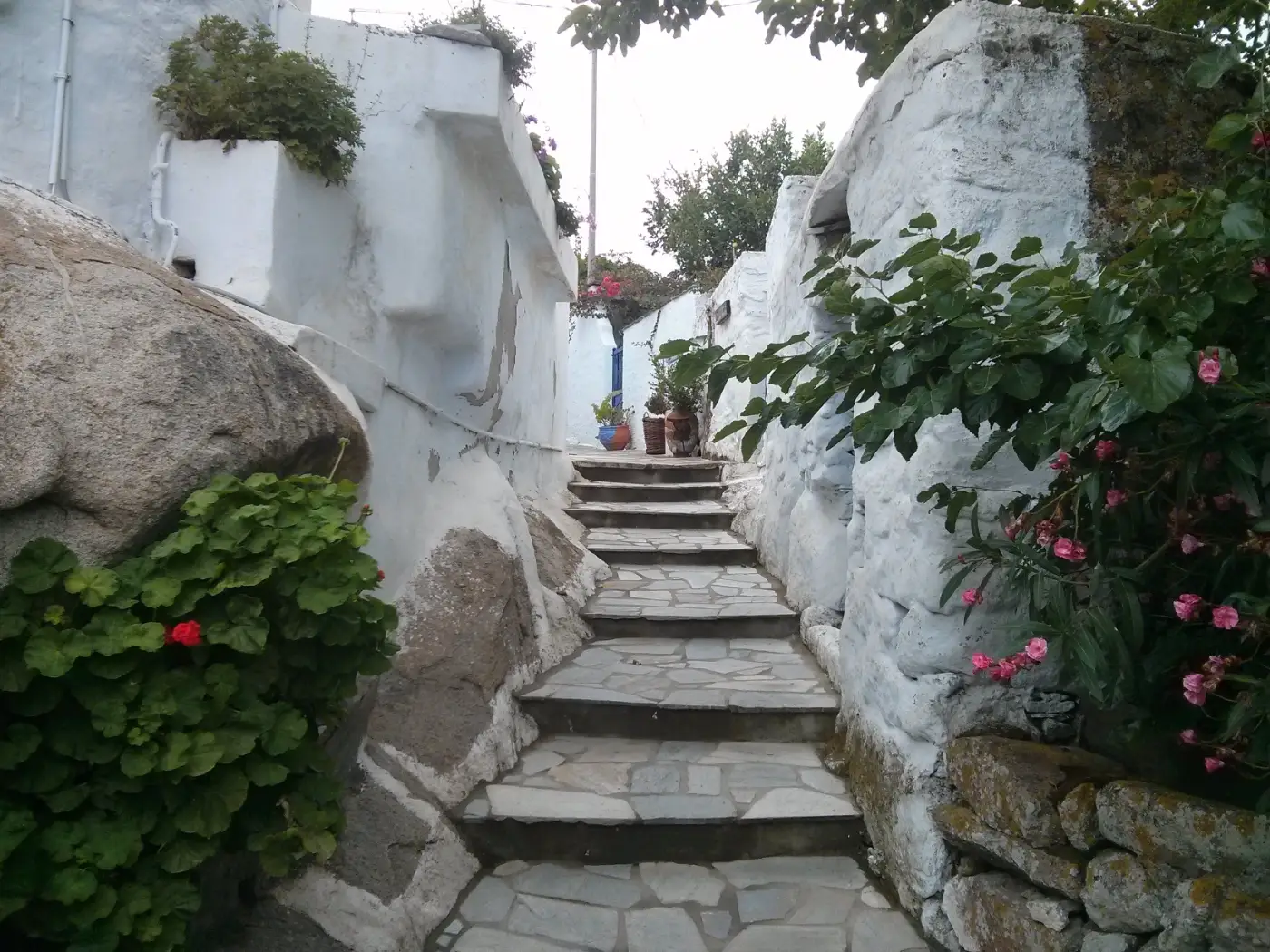
The boulder field around Volax is the strangest thing on Tinos and one of the strangest in the Cyclades.

Diagram by Greece Trips. Free to reuse with credit - CC BY 4.0.
The village is a knot of white houses on a plateau strewn with thousands of rounded granite boulders, some larger than the rooms they lean against. Wind and weather rounded the granite over an immense span of time, and the result reads as almost lunar.
What it actually looks like
Not a rock formation you drive to and photograph from a viewpoint. The boulders are among the houses - the village sits inside the field rather than beside it, so the scale registers when a garden wall turns out to be a stone twice the height of the wall next to it.
The baskets
Volax also keeps a living basket-weaving tradition, the reeds still worked by hand.
That is worth knowing because it is the difference between a landscape stop and a village: something is still made here.
The other half of the interior
Volax is one of two things the Tinos interior has at a scale you see almost nowhere else. The other is the dovecote.
These are ornamental stone towers from the Venetian centuries, their upper faces worked into geometric sunbursts, triangles and diamond lattices that double as perches and flight-holes. They were working buildings: pigeons were kept for their droppings, a prized fertiliser on a dry island, and for their squabs at the table.
They stand in the hundreds across Tinos, and sources disagree on exactly how many - counts range from several hundred to more than a thousand - so it is the density that tells the story rather than any single figure. We print no number for that reason. The valley around Tarambados holds the classic concentration.
They are farm buildings, not follies, which is why they sit among the terraces and field walls rather than in the villages.
Why this needs a car
This is the Tinos that rewards slow, car-based wandering - the half of the island the craft-and-walking traveller comes for, and the reason two days here fill easily.
Tinos is a car island. The marble villages sit along the northwest on narrow mountain roads that climb and switch back, and the interior is not a bus proposition. Which islands need a car sets out the general rule.
Practical notes
Getting to Tinos: there is no airport. Every arrival is by sea. The ferry leaves from Rafina, not Piraeus - about an hour and a half by high-speed catamaran or roughly three and a half hours by conventional ferry, daily year-round. Piraeus runs too, but slower and less often. The Mykonos hop is about a quarter of an hour to half an hour.
When: May to June and September. July and August are hot, windy and busy, and the week around 15 August is the pilgrimage peak.
Common questions
How many dovecotes are there? Nobody agrees. Counts run from several hundred to more than a thousand, so we give none.
Is Volax worth the drive? It is the reason to have the car at all, alongside the marble villages.
Is it near the pilgrimage? Panagia Evangelistria is in Tinos Town, a different half of the island and a completely different day.
Next
Our Tinos guide has the practicalities, things to do in Tinos covers the marble villages, and the beaches cover the coast and the wind.