
Diagram by Greece Trips. Free to reuse with credit - CC BY 4.0.
It is also, honestly, a short visit. You walk in, you see one enormous thing, you walk the track, you climb the seating, you leave. Twenty to forty minutes covers it. That is not a criticism. It is how to plan it.
What you are looking at
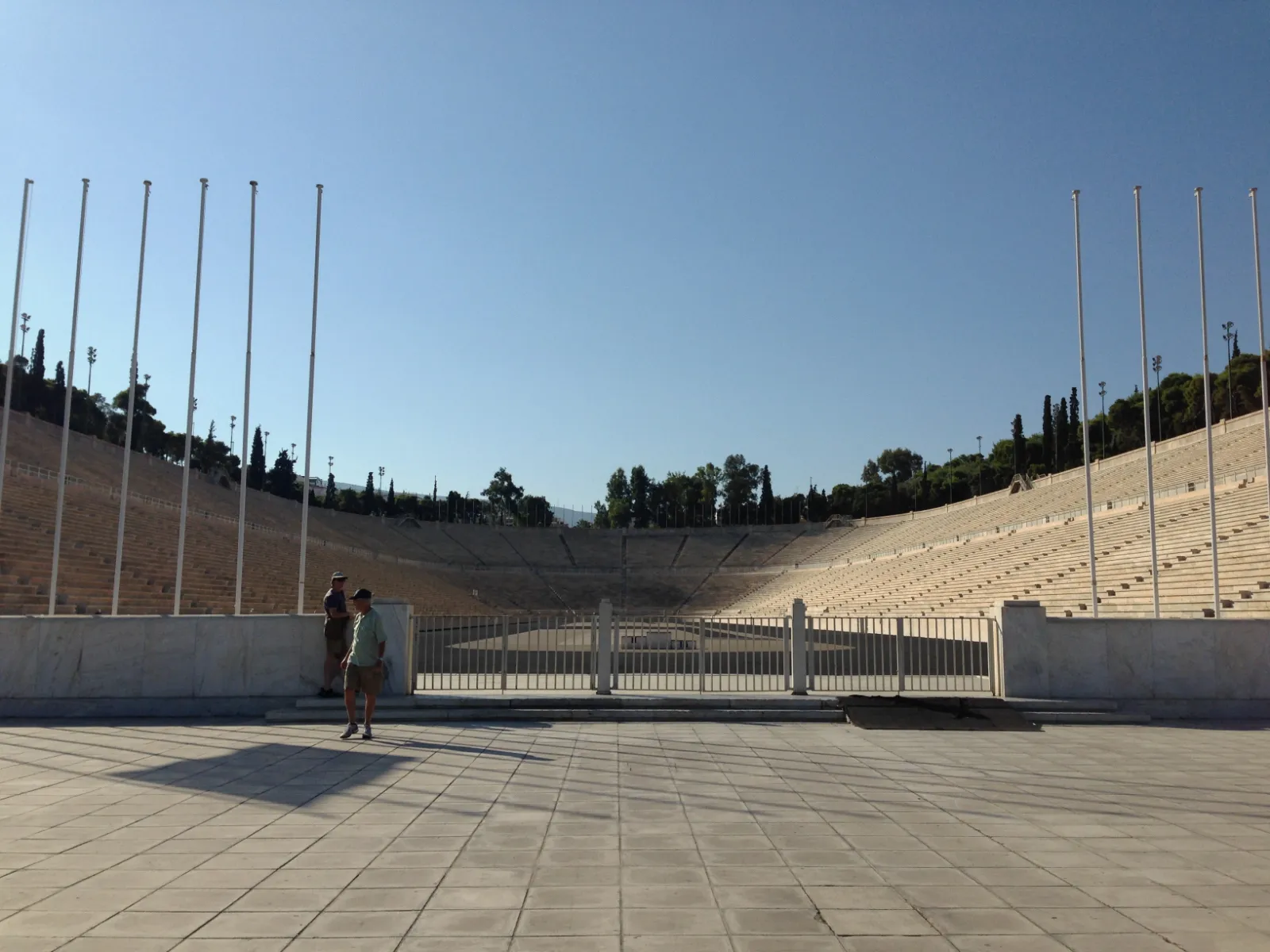
The stadium sits in a natural fold between two low hills, which is why a stadium was built on this ground in antiquity in the first place. What stands today is a nineteenth-century reconstruction on that ancient footprint, faced in Pentelic marble, from the same mountain quarry that supplied the Parthenon.
The shape is the point. It is a long narrow horseshoe with tight turns, built for foot races rather than for the wide oval of a modern athletics track. Walking the curve tells you more about ancient racing than any label does.
Why it is still in use
Three things keep it working rather than retired:
- It held the first modern Olympic Games in 1896, and hosted events again when the Games returned to Athens in 2004.
- The Olympic flame is handed to each host nation here before the Games, a ceremony that puts the stadium on television every couple of years.
- The Athens Marathon finishes on this track, which is why runners talk about the last kilometre of that race more than the first forty.
What you actually do there
You enter at track level and the visit is self-directed. Walk the track, sit in the marble tiers, climb to the top of the horseshoe for the view back across the city towards the Acropolis, and find the vaulted passage that runs under the seating.
There is a display of Olympic torches and posters in the tunnel area, and an audio guide is usually offered at the entrance. None of it takes long, which is why the stadium works as a stop rather than a destination.
Where it fits in an Athens day
The stadium sits at the far end of the National Gardens, a short walk from Syntagma, and roughly fifteen to twenty minutes on foot from Plaka.
The sequence that works: ancient sites in the morning while the light is low and the crowds are elsewhere, the gardens through the middle of the day for shade, and the stadium late in the afternoon when the marble has stopped throwing heat back at you. Things to do in Athens sets out the wider order.
Practical notes
- There is no shade. The seating is open marble. In July and August this is an early or late visit, and Greece weather by month explains why that matters more here than it sounds.
- The marble is polished by millions of visitors, and the steps between tiers are steeper than they look from the track.
- You can see a great deal from the road outside without a ticket. Some travellers decide that is enough, and on a full day that is a fair call.
- Tickets and hours change. Take the current position from the site itself rather than from any page, including this one.
Last checked August 2026. Opening hours and ticket prices change - see our editorial policy.
Common questions
What is the Panathenaic Stadium?
A horseshoe-shaped stadium in central Athens built entirely of marble, reconstructed in the nineteenth century on the site of an ancient stadium, and the venue for the first modern Olympic Games in 1896.
How long do you need at the Panathenaic Stadium?
Twenty to forty minutes for most visitors: the track, the climb up the tiers for the view, and the small Olympic display under the seating.
Is the Panathenaic Stadium worth visiting?
Yes if the Olympic story interests you or you want a short stop between Syntagma and Plaka. It is one large object rather than a site to explore, so it works better inside a day than as the day.
Can you walk on the track at the Panathenaic Stadium?
Visitors generally walk the track during opening hours. It is also the finish line of the Athens Marathon, which is the one day a year it is used for racing.
How do you get to the Panathenaic Stadium?
On foot from Syntagma through the National Gardens, or a walk of fifteen to twenty minutes from Plaka. It is on the eastern edge of the centre, so it needs no ferry, bus or taxi planning.
Next
Read things to do in Athens, the Acropolis, or where to stay in Athens.