The short answer
Roughly one to two hours from Piraeus, and only on high-speed boats - hydrofoils and catamarans. Conventional car ferries do not serve Hydra at all, because cars and scooters are banned on the island.
That single fact is what makes this the best short trip out of Athens. You are an hour or so from a working harbour town where the traffic is donkeys, mules and your own feet, and there is no version of the island where a coach park spoils the view.
Do it as a day trip if you have a spare day in Athens. Stay a night or two if you want the town after the day boats leave, which is when it is best.
Athens to Hydra at a glance
The no-cars thing is not a gimmick
| Crossing time | ~1h05 to 2 hours |
|---|---|
| Vessel | High-speed only. No car ferries serve Hydra |
| Leaves from | Piraeus. Check your gate - the port is huge |
| Cars | Banned on the island. Do not plan to bring one |
| Arrives at | Hydra town harbour, which is the town |
| Also on this line | Aegina, Poros, Spetses |

Plenty of places advertise themselves as unspoilt. Hydra is one of the few that has a law about it.
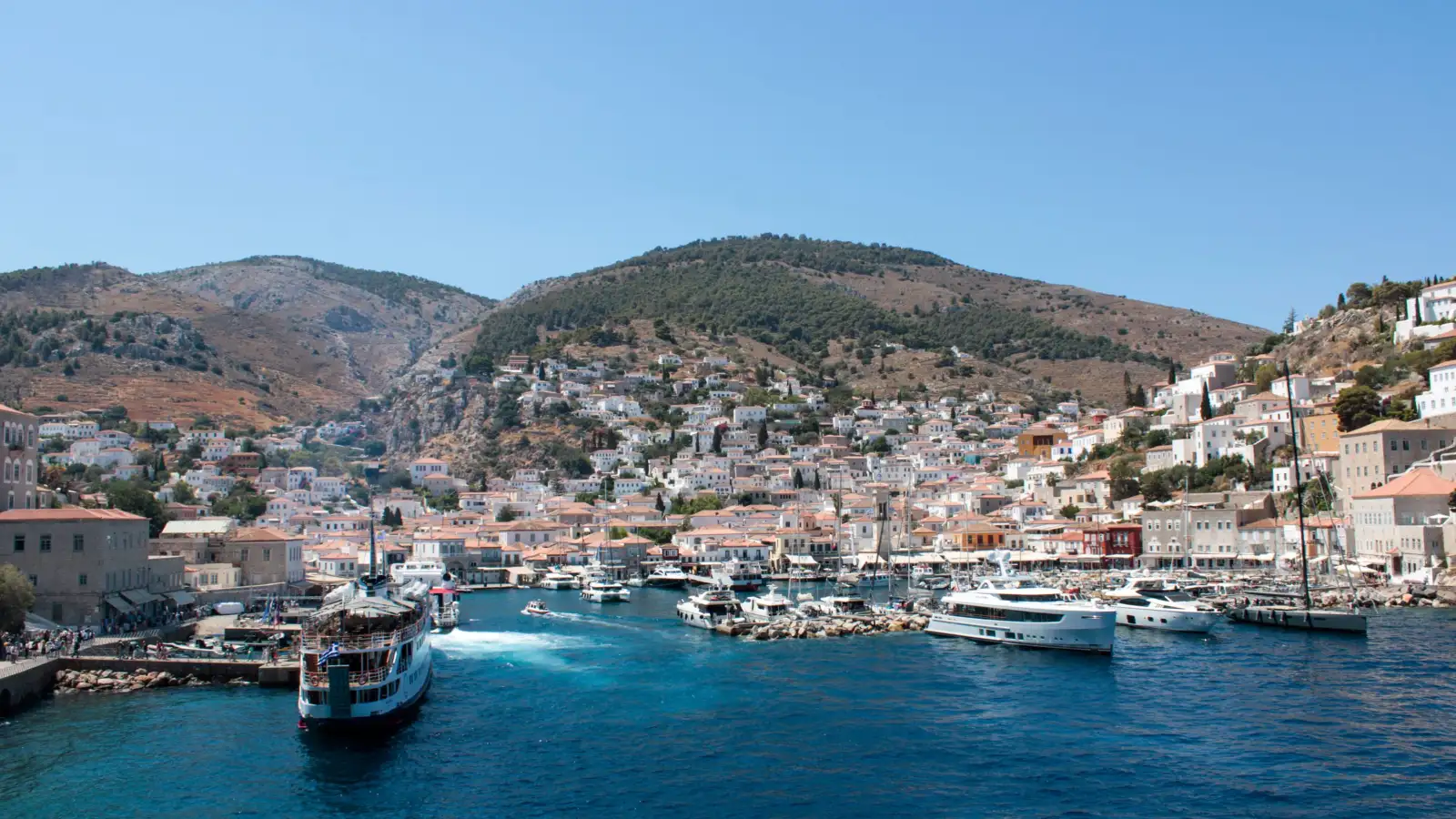
Motor vehicles are banned. Goods move by mule, by handcart and by boat, and people move on foot or by water taxi. The result is a town that has not been widened, flattened or bypassed for traffic, and a quiet that you notice within about ninety seconds of stepping off the boat.
The practical consequences are worth knowing before you go:
- You will walk, and it is steep. The town rises in a horseshoe from the harbour. Wheeled luggage is a poor idea; a rucksack is a good one.
- There is no bus from the port to your room, because there is no port-to-town journey. The harbour is the town.
- Mules do the carrying. If you are staying somewhere high with heavy bags, that is the service that exists.
- Accessibility is genuinely difficult, and honestly so - stone steps, no vehicles. See accessibility in Greece.
Fast boats only, and what that means
Because no conventional ferry serves the island, you do not get the usual slow-cheap-steady option. Every sailing is a high-speed hydrofoil or catamaran.
Two consequences. First, the crossing is quick - roughly an hour on the fastest services and up to about two on others. Second, high-speed craft are the first vessels stood down when the wind gets up, and the Saronic Gulf can blow. If you are day-tripping this matters less; if you have a flight the next morning, leave margin. When a ferry is cancelled covers what happens.
Note also that Piraeus is a very large working port with numbered gates spread along a long waterfront. Find your gate before you find your taxi - the Greek island ferries guide has the detail.
Day trip, or a night?

You can do Hydra in a day from Athens comfortably, and most people do.
But the island changes at about five in the afternoon, when the day boats take the crowds back and the harbour returns to the people who live there. Dinner on the quay in a town with no engine noise is the actual product, and you only get it by staying.
If you are choosing among Athens day trips generally - Delphi, Cape Sounion, the Saronic islands - see day trips from Athens.
The rest of the line
The same boats work the Saronic Gulf, so Hydra is not the only stop: Aegina, Poros and Spetses sit on the same run. That makes a two- or three-island Saronic trip easy without ever crossing open Aegean water, and it is a much gentler introduction to Greek ferries than the Cyclades.
More on the group in the Saronic islands guide.

Diagram by Greece Trips. Free to reuse with credit - CC BY 4.0.
Frequently asked questions
How long is the ferry from Athens to Hydra?
Roughly one hour to two hours from Piraeus, depending on the vessel and whether it calls at other Saronic islands first. Only high-speed boats serve the route.
Can you take a car to Hydra?
No. Cars and scooters are banned on the island, and conventional car ferries do not serve it. Transport on Hydra is on foot, by mule or by water taxi.
Can you visit Hydra as a day trip from Athens?
Easily, and it is one of the best day trips from the city. Staying a night is better if you can, because the town is at its best after the day boats leave.
Which port do Hydra ferries leave from?
Piraeus. It is a large port with numbered gates along a long waterfront, so check which gate your sailing uses before you travel.
Is Hydra suitable for people with limited mobility?
It is genuinely difficult. The town is stone steps rising steeply from the harbour and there are no vehicles at all. Read accessibility in Greece and contact your accommodation directly.
What else is on the same ferry line?
Aegina, Poros and Spetses - the Saronic islands - which makes a multi-island trip straightforward without any long open-water crossings.
Next
Read the Hydra travel guide, see the wider group in the Saronic islands, or compare it with the other options in day trips from Athens.