Athens airport storage
a staffed left-luggage desk on the arrivals level, taking bags of any size and screening them
Athens rail station storage
baggage lockers at Larissis, keeping station hours rather than running around the clock, and sized for day bags rather than large cases
Piraeus storage
provided by private services inside and around the port rather than by the Piraeus Port Authority, whose own service pages describe no left-luggage office. Location, hours and price belong to the operator and must be confirmed for the date
Hotel bag-holding
normal practice on departure day and often on arrival day, usually free, but a courtesy rather than an entitlement and rarely a secured room
Athens airport express buses
four lines, all stated by OASA to run on a 24-hour basis. X95 to Syntagma, approximately 60 minutes by OASA’s own measurement; X96 to the port of Piraeus along the coastal road, approximately 90; X93 to the Kifissos and Liossia intercity bus stations; X97 to Elliniko metro station, with night routes starting from Dafni. Alighting is restricted towards the airport and boarding is restricted away from it, at all hours
Athens airport metro
Metro Line 3 serves the airport; the airport lies outside the standard fare zone and carries its own per-person ticket. No fare or interval printed here; the fares page is the operator’s
Airport taxi
Athens International Airport publishes a regulated flat fare to the city centre with a higher overnight rate. No figure printed, and whether any flat fare covers Piraeus is not asserted either way
Island ports
provision varies by island and by season; treat storage as arranged in advance through accommodation or the ticket agency rather than found on the quay
Travel details last checked July 2026.
So this page is written as a practice rather than a directory. We name no storage company and print no price, on purpose, and there is a reason worth saying out loud before you read on.
Why this page names nobody and quotes no price
Search for luggage storage in Athens and almost everything you find was written by someone selling the locker. Aggregators, app-booked networks, shops with a back room and a partnership deal: they all rank, they all quote a per-bag price, and they all reorganise between seasons.
We sell nothing here, and a company we recommend in July can have changed hands by the following spring. A price we print is wrong sooner than that. Naming one operator also reads as a promise about how your bags are handled, and that is a promise we are in no position to make.
What survives all of it is the shape: which kinds of place hold bags in Greece, what each one is good for, and the one question to ask before you build a day around it. That question is always the same. Confirm it for your date, in advance, with whoever actually holds the bag.
The four kinds of place that hold bags in Greece
There are broadly four, and they behave very differently.
A staffed left-luggage desk takes the bag off you, tags it and puts it behind a counter. This is what the airport has. It handles any size, it screens what goes in, and in high season it grows a queue exactly when every morning flight has landed at once.
A locker bank is self-service and sized to the locker. Athens’ main rail station, Larissis, has one. Lockers are quick and they are cheap, and they suit a day bag far better than a hardside case, because the biggest locker in the bank is still smaller than the largest thing you brought.
A hotel’s back room is the one most travellers underuse and the one that costs least, which is the next section.
And a private storage point is a shop, a bar, a travel agency or a dedicated terminal that has agreed to hold bags for a fee. This is the layer that covers Piraeus and most island towns. It is also the layer with no standards behind it, so what you are buying varies from a monitored room to a corner of somebody’s storeroom.
Your hotel is the option you already paid for
On the day you leave, ask reception to hold your bags. Most hotels in Greece will, at no charge, and many will do the same on arrival day if you land before the room is ready. That single arrangement solves the majority of the gap-day problem without you paying anyone.
Two honest limits. It is a courtesy and not an entitlement, so a small rooms-only place on an island may genuinely have nowhere secure to put four cases, and a hotel that says no is not being difficult. And the room where the bags go is very often not locked or watched in the way a staffed desk is, which is a reason to keep your passport, your medication and anything expensive on you rather than in the case.
Ask when you book rather than at the desk on the morning. If the answer is no, you have found out while you can still plan around it, instead of standing in a lobby with a ferry to catch.
Athens: airport, port, station
Athens is the one place in Greece where the provision is genuinely predictable, and it is worth knowing which of the three you are near.
The airport has a staffed left-luggage desk on the arrivals level, per the city’s official visitor guide. It takes bags of any size and it screens them. Hours and price are the things to confirm before you count on it, because the airport’s own site would not open for us, and we would rather tell you that than print a number we could not trace. It is the right choice for one specific shape of day: a long layover, or a late flight after a morning that ended at the airport anyway.
The main rail station, Larissis, has baggage lockers. They keep station hours rather than running around the clock, so an overnight plan is not what they are for, and the locker is sized for a rucksack rather than a family’s cases.
Piraeus is the awkward one, and it is awkward for a structural reason rather than a bad one. Storage there is run by private services rather than by the port authority, which means its location, its hours and its price belong to whoever runs it and can change without anyone announcing it. Piraeus is also a long working waterfront rather than a building with an entrance, so “at the port” can mean a twenty-minute walk from where your boat goes. Find the actual point on a map, with your gate number in hand, before you decide it solves your day. How the port is laid out and which gate serves which island is the business of our guide to the ferry network and its ports.
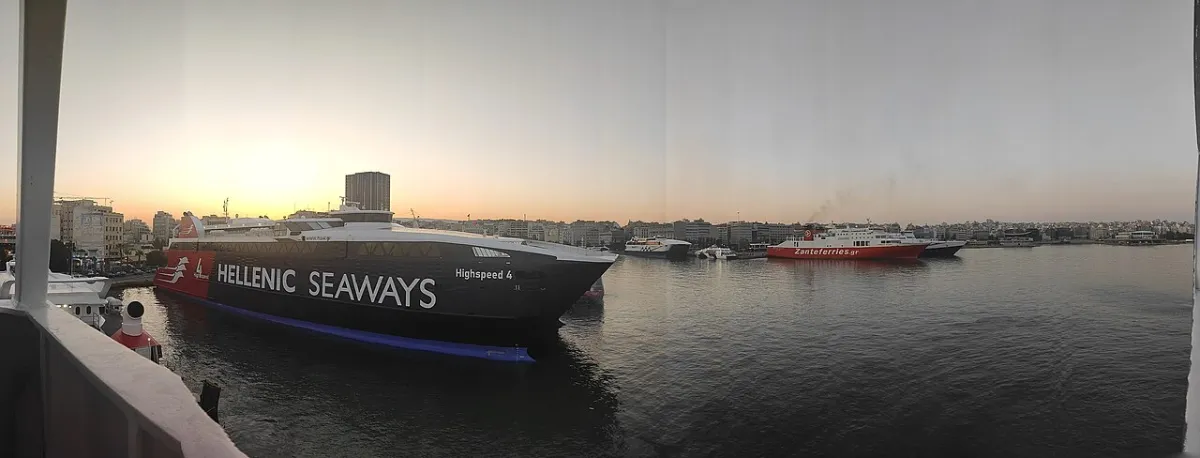
Ferry ports outside Athens vary more than anything else on this page
This is the part where a national answer stops existing. Greece has more than two hundred inhabited islands, and their ports run from a concrete quay with a shelter to a terminal building with staff.
On the bigger islands and the busier ports you will usually find somebody holding bags for a fee, most often a travel agency or a café by the quay rather than a formal facility. On a small island in June you may find that the arrangement is the same person who sold you the ferry ticket, and in October you may find they are shut. We are not going to tell you which islands have nothing, because that is precisely the claim we would get wrong: what exists on a quay in one season is not what exists there in another.
The reliable move is to treat storage on an island as something you arrange rather than something you find. Ask your accommodation first, because they are the ones with an interest in your day going well and the ones most likely to keep the bag for free. If you are moving through without staying, ask the agency you buy the ticket from. And if your plan genuinely depends on dropping bags somewhere between a check-out and an evening boat, confirm it the day before, not on the morning.
The wider logistics of moving between islands, including how much slack a connection needs, sit in the island hopping guide.
Transfers: the modes, and what actually separates them
The other half of this question is how you and the bags move. From Athens airport there are four modes, and the thing that separates them is not price.
The metro reaches the airport on Line 3 and runs into the city. It is the only option a traffic jam cannot lengthen, which is what makes it the one you can build a boat or a flight around. It runs less often than the rest of the network, and the airport sits outside the standard fare zone, so it has its own ticket priced per person rather than the ordinary city one. The cost you feel is not the fare, it is that you carry everything yourself: platform, carriage, interchange, stairs. Hand luggage and time to spare, take the train.
Whether the airport train continues to Piraeus without a change is something we could not confirm at the operator, and the published accounts contradict each other, so we state neither version. Get it from the metro operator for your date.
The express buses are the mode most visitors never look at, and OASA, the Athens transport authority, publishes what they do plainly. Four lines leave the airport: one to Syntagma in the centre, which OASA measures at approximately sixty minutes; one to the port of Piraeus along the coast road, at approximately ninety; one to the intercity bus stations at Kifissos and Liossia, which is how you connect to the long-distance coach network; and one to a southern metro station. OASA states all four operate on a 24-hour basis, which is the whole argument for them at four in the morning.
One rule on those lines almost nobody repeats, and OASA prints it: on the way to the airport, getting off is restricted, and on the way from it, getting on is restricted, at all hours. If you were planning to join one somewhere other than the airport, check at the stop rather than assume.
A taxi is the quickest of the four in an empty city and no quicker than the bus in a full one. Athens airport publishes a regulated flat fare to the city centre, with a higher overnight rate. Read it on the airport’s own site before you fly rather than taking a number from a page that sells rides, and agree the basis of the fare before the bags go in the boot: the flat rate where one applies, the meter where it does not. Whether any flat fare covers Piraeus is something we could not confirm at the body that sets it, so we assert neither answer.
A pre-booked car is the fourth, and it earns its money in four specific cases rather than generally: a night landing, four people with four cases, an island arrival in peak season where the taxi rank is small and finite, and anyone for whom queueing with a small child is not a plan. We recommend no company by name, for the same reason we name no storage operator. Confirm the meeting point, the price and what happens if the flight is late. The mode-by-mode comparison for the specific airport-to-Piraeus run is on our airport transfers page, and the rest of the country’s transport works differently again in getting around Greece.
Islands invert the whole calculation
On an island the constraint flips. In Athens the problem is distance and traffic; on an island it is supply.
Many island ports have a taxi fleet you could count on your fingers, and it meets the boats. When three ferries land within an hour of each other in August, the rank empties and the wait is real. Some islands run a bus that meets arrivals and some do not, and the ones that do run it to the boat rather than to a clock. Hotels on the smaller islands frequently send someone to the port, and it is worth asking, because it is often free and it is always the person who knows which quay your boat uses.
That is also why bags and transfers are one question rather than two on an island. If you have arranged for your accommodation to collect you, you have also solved your storage, because they will take the cases and you can walk into town with nothing.
Planning the gap day
The specific day this page exists for is the one where you leave a room in the morning and leave the country, or the island, in the evening. Handle it in this order.
Ask the place you are leaving to hold the bags first, because it is free and it is where they already are. If that is not possible, work out which of the three Athens options is on your route rather than which is nearest, since a locker you have to backtrack for costs you the hour you were trying to save. Keep documents, medication, chargers and anything valuable on you rather than in the stored bag. Then leave more slack than the map suggests, because the leg nobody budgets for is the walk at the end, done last, in the heat, carrying everything.
And decide what you are actually buying. Storage buys you a free afternoon in a city you would otherwise spend sitting on a case. On a day when your boat leaves at three and your room was yours until noon, it may buy you nothing at all.
What to take from this
The durable version of this page is short. Ask your hotel first. Athens has a staffed desk at the airport, lockers at the main rail station and private services at Piraeus. Everywhere else, treat storage as something you arrange the day before rather than something that will be waiting. And choose the transfer by what the road can do to it, not by the fare: the train is the only one traffic cannot lengthen, the express buses run around the clock, and a taxi is fastest exactly when the roads are empty.
Then pack so that the plan is possible in the first place, which is the argument of what to pack for Greece. Two people with cabin bags have options on this page that a family with four hardside cases does not.
Luggage storage and transfers FAQ
Where can I store luggage in Athens?
Athens has a staffed left-luggage desk on the arrivals level of the airport, baggage lockers at Larissis, the main rail station, and private storage services around Piraeus and the centre. Your hotel is usually the best of the lot on the day you leave, and it normally costs nothing. We name no company and print no price, because both change between seasons. Confirm hours and space for your own date.
Will my hotel hold my bags after I check out?
Usually, and it is worth asking at the moment you book rather than on the morning you leave. Most Greek hotels hold bags on departure day at no charge, and many do the same on arrival day before the room is ready. It is a courtesy rather than an entitlement, a small island guesthouse may have nowhere to put several cases, and the storeroom is rarely watched the way a staffed desk is, so keep documents and valuables on you.
Is there luggage storage at Piraeus port?
Yes, but it is run by private services rather than by the port authority, so its location, hours and price belong to whoever runs it. Piraeus is a long working waterfront rather than a single building, so find the storage point on a map next to your actual gate before you build a day around it. Twenty minutes with cases in August is not a detail.
How do I get from Athens airport to the city?
Four ways. Metro Line 3 runs into the city and is the only one traffic cannot lengthen. OASA’s express bus lines run to Syntagma, to Piraeus, to the intercity bus stations and to a southern metro station, all on a 24-hour basis, with the Syntagma run measured by OASA at approximately sixty minutes and the Piraeus run at approximately ninety. A taxi runs to a regulated flat fare into the centre. A pre-booked car meets you at arrivals.
Can I take luggage on the Athens metro and the airport buses?
Yes on both, and the difference is who carries it. On the metro it stays with you through the platform, the carriage, any interchange and the stairs, and lifts and escalators are not everywhere. On the express buses it goes into the hold and comes out at the stop. That is the real trade for anyone with more than a cabin bag, and it matters more than the ticket price.
Do Greek islands have luggage storage at the port?
It varies more than anything else on this page, and it varies by season as well as by island. Busier ports usually have a travel agency or a café holding bags for a fee; small ports may have an informal arrangement in summer and nothing running in October. Treat island storage as something you arrange in advance through your accommodation or the agency that sold your ticket, rather than something you expect to find on the quay.
What should I keep with me rather than in a stored bag?
Passport and travel documents, medication, phone and chargers, cards and cash, keys, and anything you could not replace on a Sunday. Storage rooms behind a hotel reception are commonly unlocked and unwatched, and even a staffed desk is a cloakroom rather than a vault. Pack the gap day so the stored bag holds clothes and the bag on your shoulder holds everything that matters.
Booking
We sell nothing and book nothing for you. Every guide on this page tells you how to arrange each piece yourself - which ferry operator, when to book, what to prebook and what to leave loose.