Vergina is the site of ancient Aigai, the first capital of Macedon and the burial place of its kings, and it holds one of the most significant archaeological finds made in Greece.

Diagram by Greece Trips. Free to reuse with credit - CC BY 4.0.
In the late twentieth century a large burial mound here was excavated and found to contain tombs that grave robbers had never reached. Almost everything placed in them was still there.
The museum inside the mound
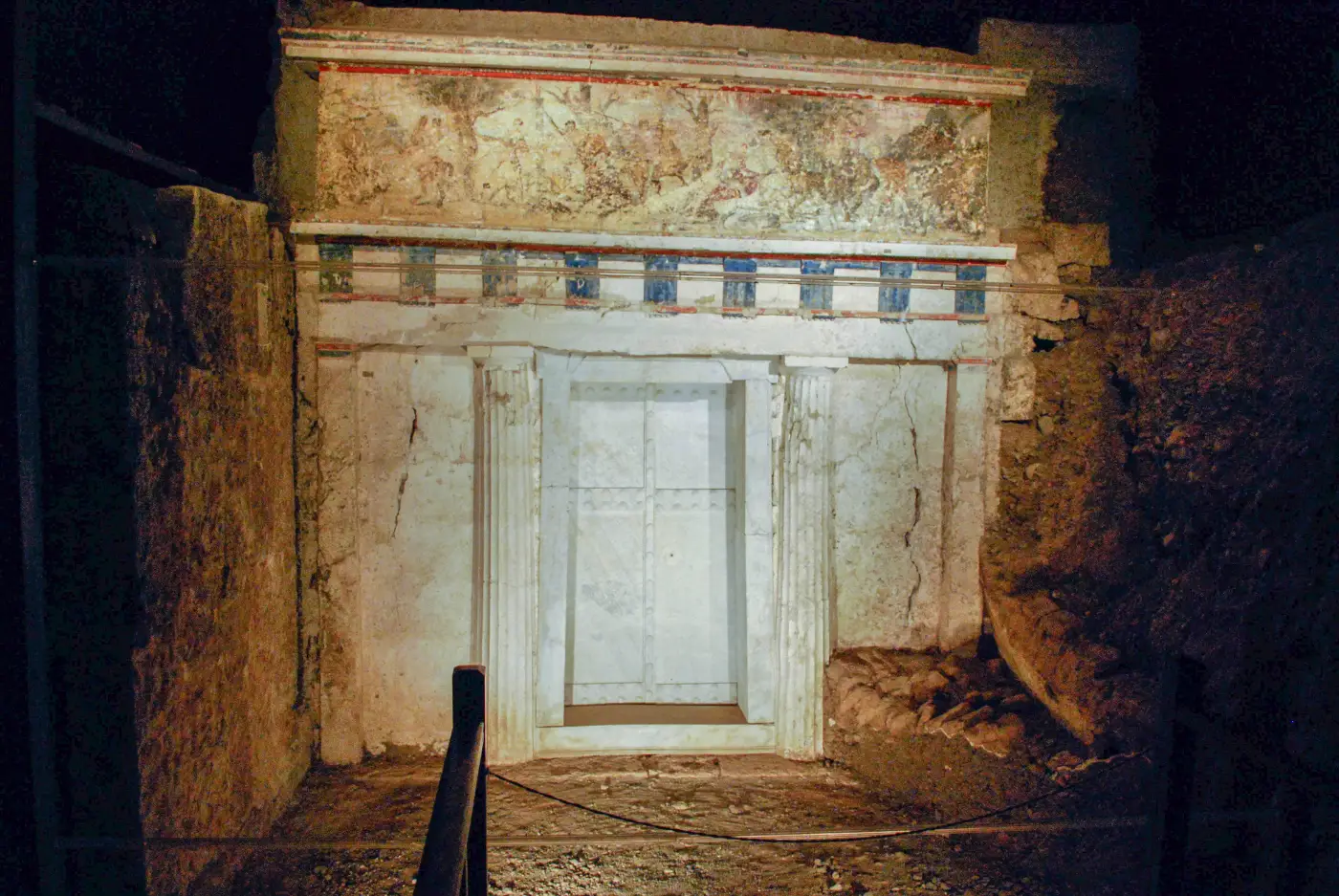
The presentation is the unusual part. Rather than removing the tombs to a building, the mound was reconstructed over them and the museum is inside it: you walk into an artificial hill, in low light, and see the tomb facades in place where they were built.
What is there:
- The tomb facade, painted, with a hunting frieze across the top.
- A gold larnax, the casket that held the cremated remains, with the Macedonian star on its lid.
- A gold wreath of oak leaves, extraordinarily fine.
- Armour, greaves, a ceremonial shield and silver vessels.
The main burial is widely identified as Philip II, father of Alexander the Great, though that identification has been argued over for decades and the debate is not closed. The museum presents the case rather than asserting it, which is the right way round.
The rest of the site
- The palace of Aigai, on the slope above, an enormous complex that has been under a long restoration and is now open. It is where Philip was assassinated.
- The theatre beside it, where the assassination actually took place.
- Further burial clusters across the site.
Practical notes
- The tomb museum is dark and cool, deliberately, and photography is restricted.
- Allow two hours for the museum and the palace together, more if the palace interests you.
- It is not in the town: the site sits at the edge of modern Vergina, with parking.
Getting there and how long
About an hour and a quarter from Thessaloniki by road, and often combined with Edessa or Dion in a Macedonian day.
A half day, as part of a wider trip rather than on its own.
Last checked August 2026. Museum and palace opening hours change - see our editorial policy.
Common questions
What is at Vergina?
The royal cemetery of ancient Aigai, first capital of Macedon, including an unlooted royal tomb with its gold contents, displayed inside the burial mound.
Is the tomb at Vergina really Philip II?
It is widely identified as his, but the identification has been debated for decades and is not settled. The museum presents the evidence rather than asserting a conclusion.
Why is the museum underground?
Because the mound was reconstructed over the excavated tombs, so the facades stand where they were built and you walk into the hill to see them.
What else is at the site?
The palace of Aigai on the slope above, where Philip was assassinated, and the theatre beside it where the killing happened.
How far is Vergina from Thessaloniki?
About an hour and a quarter by road.
Next
Read Edessa, Dion, or Thessaloniki.