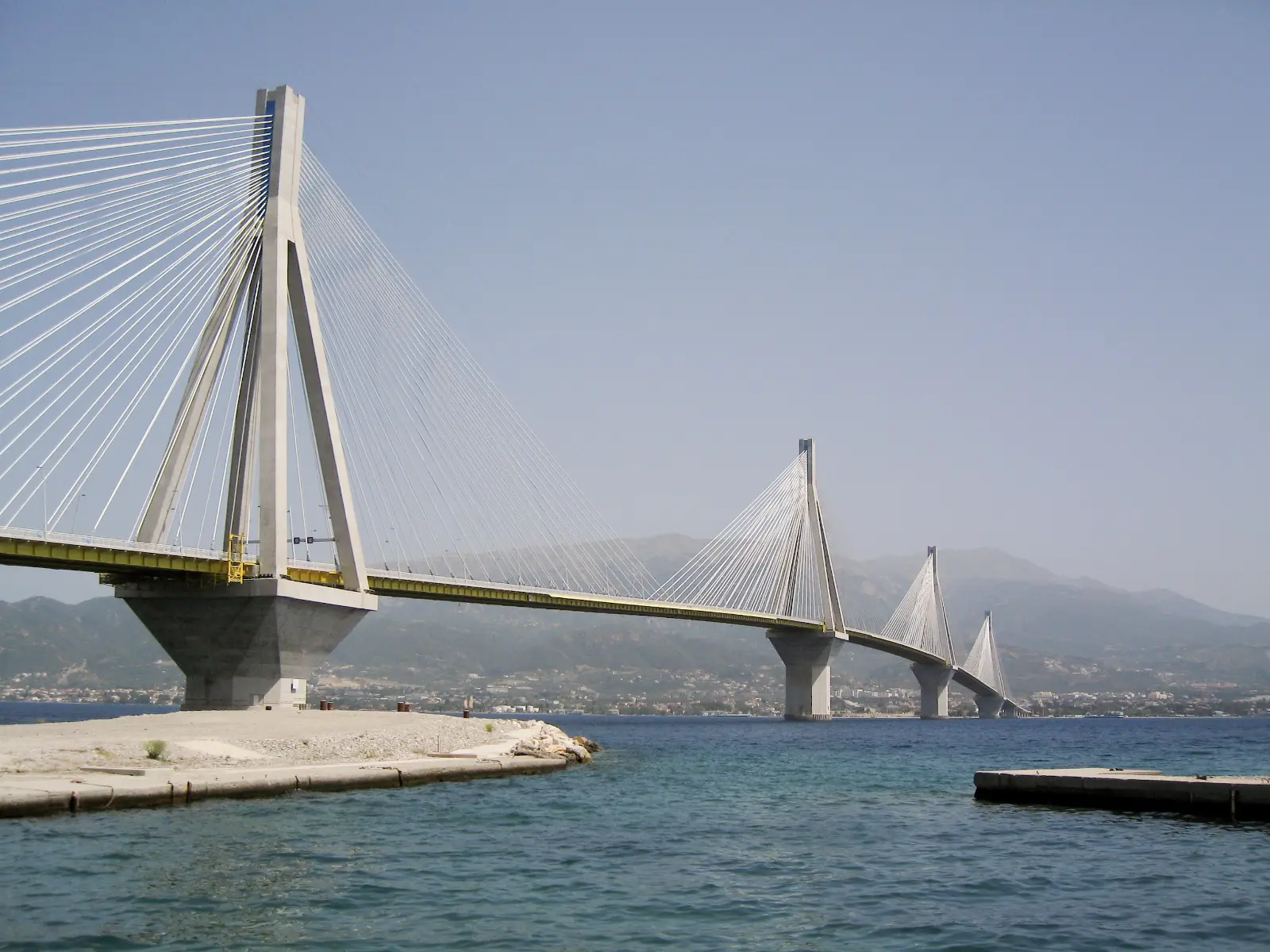
The Rio-Antirrio bridge just north of Patras is one of the longest cable-stayed bridges in the world, and it carries the road to Epirus across the mouth of the gulf.

Diagram by Greece Trips. Free to reuse with credit - CC BY 4.0.
Crossing it is a piece of engineering tourism in its own right.
Why it matters beyond the engineering
It is the reason the western mainland works as one drive. Before it, the gulf was a ferry. Now the road from the Peloponnese to Epirus is continuous, which is what makes routes like Athens to Lefkada a drive rather than a sequence of crossings - Athens to Lefkada is our own page on a journey where no boat is involved.
If you are driving anywhere up the west coast, you will cross it whether or not you came for it.
What this page does not print
No span length, no tower height, no opening year, no toll. Our own guide gives none of those, and the superlative it does give - one of the longest cable-stayed bridges in the world - is carried with its hedge intact rather than sharpened into a ranking.
Patras, which repays a night
The bridge is a reason to slow down at Patras rather than pass it.
Greece’s third city and the ferry gate to Italy, it has an arcaded main street, a Byzantine castle above it, and the largest carnival in the country in the weeks before Lent. It repays a night more than that suggests.
The arcades are the distinguishing feature: long covered colonnades along the main streets, which make the city walkable in both sun and rain.
The castle is Byzantine on Roman foundations, with a park inside the walls and the whole gulf below. The climb from the centre is by a long stair, Agiou Nikolaou, which is a small event in itself.
Agios Andreas, at the western end of the front, is one of the largest churches in the Balkans, built in the twentieth century over the site where Saint Andrew was martyred, and holds relics associated with him.
The carnival
Patras Carnival is the largest in Greece and among the larger ones in Europe: weeks of events through January and February, a treasure hunt that involves much of the city, a night parade, and a closing procession with satirical floats before Lent.
It is genuinely a city-wide event rather than a show put on for visitors - and carnival dates change, which our own guide flags.
What else is within reach
Kalavryta and its rack railway up the Vouraikos gorge (suspended since March 2026, so check whether it has reopened), the wineries of Nemea east, and Olympia south.
Practical notes
Getting there: the Athens motorway takes about two and a half hours; there is a suburban rail line but no through train from Athens.
Ferries to Ancona, Bari, Venice and Brindisi - which makes Patras the main western gate of Greece. Ferry routes change.
One night, or a base if you are working the north-west Peloponnese.
Next
Our Patras guide has the practicalities, things to do in Patras covers the city, and where to stay covers the areas.