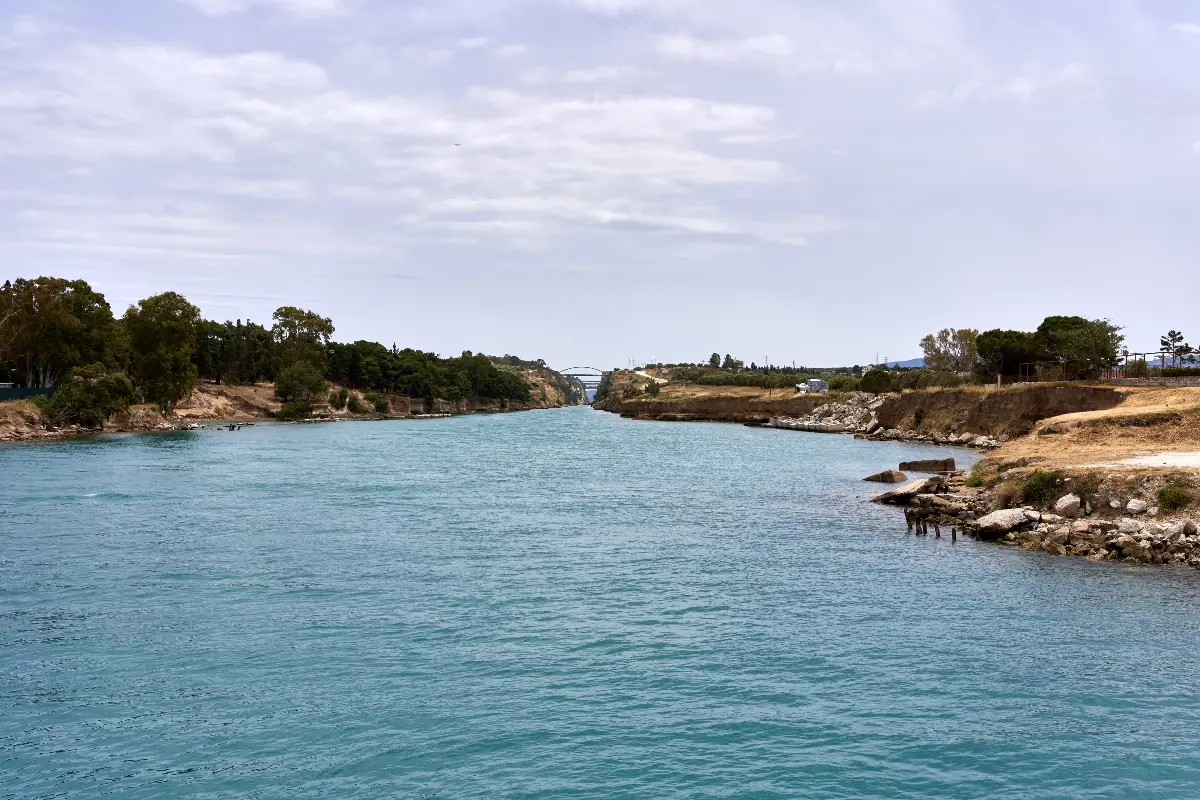
The Corinth Canal is a straight cut through the isthmus that joins the Peloponnese to mainland Greece, and its dimensions are the whole point: roughly six kilometres long, about 25 metres wide at the waterline, and up to 90 metres deep between near-vertical rock walls.

Diagram by Greece Trips. Free to reuse with credit - CC BY 4.0.
Standing on the road bridge and looking down is the visit. It takes ten minutes and it is genuinely startling.
Why it took two thousand years
The idea is ancient. Periander considered it in the seventh century BC, Nero actually began it and had the first sod cut, and the project was abandoned when he died. For most of the intervening period ships were dragged across the isthmus instead, on a paved trackway called the diolkos, sections of which survive near the western end.
The canal as it stands was dug in the late nineteenth century, and it opened after eleven years of work.
Why it is barely used
It was obsolete almost immediately. At 25 metres wide it cannot take modern cargo vessels, so traffic is small ships, tourist boats and yachts. The walls also slip: landslides have closed the canal repeatedly, sometimes for long periods, and repair work is a recurring fact of its life.
That is worth checking before travelling specially to see a boat go through, because sometimes none do.
Visiting
- The road bridge at Isthmia carries the old national road and has parking and cafes either side. This is where the photographs come from.
- The submersible bridges at each end are the curiosity: instead of lifting, they sink beneath the water to let vessels pass over them. Watching one go down is better than the canal itself.
- The diolkos remains lie near the western end.
Where it fits
The canal sits on the main road from Athens into the Peloponnese, about an hour from the city, and almost every trip to Nafplio or Epidaurus passes it. It is a stop rather than a destination, and it is a good one.
Last checked August 2026. The canal closes for repairs and landslides - see our editorial policy.
Common questions
How deep is the Corinth Canal?
Up to about 90 metres from the top of the rock walls to the water, with a channel roughly 25 metres wide and six kilometres long.
Why is the Corinth Canal not used much?
It is too narrow for modern cargo ships. Traffic is small vessels, yachts and tourist boats, and landslides have closed it for extended periods.
Who built the Corinth Canal?
It was cut in the late nineteenth century, after two thousand years of proposals. Nero began an attempt in antiquity that was abandoned on his death.
What is the diolkos?
The ancient paved trackway across the isthmus, on which ships were dragged overland before a canal existed. Sections survive near the western end.
How do you visit the Corinth Canal?
From the road bridge at Isthmia, about an hour from Athens on the way into the Peloponnese, where there is parking either side.
Next
Read Nafplio, Epidaurus, or day trips from Athens.