What it is
a fifth-century-BC Doric temple of Poseidon on the headland at the southern tip of Attica, with a sanctuary of Athena and fortification remains nearby
Distance from Athens
about 70 km by the coast road. No drive time printed: traffic, not distance, governs the journey
Architect
possibly the architect of the Temple of Hephaistos in the Ancient Agora, per the City of Athens visitor guide. An attribution, not a signature
The marble
quarried at Agrileza, a short distance inland, which is why the stone differs from the Acropolis
The graffiti
carved names left by nineteenth-century travellers. The one traditionally identified as Byron’s is disputed in print and is not asserted here
The sunset
the sun sets into open water beyond the colonnade. It is also the busiest hour on the site and it commits you to a late return
How long
about an hour on the headland. Our estimate; no authority publishes one
Shade
the headland is open ground. The site is exposed in the middle of the day
Tickets, hours and transport
set by the Hellenic Ministry of Culture and by the operators. Deliberately not reprinted here
Travel details last checked July 2026.
That is worth saying at the start, because the sunset is both the point and the problem. It is why the site is beautiful at the hour it is most crowded, why the coaches all arrive at once, and why a trip that looks like an afternoon actually costs you an evening.
What is up there is a Doric temple of Poseidon on the headland, a partial colonnade of white marble standing against open sea on three sides, and a sanctuary of Athena on lower ground nearby. What is also up there, cut into the stone at eye level, are the names of nineteenth-century travellers.
What actually stands on the cape
The temple is fifth-century BC, Doric, and it is a ruin of an unusually legible kind: enough columns stand, in enough of a line, that you can read the building’s plan by walking round it.
The official visitor guide of the City of Athens dates it to the fifth century BC and adds a detail worth carrying: it was probably built by the same architect who designed the Temple of Hephaistos in the Ancient Agora in Athens. That is an attribution rather than a signature, and the guide hedges it too. But if you have seen the Hephaisteion, you will recognise the proportions here, and the recognition is most of the pleasure of a second Doric temple.
The marble came from Agrileza, a quarry a short distance inland, which is why the stone reads differently from the Pentelic marble of the Acropolis.
Two things the guidebooks under-sell.
The cape was sacred long before this temple. There is evidence of sanctuary use on this headland centuries earlier, so the fifth-century building is a rebuilding of a habit rather than the start of one.
And the site is not only the temple. A sanctuary of Athena occupied lower ground close by, and the headland carried fortifications: this was a strategic point controlling the sea approach to Athens, not a scenic viewpoint that happened to get a temple. The view you are photographing is the reason the Athenians cared about the place.
The carved names, and the one everybody looks for
Walk up to the columns and you will find them covered in graffiti. Not modern spray: names cut carefully into the marble, mostly in the nineteenth century, by travellers who thought of themselves as leaving a record rather than damaging a monument.
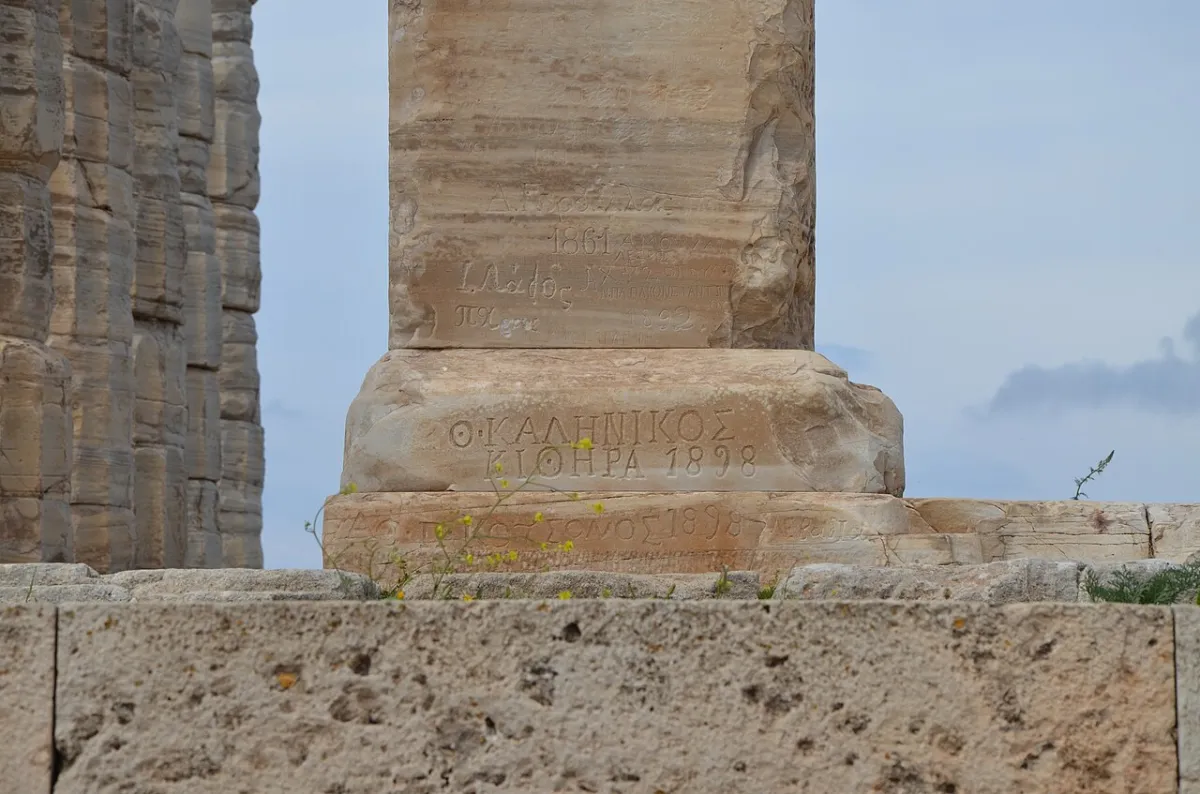
The one people look for is Byron’s. The official Athens visitor guide states it plainly: Lord Byron was so taken with Sounion that he carved his name into the temple’s stones sometime in the early nineteenth century.
We would put it one degree softer than that, and here is why. Byron certainly came to Sounion, and Sounion appears in his verse. The carving traditionally identified as his is on a column of the temple. But the identification has been doubted in print by people who looked at it closely, including Lawrence Durrell, who wrote that the lettering was not Byron’s hand and nothing like his signature. Nobody has settled it, and we are not going to settle it in a travel page.
So: the carving is traditionally identified as Byron’s, and the tradition is old, and whether the hand is his is an open question. That is a better fact than the clean version, because it is the true one.
Two practical notes. It is genuinely hard to pick out with the naked eye, and people spend a long time hunting it. And the graffiti as a whole is the more interesting thing anyway: a century of literate travellers deciding that carving into a Greek temple was the appropriate response to seeing one. Nobody would defend it now. It is also, at this point, part of the monument’s history.
The sunset, and what it costs you
Here is the trade nobody puts in the headline.
Sunset at Sounion is genuinely one of the sights of Attica: the sun goes down into open water directly beyond the colonnade, the marble goes from white to gold to grey, and the sea is on three sides of you the whole time. It deserves its reputation.
It also means everybody is there at once. Every coach in Athens aims at the same hour on the same small headland, and the site has a limited amount of standing room near the temple. The last hour before sunset is when the cape is fullest, and no amount of planning changes that, because the thing you came for happens then.
Then the second half of the trade. The Ministry sets the site’s closing time and it changes through the year, which means the alignment between “the site is open” and “the sun sets” is not the same in April as it is in July. Some months the two are comfortable; some months they are tight. We are not going to print a timetable, because a Greek archaeological timetable reprinted on a travel page is wrong within a season and confidently wrong, which is worse than silence. Read the Ministry’s own published hours for the date you are going, and check them against the sunset time for that date.
And the third: the drive back. You leave a headland 70 km from Athens in the dark, on a coast road, with everybody else who came for the same reason, and you arrive back in the city at dinner time or later. That is the real cost of the sunset version, and it is why plenty of people who have done it twice go in the late morning the second time.
Late morning has an honest case. Fewer people, better light for looking at architecture rather than photographing silhouettes, and an afternoon left over. You lose the spectacle and you gain the temple.
How to get there, and what we will not tell you
There are two shapes of trip: your own vehicle, or an organised one.
With your own car you get the coast road, which is most of the point. It runs south from Athens along the Riviera and then out through low scrub and coastal villages, and it is a genuinely good drive rather than a transfer. You also get to choose your own hour, which is the thing that decides whether this trip is crowded. Driving in Greece covers the road rules, and renting a car in Greece covers the paperwork, which is the part that catches people out.
Without a car, there are scheduled public services down the coast and there are organised sunset excursions, and both are easy enough to find. We name no operator, print no route number and quote no fare on this page. Those change every season, they are the most heavily monetised part of this search, and a page that lists them is a page that is wrong by next spring while still sounding authoritative. Check the operators’ own channels. Getting around Greece explains how the pieces fit together.
One thing that is worth planning either way: this is a headland with no shade, and the walk from the car park up to the temple is exposed in both directions. In July and August the middle of the day is the hardest hour of the trip and the sunset hour is the pleasant one, which is another argument for the version everyone else is also doing. What to pack and the Greek summer month by month are the wider answer.
Admission to the archaeological site is sold by the Hellenic Ministry of Culture, at the site and through its own e-ticketing service. We sell nothing here and take no commission on any tour. If you buy an organised trip, buy it on the operator’s own terms and check what time it leaves the cape.
Is Cape Sounion worth a day?
It is worth half a day, and it is one of the better half-days from Athens, but it is not a full one and pretending otherwise is how people end up disappointed.
The site itself is compact. Allow an hour on the headland, more if you are going to sit and wait for the light. That is our estimate from the size of the place rather than a published figure. The rest of the time is the journey, and whether the journey is a pleasure or a chore depends almost entirely on whether you are driving it yourself.
Who it suits: anyone who has done the Acropolis and wants a second temple in a completely different setting, anyone who likes a coast road, and anyone who wants one evening out of central Athens. The Acropolis is the comparison that will be in your head, and Sounion wins on setting and loses on everything else.
Who it suits less: people on a tight three-day Athens visit with the museums still unseen, and anyone who does not want to be back in the city late. On a first week in Greece it competes directly with Delphi, which is a longer day and a bigger site. If you can only do one, and antiquity is what you came for, do Delphi. If what you want is an evening and a horizon, do Sounion.
Last checked July 2026. What we re-read before every update: the site’s published opening arrangements at the Ministry, which we deliberately do not reprint, and the standing of the Byron attribution. How we date and check facts is set out in our editorial policy.
Common questions
What is at Cape Sounion?
A fifth-century-BC Doric temple of Poseidon standing on the headland at the southern tip of Attica, with a partial colonnade of white marble and open sea on three sides. There is also a sanctuary of Athena on lower ground nearby, and the remains of fortifications: the cape controlled the sea approach to Athens. The temple’s columns carry carved names left by nineteenth-century visitors.
How far is Cape Sounion from Athens?
About 70 km down the coast road from central Athens, at the southern tip of Attica. We give the distance rather than a driving time on purpose: on that road the traffic decides the journey, not the kilometres, and the return leg after sunset is slower than the outbound one. Plan the trip around the hour you want to be on the headland and work backwards.
Is the Byron graffiti at Cape Sounion real?
The carving is traditionally identified as Lord Byron’s, and the official Athens visitor guide states it as fact. It is worth knowing that the identification has been doubted in print, notably by Lawrence Durrell, who said the lettering was not Byron’s hand. Byron certainly visited Sounion. Whether he cut that particular name is unresolved, and it is more honest to treat it as a tradition than as a signature.
Is the sunset at Cape Sounion worth it?
Yes, with a cost attached. The sun sets into open water directly beyond the temple’s colonnade and the marble changes colour as it goes, and it is one of the sights of Attica. The cost is that everyone arrives for the same hour, the headland is small, and you then drive 70 km back to Athens in the dark. A late-morning visit gives you the architecture with a fraction of the people, and no spectacle.
What time does Cape Sounion close?
The Hellenic Ministry of Culture sets and publishes the closing time, and it changes through the year, which matters here more than at most sites because the whole trip turns on whether closing falls before or after sunset. We deliberately print no timetable: a reprinted Greek archaeological schedule goes stale within a season. Read the Ministry’s own published hours for your date, alongside the sunset time for that date.
How do you get to Cape Sounion without a car?
There are scheduled public services down the coast and there are organised sunset excursions from Athens. We name no operator, no route number and no fare on this page, because those change every season and this is the most heavily monetised part of the search. Check the operators’ own channels for the current arrangements, and confirm what time an organised trip leaves the cape before you book it.
How long do you need at Cape Sounion?
About an hour on the headland covers the temple, the sanctuary of Athena and a slow walk around the cliff edges. Longer if you are waiting for the light. That is our estimate from the size of the site rather than a published figure. The journey is what makes this a half-day rather than an hour.
Sounion or Delphi as a day trip from Athens?
Delphi if antiquity is the point: it is a larger, denser site in mountain landscape and it takes a full day. Sounion if what you want is a temple, a headland and an evening: it is a half-day, it is easier, and it has the better horizon. Doing both on a first week is entirely reasonable, and they do not overlap.
Plan by category
The מטאורה guides
4 guides, each scoped to a decision you actually have to make.
 Attractions
Things to do
See the attractions → Hotels
Where to stay
Compare the areas → Itinerary
Day by day
See the itinerary → Day trips
Day trips
See the day trips →
Booking
We sell nothing and book nothing for you. Every guide on this page tells you how to arrange each piece yourself - which ferry operator, when to book, what to prebook and what to leave loose.