What it is
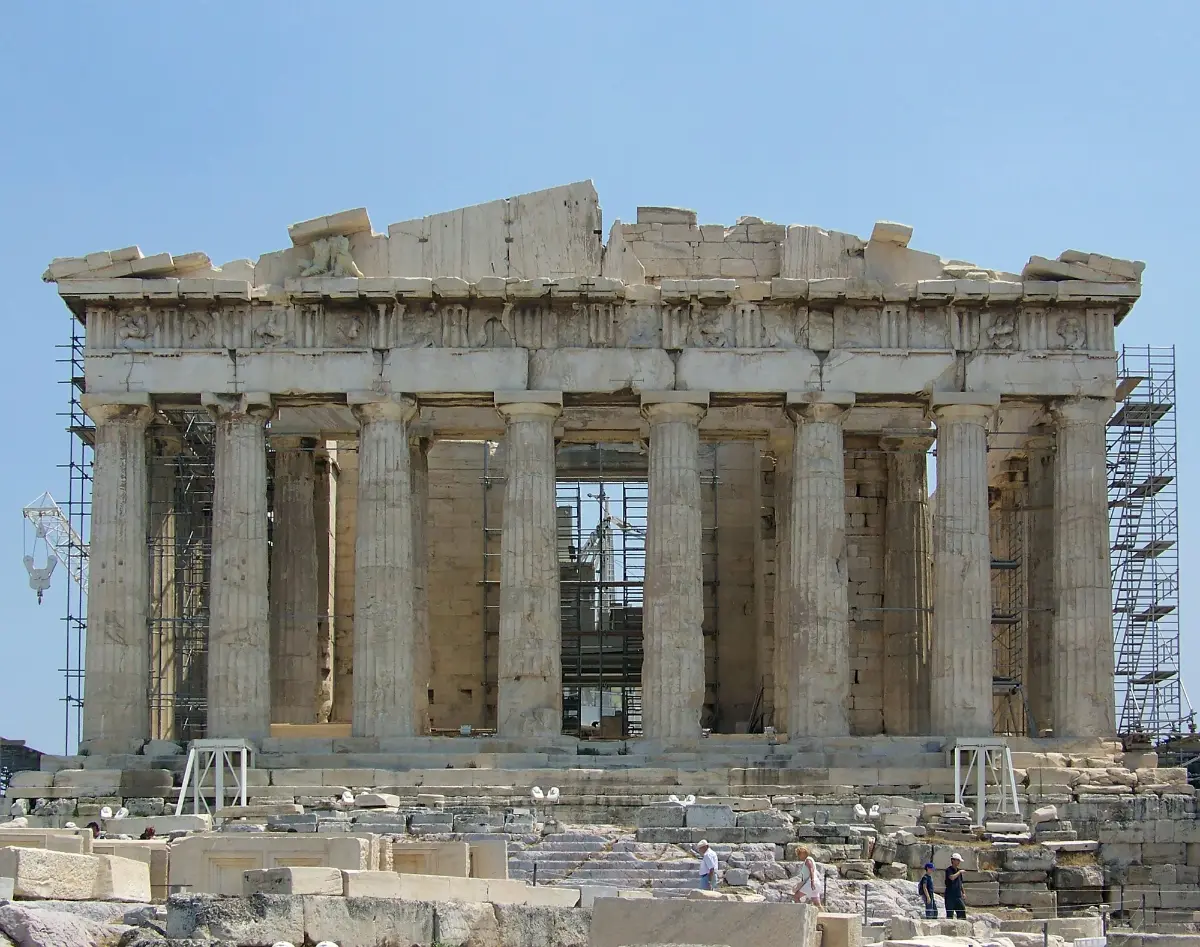
The Doric temple of Athena on the Acropolis of Athens, built 447-438 BC, with its pedimental sculpture finished in 432 BC
Architects
Iktinos and Kallikrates; the sculptor Pheidias had general supervision and the sculptural programme
Material
Pentelic marble
Sculpture
Two pediments, four metope cycles, and a continuous Ionic frieze of the Panathenaia round the cella. Largely no longer on the building; split mainly between the Acropolis Museum and the British Museum
Entry
Part of the Acropolis archaeological site; timed slot from the Ministry’s own e-ticketing service. No price or hours are printed here
Latest restoration
West pediment completed 2026; scaffolding removed from the west facade 15 June 2026, the first time it has been complete in about 220 years
Travel details last checked July 2026.
This one is about the building. What it was built as, what was carved on it, what happened to it across two and a half thousand years of being useful to somebody, and why the sculptures that made it famous are now split between two museums in two countries.
Three things are worth knowing before you stand in front of it. Almost none of its sculpture is still on it. A great deal of what you see standing up was put back by modern hands. And in June 2026 its west end was finished for the first time in roughly two hundred and twenty years.
A Doric temple, and the numbers that describe it
The temple was built between 447 and 438 BC, and the sculpture in its pediments was finished a few years later, in 432. The architects were Iktinos and Kallikrates. The sculptor Pheidias had general supervision of the work and responsibility for the sculptural programme, which is a more precise thing than the popular version in which he designed the building.
It is a Doric peripteral temple, meaning a colonnade runs the whole way round. Eight columns stand at each narrow end and seventeen along each side, which is a wider front than the Doric norm and is the first thing that makes it look the way it does. Inside the colonnade the plan runs pronaos, cella and opisthonaos, with the cella divided by a cross wall.
In the cella stood the reason for the whole building: a chryselephantine statue of Athena by Pheidias, made of gold and ivory, armed, holding a Nike on her outstretched right hand and resting her left on her shield. She is not there. What became of her is not something the Acropolis Restoration Service states on its own record for the monument, so this page does not state it either.
The material is the point of the colour. It is Pentelic marble, quarried on Mount Penteli northeast of the city, and the warm honey tone the stone takes at the end of the day is iron in the marble oxidising over centuries. That is not a lighting effect. It is the surface itself.
The lines are not straight, and that is deliberate
Here is the thing to actually look for while you are up there, because it is invisible until somebody tells you and obvious afterwards.
The Acropolis Restoration Service describes the Parthenon as employing “a highly sophisticated system of refinements”, and names three. The stylobate, the platform the columns stand on, is curved rather than flat. The columns have entasis, a slight swelling through their height rather than a straight taper. And the spacing at the corners is contracted, so the end columns sit closer to their neighbours than the rest.
Stand at one corner of the platform and sight along the long edge towards the far corner. The line rises and falls away from you. It is a few centimetres over thirty-odd metres, and once your eye catches it you cannot lose it again.
Why they were cut is the part this page will not settle. The traditional explanation, the one in every architecture textbook, is optical correction: a genuinely flat platform reads as sagging, a straight column reads as pinched, so the builders bent the stone to make it look straight. That account is old, widely held and entirely plausible. It is also an inference about the intentions of people who left no explanation, and it has been argued against in recent scholarship. We can tell you with confidence that the curvature is there, because the body that restores the monument says so. What was in an architect’s head in 447 BC is not ours to certify.
The practical version, for a person with twenty minutes on a hot rock: the building has almost no straight lines in it, and you can see that with your own eye if you look along an edge rather than at a face.
Three sculptural programmes, and where they went
The Parthenon carried sculpture in three places, and they are three different jobs.
The pediments, the triangles at each end, held free-standing figures. The east pediment showed the birth of Athena; the west showed her contest with Poseidon for the city. The metopes, the square panels above the outer colonnade, carried four battle cycles: gods against giants, Greeks against Amazons, Lapiths against centaurs, and the Trojan War. And running round the outside of the cella wall, inside the colonnade and awkward to see even when it was new, was a continuous Ionic frieze showing the Panathenaia, the festival procession in honour of the goddess.
The Ionic frieze on a Doric building is the deliberate oddity. It is a running band of relief where the Doric order expects alternating panels and grooved blocks, and it puts the city’s own citizens where a temple normally puts gods and monsters.
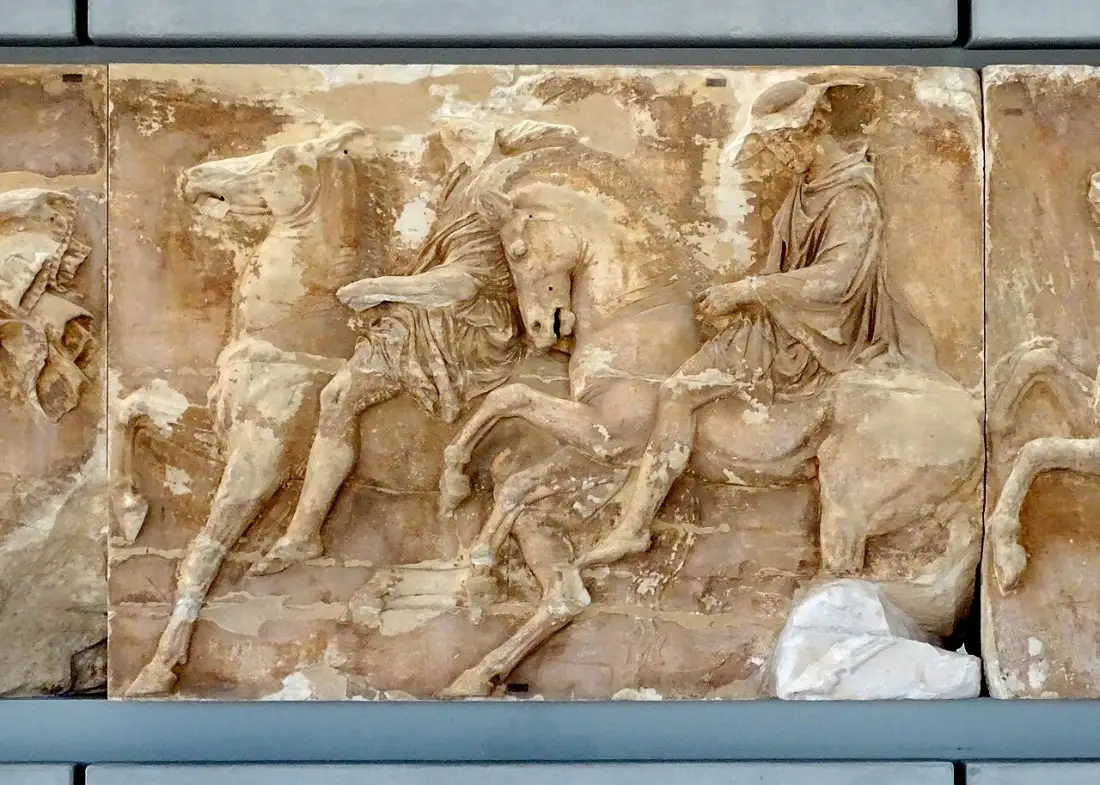
Look up at the building today and you will see very little of this. What was not destroyed in 1687 was largely removed afterwards. The Ministry’s own restoration service records that Lord Elgin took eighteen pedimental statues, fifteen metopes and fifty-six blocks of the frieze. Those three numbers are the Ministry’s, and they are the only sculpture counts on this page.
Temple, church, mosque, powder magazine
The building spent roughly a thousand years as a temple and then did four more jobs, which is why it is a ruin.
It became a Christian church in 1205 and a mosque after 1460. Neither conversion wrecked it. A church needs a big roofed hall and so does a temple, and the Parthenon was still substantially intact in the seventeenth century, roof on, walls up, sculpture in place. Most of the famous ancient buildings of the Mediterranean had fallen down long before. This one had not.
Then the Ottoman garrison holding the Acropolis put its gunpowder inside it.
On 26 September 1687, during the Venetian siege of the Acropolis under Francesco Morosini, a mortar round fired at the rock hit the magazine. The Acropolis Restoration Service records the 1687 Venetian bombardment and the catastrophic damage it caused, and that is the whole of the sentence that matters: the roof went, and so did most of the walls and the sculpture standing on them. The date, the commanders and the powder store are corroborated across independent accounts of the siege. The casualty figures and the number of barrels vary from one account to the next, so we print neither.
Everything that has happened to the Parthenon since is a response to one night. The excavation, the anastylosis, the museum, the argument about the sculptures, the cranes that have been on the rock for fifty years: all of it is the aftermath of a building that survived two millennia of reuse and was then used as a shed.
The sculptures are in two cities, and that is a live dispute
Walk into the Acropolis Museum’s top-floor Parthenon Gallery and you are standing inside an argument made out of architecture.
The gallery’s rectangular core matches the orientation and the dimensions of the temple’s inner chamber. The frieze blocks are mounted in the positions they held on the monument, lowered so you can actually see them. The metopes are shown in pairs between steel columns that match the Parthenon’s own column count. The pediment figures stand on low pedestals at the east and west ends. Glass walls give a direct line of sight from the sculptures to the building they came off, half a mile up the hill.
And in the museum’s own words, the gallery combines original marble sculptures with plaster copies “of those retained in the British Museum or other foreign museums”. You can see where the whites change. That is the dispute, rendered as an exhibit.
The positions, stated and attributed. The British Museum holds a substantial part of the surviving Parthenon sculpture, acquired from Lord Elgin in the early nineteenth century. Its Trustees decline permanent return and argue that there is a public benefit in the sculptures being divided between two great museums telling complementary stories, and they have said they have been asked for permanent removal rather than for a loan. The Greek state seeks the return of the sculptures, and the Acropolis Museum was built with a gallery sized for them.
We could not open the British Museum’s own statement page, which returned a refusal to our fetcher, so that account of the Trustees’ position comes from search-index summaries of their own text rather than from the text. Read it at the museum’s site rather than take our paraphrase for it.
This page does not adjudicate that. It is a question of law, ownership and national feeling, and a travel guide is the wrong instrument for it. What we will tell you is the practical consequence, because it changes your itinerary: seeing the Parthenon sculpture properly means two museums in two countries, and the museum in Athens is honest enough to show you which of its pieces are casts.
The cranes are not a delay, they are the method
There has been scaffolding on the Parthenon for most of living memory, and visitors treat it as a shame. It is the opposite.
Restoration on the classical buildings of the Acropolis began in the 1970s, and surface conservation has run alongside the structural programme since 1987. Before that, the restorations carried out by Nikolaos Balanos between 1896 and 1902 and again between 1923 and 1933 are, in the restoration service’s own phrase, what “gave the monument its present appearance”. Much of what stands up on that rock stands up because somebody in the last century and a half put it back.
Then the thing almost no page about the Parthenon has caught up with yet.
On 3 and 5 March 2026 two blocks of the western tympanon were set into the monument, and on 15 June 2026 the scaffolding came off the west facade. The west pediment is complete for the first time in about two hundred and twenty years, incomplete, in the restoration service’s own words, since the founding of the Greek state. One of the two blocks was rebuilt by mending two ancient fragments with new marble supplements; the other was carved entirely from new marble. The work was done by the Acropolis Restoration Service under the Committee for the Conservation of the Acropolis Monuments.
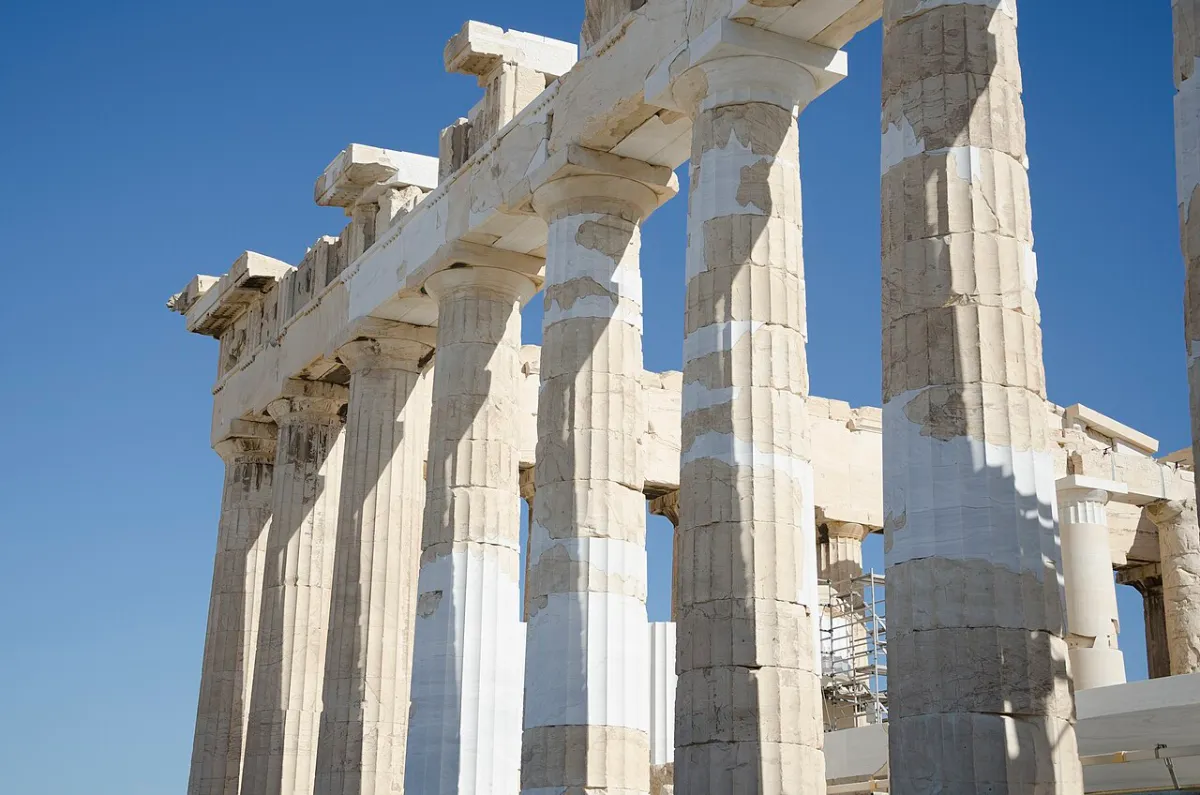
So the west end, the end you walk towards from the Propylaia, is the one to look at first. It is the newest thing on the oldest building in the city, and for the first time since before there was a Greek state you are seeing the shape the architects drew.
Entry to the rock is a timed slot bought from the Hellenic Ministry of Culture’s own e-ticketing service, and how that works is set out on our Acropolis page. We sell nothing and take no commission on this page.
What to do with all this, standing in front of it
The Parthenon does not explain itself, and the label on the fence will not do it for you.
Four things pay off in the twenty minutes most people give it. Look along the edge of the platform, not at the front, and find the curve. Look at the west pediment, which is finished now. Look at the cella wall inside the colonnade and picture a continuous band of carved procession where there is now nothing. And notice how much of the standing structure is clean modern marble set beside weathered ancient stone, because that seam is the last hundred and fifty years of Greek archaeology written on the building.
Then walk down and go to the museum, which is a separate institution with its own admission. Half of this building is there.
Last checked July 2026. What gets re-read on this page: the restoration service’s record for the monument, its announcements of completed interventions, and the Acropolis Museum’s own description of its Parthenon Gallery. Prices, opening hours and entry rules are deliberately absent and live with the Ministry. How we date and correct facts is set out in our editorial policy.
Common questions
Why is the Parthenon a ruin?
Because of a single night in 1687. The building had come through roughly two thousand years largely intact, serving as a temple, then a church from 1205, then a mosque after 1460. During the Venetian siege of the Acropolis under Francesco Morosini, the Ottoman garrison was storing gunpowder inside it, and on 26 September 1687 a mortar round hit the magazine. The Acropolis Restoration Service records the 1687 bombardment and the catastrophic damage. The roof and most of the walls went with it, and everything since has been a response to that.
Are the Parthenon sculptures still on the building?
Very little of the sculpture is on the monument. What survived 1687 was largely removed afterwards, and the Acropolis Restoration Service records that Lord Elgin took eighteen pedimental statues, fifteen metopes and fifty-six blocks of the frieze. The surviving sculpture is now split mainly between the Acropolis Museum in Athens and the British Museum in London, with fragments elsewhere. The Acropolis Museum shows originals alongside plaster copies of what is held abroad.
Who has the Parthenon Marbles, and why is it disputed?
The British Museum holds a substantial part of the surviving sculpture, acquired from Lord Elgin in the early nineteenth century. Its Trustees decline permanent return and argue for a public benefit in the collection being divided between two museums; they have said the request made to them has been for permanent removal rather than a loan. Greece seeks the sculptures’ return, and the Acropolis Museum in Athens was built with a gallery sized and oriented for them. We report the positions and do not adjudicate between them. We could not open the British Museum’s own statement page, which refused our fetcher, so read the Trustees’ wording at the source.
What are the Parthenon’s optical refinements?
The Acropolis Restoration Service describes a system of refinements and names three: curvature of the stylobate, so the platform the columns stand on is not flat; entasis of the columns, a slight swelling through their height; and contraction of the corner spacing, so the end columns sit closer to their neighbours. You can see the first one by sighting along an edge of the platform rather than looking at a face. Why they were cut is a matter of interpretation, and the usual optical-correction explanation is an inference rather than something the builders wrote down.
What is the Parthenon made of?
Pentelic marble, quarried on Mount Penteli northeast of Athens. The honey and rust tones in the stone come from iron in the marble oxidising over time, which is why the building changes colour through the day and why newly carved replacement blocks read as bright white against the old surfaces for decades after they are set.
Why is the Parthenon always covered in scaffolding?
Because it is being rebuilt, carefully, and has been since the 1970s, with surface conservation running alongside since 1987. Much of what stands today was reassembled by Nikolaos Balanos between 1896 and 1933, which is what gave the monument its present appearance. The most recent milestone is worth timing a visit around: two blocks of the western tympanon were set in March 2026 and the scaffolding came off the west facade on 15 June 2026, completing the west pediment for the first time in around 220 years.
Is the Parthenon the same thing as the Acropolis?
No. The Acropolis is the rock and the whole archaeological site, which also holds the Propylaia, the Erechtheion and the temple of Athena Nike, plus the North and South Slopes below. The Parthenon is one building on it, the largest. Your ticket, your entry slot and your walk up are all questions about the site, and they are answered on our Acropolis page.
Booking
We sell nothing and book nothing for you. Every guide on this page tells you how to arrange each piece yourself - which ferry operator, when to book, what to prebook and what to leave loose.