Emergency number
112, throughout the EU including Greece, free from fixed and mobile phones, reaching police, ambulance and fire. Greece runs national numbers alongside it; the FCDO advises 112 or 166 for an ambulance
Finding a pharmacy
look for the lit green cross. Towns have several; a small island may have one
Out of hours
a formal duty rota (efimeries) run by the regional pharmaceutical association covers nights, Sundays and holidays; pharmacies are obliged to display the extended-hours table, so a closed shop’s door names who is on duty. No opening hours are printed here: they are regional and seasonal
The pharmacist
a qualified healthcare professional and the normal first stop for a minor complaint. Stock is good; dispensing is regulated, with strict rules around certain medicines including antibiotics
EHIC / GHIC
free card, medically necessary state-provided care during a temporary stay. Does not guarantee free services, is not an alternative to travel insurance, and excludes private care, repatriation flights and lost property
Uninsured
the FCDO states you may be limited to public hospitals and primary healthcare centres rather than private doctors
Mainland versus islands
the FCDO states treatment and facilities are generally good on the mainland and may be limited on the islands. Attributed, not our assessment
National public health body
EODY
Not on this page, by policy
no drug names, no doses, no “what to take for”, no statement about what is available without prescription, no certification that any place, activity, food or water is safe.
Travel details last checked July 2026.
So the shape of this page is deliberately narrow. The system, the paperwork, and the number.
The green cross, and what a Greek pharmacy is for
A pharmacy in Greece is a farmakeio, and the sign is a green cross, usually lit, usually projecting out over the pavement so you can see it down a street. In a town of any size there will be several. On a small island there may be one, in the main village, and that single shop is the whole of the island’s pharmacy provision.
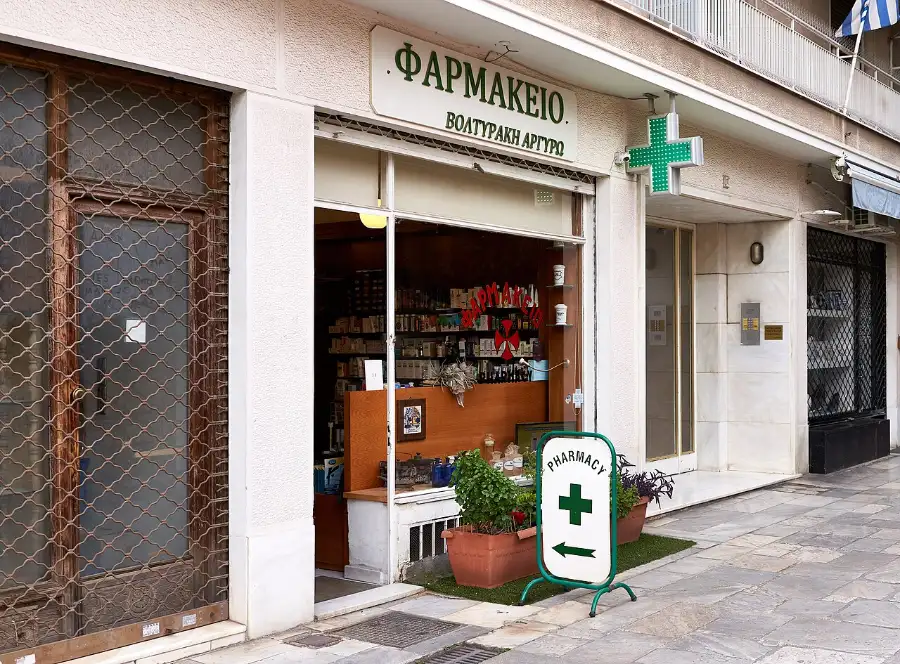
The important thing for a visitor is what the person inside is. A Greek pharmacist is a qualified healthcare professional, not a shop assistant, and the counter is the first place people go with a minor complaint before they consider a doctor. Describing your problem to a pharmacist is a normal and expected use of their time. English is widely spoken in pharmacies in tourist areas, and less so away from them, which is one of the few situations where having the name of your own regular medication written down in Latin script genuinely helps.
What a pharmacy will not do is act on our advice instead of theirs. This page names no medicine and no remedy, on purpose.
The stock question is worth quoting rather than paraphrasing, because it is the one travellers get wrong in both directions. The UK Foreign, Commonwealth and Development Office says that “pharmacies across Greece stock a good supply of medicines, but there are strict rules around dispensing certain medicines, including antibiotics.” Both halves of that sentence matter. Greek pharmacies are well stocked. They are also regulated, and what is handed over without a prescription is a matter of Greek pharmacy law rather than of how far you have travelled. Do not plan a trip around obtaining something specific at a counter; plan it around bringing what you already rely on.
Nights, Sundays and the duty rota
Greek pharmacies are not open all the time, and the country’s answer to that is a rota rather than a chain of all-night branches.
The system is called efimeries, and it is run by the regional pharmaceutical association rather than by individual shops. Pharmacies take turns covering the hours when the rest are closed, so that at any given moment an area has a pharmacy on duty. The Pharmaceutical Association of Attica, which covers greater Athens, publishes its rota through a dedicated duty portal, and pharmacies are obliged to display the table of extended-hours pharmacies.
That obligation is the practical part. If you arrive at a closed pharmacy at ten on a Sunday night, the door itself is the directory: the notice on it tells you who is on duty and where. Read the door before you start searching.
Two things follow for a traveller. First, the rota is regional, so the portal that covers Athens is not the one that covers Rhodes or Corfu; search for the duty rota of the specific area you are in, or ask your accommodation to make the call, which is faster and is a normal thing to ask. Second, this page prints no opening hours anywhere, because they vary by region and by season and a printed clock time is the fastest way for a travel page to become wrong. Greek trading hours in general follow their own logic, which is set out in siesta and opening hours, and public holidays close things that a normal Sunday does not - see public holidays and what closes.
Bringing your own medication
The single decision that removes most of this problem is made before you leave: bring what you take, in enough quantity, in its original labelled packaging, with a copy of the prescription or a letter from your prescriber.
That is a logistics recommendation, not a legal one. Rules on carrying particular medicines across borders belong to the country you are entering and to the authority that regulates them, and they differ by substance in ways no travel page should summarise. If anything you take is controlled, unusual, injectable, or requires refrigeration, the question goes to your own prescriber and to the Greek authorities before you fly, not to a pharmacist at the other end who is being asked to solve it at short notice.
Split the supply between your hand luggage and your hold bag if you are checking one, keep it out of a hot car, and remember that a summer ferry deck in August is not a cool place. Anything temperature-sensitive is worth a word with your accommodation about a fridge before you arrive, and what to pack for Greece covers the rest of the bag.
EHIC, GHIC, and the sentence everyone skips
Here is the part that costs people money.
The European Health Insurance Card is, in the European Commission’s own words, “a free card that allows you to access medically necessary, state-provided healthcare” during a temporary stay in the EU. The UK equivalent is the Global Health Insurance Card. The FCDO puts the requirement plainly: to get medically necessary state healthcare in Greece, you need a GHIC or an EHIC.
And then the sentence that gets left off the travel blogs. The Commission states that the card “is not an alternative to travel insurance”, and, separately, that it “does not guarantee free services”. It does not cover private healthcare. It does not cover “costs such as return flights to your home country”. It does not cover lost or stolen property, and it does not cover you if the purpose of your trip was to obtain treatment.
Read those two documents as a pair rather than as alternatives. The card gets you into the state system on the same footing as a resident. Insurance covers the things the state system was never going to pay for, and repatriation is the one that turns a bad week into a bad year. Carry both.
One more line from the FCDO is worth having in front of you, because it decides where you end up rather than what you pay: “if you are uninsured, you may not be able to get medical treatment or diagnostic tests from private doctors in Greece, only from public hospitals and primary healthcare centres.” Being uninsured in Greece does not mean paying more for the same options. It can mean having fewer of them.
Two practical notes on the card itself. It is issued by your own national health insurance provider and it is free, so a site charging you for one is selling you a form you can get for nothing. And it expires, quietly, in a wallet you have not opened since the last trip, which is worth checking in the same sitting as your passport rather than at the departure gate.
On the insurance side, read the policy for the shape of your actual trip rather than for the headline figure. What you want to know is whether it covers repatriation, whether the activities you have planned are inside or outside the cover, and what it requires you to declare in advance. Those three answers vary enormously between policies at similar prices, and they are the ones that get argued about later. If your trip involves hiring anything with an engine, that is worth reading twice against the terms in renting a car in Greece; the cost side of insurance sits with what a Greece trip costs.
Doctors, hospitals and the island question
Greece runs public hospitals and primary healthcare centres, and the geography of the country means provision is not evenly spread across it.
We are not going to grade Greek clinical care, so take the assessment from the government that publishes one. The FCDO’s Greece advice states that “treatment and facilities are generally good on the mainland, but may be limited on the islands.” That is attributed to them and stated as their finding, not as ours.
Two kinds of place appear in that sentence and they are not the same thing. A public hospital is the larger institution, concentrated in cities and on the bigger islands. A primary healthcare centre is the smaller local unit, and on a great many islands it is what exists. Both sit inside the state system your card gives you access to, and knowing which one is nearest to where you are staying is a five-minute check you can do from home rather than a question you want to be asking a stranger in a second language.
What it means when you are planning is a question of distance rather than of quality. A large island with a city on it and a hospital in that city is a different proposition from a small island whose provision is a health centre and whose route to anything larger is a boat or a helicopter. If a member of your party has a condition that could need attention at short notice, that difference deserves a place in the choice of island, alongside the ferry frequency covered in Greek island ferries and the airport question in which islands have an airport.
For national public health information, the body to look to is EODY, Greece’s national public health organisation.
112, and the one number worth writing down
If something is an emergency, dial 112.
It is the European emergency number, and Your Europe states that you can dial it “free of charge from fixed and mobile phones everywhere in the EU”, that it puts you “straight through to the emergency services - police, ambulance, fire brigade”, and that it is “the only number you can use to access the emergency services in all EU countries”.
That last clause is the reason it beats every national number for a traveller. Greece also runs its own numbers alongside it, and the FCDO’s advice for an ambulance is to “dial 112 or 166 and ask for an ambulance”. But 112 is the one that works whether you are in Athens, on a Cycladic island, or somewhere you crossed into an hour ago and cannot name.
Write it down somewhere that does not depend on a charged phone with a working data connection. On that: coverage on the islands is a real variable and worth reading about in eSIM and staying connected before you rely on a map app to tell an operator where you are.
What this page will not do
It will not tell you what to take, and it will not tell you what is fine.
Those are the two questions that bring people to a page like this, and both belong to a professional who can ask you follow-up questions. A pharmacist can, in a five-minute conversation across a counter, in a country where that conversation is the normal first step. A doctor can. A page written months earlier for an audience of strangers cannot, and any page that tries is guessing at your expense.
So the whole of the practical advice here is short. Bring what you take. Carry your card and your insurance. Find the green cross, and if the shop is shut, read its door. And put 112 in your phone before you need it.
Pharmacies and health in Greece: FAQ
What is the emergency number in Greece?
- It is the European emergency number and works throughout the EU, including Greece, free of charge from fixed and mobile phones, connecting you to police, ambulance and fire services. Greece also operates national numbers alongside it, and the FCDO advises dialling 112 or 166 for an ambulance. Use 112 if you are unsure.
How do I find a pharmacy in Greece at night or on a Sunday?
Greece runs a duty rota, called efimeries, organised by the regional pharmaceutical association, so an area has a pharmacy on duty when the others are closed. Pharmacies are obliged to display the table of extended-hours pharmacies, so a closed shop’s door tells you who is covering. Your accommodation can also ring the local rota for you.
Does an EHIC or GHIC mean healthcare in Greece is free?
No. The European Commission states that the card gives access to medically necessary, state-provided healthcare, that it “does not guarantee free services”, and that it “is not an alternative to travel insurance”. It does not cover private care or a flight home. Carry the card and a travel insurance policy together, not one instead of the other.
Can a Greek pharmacist advise me about a minor complaint?
Yes. Greek pharmacists are qualified healthcare professionals, and going to the pharmacy counter first with a minor complaint is a normal step in Greece rather than an imposition. Describe the problem and let them advise. What they can dispense is set by Greek pharmacy law, and the FCDO notes strict rules around certain medicines, including antibiotics.
What happens if I do not have travel insurance in Greece?
The FCDO states that if you are uninsured “you may not be able to get medical treatment or diagnostic tests from private doctors in Greece, only from public hospitals and primary healthcare centres.” So the consequence is not only cost, it is a narrower set of places that will see you. This is one reason insurance is worth arranging before departure rather than at the airport.
Is healthcare the same across the Greek islands?
We do not grade clinical provision, so take the government assessment: the FCDO states that treatment and facilities in Greece are “generally good on the mainland, but may be limited on the islands.” Practically, a large island with a city hospital differs from a small island whose provision is a health centre and whose onward route is a boat. Factor that into island choice.
Should I bring my own medication to Greece?
Bring what you take, in original labelled packaging, with a copy of the prescription or a letter from your prescriber, split between bags if you are checking one. Rules on carrying particular substances across borders belong to the regulator, not to a travel page, so anything controlled, injectable or refrigerated is a question for your prescriber before you fly.
Booking
We sell nothing and book nothing for you. Every guide on this page tells you how to arrange each piece yourself - which ferry operator, when to book, what to prebook and what to leave loose.